• العربية
  • فارسی
Brand
  • Iran Insight
  • Politics
  • Economy
  • Analysis
  • Special Report
  • Opinion
  • Podcast
  • Iran Insight
  • Politics
  • Economy
  • Analysis
  • Special Report
  • Opinion
  • Podcast
  • Theme
  • Language
    • العربية
    • فارسی
  • Iran Insight
  • Politics
  • Economy
  • Analysis
  • Special Report
  • Opinion
  • Podcast
All rights reserved for Volant Media UK Limited
volant media logo
VOICES FROM IRAN

Iranians report renewed power cuts as heat drives electricity demand

Hooman Abedi
Hooman Abedi

Iran International

Jul 10, 2026, 09:34 GMT+1Updated: 11:35 GMT+1
File photo shows a shopkeeper using a gas-powered lantern inside a darkened store during a power outage in Iran.

Power and water outages have returned to several parts of Iran, residents across the country told Iran International on Friday, describing hours-long blackouts during intense summer heat despite official assurances the electricity network remains stable.

The complaints came as the energy ministry called for consumers to reduce electricity use by at least 10%, warning that high temperatures are expected to push demand above 75,500 megawatts in the coming days.

"Electricity has been out since 2 a.m. and it's now 5 a.m. We still don't have power," one resident in Islamshahr, near Tehran wrote.

Average temperatures, the ministry said, are forecast to reach around 41 degrees Celsius between July 14 and July 18 and remain unusually high through the following week. It urged households to set air conditioners to 25 degrees Celsius, switch off unnecessary electrical appliances and move heavy electricity use outside peak hours to preserve grid stability.

The outages come against the backdrop of a widening structural energy deficit. The latest Statistical Review of World Energy by the Energy Institute found Iran's electricity generation increased by only 1% last year and natural gas production by 1.3%, a sharp slowdown from the previous decade and well below the pace needed to meet rising demand.

Years of underinvestment, delayed infrastructure projects and international sanctions have left the country increasingly unable to meet its own energy needs despite holding some of the world's largest oil and gas reserves.

Residents report outages across Iran

Accounts shared pointed to repeated outages in Tehran province, Alborz, Khuzestan and Fars, with many residents saying electricity was cut for two to three hours at a time.

"Power in Fardis of Karaj went out twice on Thursday – first from 7 a.m. to 7:50 a.m. and then again from 10 until 12:10 p.m.," one resident wrote.

Another in Shiraz said electricity was cut shortly after 1 a.m. on Thursday, while residents in Karaj, in the vicinity of Tehran, also reported another evening blackout.

Several messages came from the southern Khuzestan province, where temperatures regularly climb well above 40 degrees Celsius during the summer.

"They've started the two-hour power cuts again in this unbearable heat," one citizen wrote. "Then they ask what we're supposed to do if power plants are hit."

Another resident questioned why shortages persist despite the province's energy resources.

"With this intense heat in Khuzestan, why should a country this rich suffer shortages of water and electricity?" the resident wrote. "They've started cutting both for at least three hours a day again. Inflation has already broken people's backs."

One person in Masjed Soleyman, Khuzestan province, described losing both electricity and water for three hours, ending the message with a call for public protests.

Food, water and daily life affected

Several said the outages were disrupting everyday life beyond the inconvenience of losing air conditioning.

100%
File photo shows a patient lying on a hospital stretcher during a power outage at a medical facility in Iran.

"I went through so much hardship and debt to buy meat and fish," one resident wrote. "By the time I got home, the electricity went out and we've been without power for three hours. The meat I struggled to buy is spoiling."

Another wrote: "Every day it's either the water or the electricity, or they dig up the streets and take forever to fix them. We live in a city with abundant oil, yet there's poverty and unemployment."

The energy ministry said climate studies show the southern provinces of Hormozgan, Bushehr, Khuzestan, Sistan and Baluchestan and Ilam experience the country's longest periods of extreme heat, placing the greatest strain on the electricity network during the summer.

Officials said reducing air-conditioner settings by one degree and improving energy efficiency could significantly lower demand, urging consumers to conserve electricity to help maintain supplies during the prolonged heatwave.

Messages from Shiraz and Mashhad also described overnight or daytime power cuts, while another resident complained that either electricity or water was being interrupted almost daily.

Officials say prolonged high temperatures have sharply increased electricity demand, particularly in southern provinces, where cooling accounts for a large share of consumption.

Energy experts cited by state media say raising air-conditioner settings by one degree Celsius could reduce cooling demand by roughly 2.5%, while improving the efficiency of cooling equipment and buildings could further lower electricity consumption.

Most Viewed

US imposes new Iran sanctions as officials say Hormuz deal is near
1

US imposes new Iran sanctions as officials say Hormuz deal is near

2

Mecca pact ties three Sunni powers together as Iran-backed attacks loom

3
PODCAST

Ending Iran war could expose regime to its greatest threat yet, experts say

4
ANALYSIS

US miscalculated Iran’s resilience and hurt deal prospects, expert says

5
INSIGHT

What the Pentagon learned from the Iran war

Banner
Banner
Banner

Spotlight

  • Iran’s reality TV boom abroad captures a generation in limbo
    ANALYSIS

    Iran’s reality TV boom abroad captures a generation in limbo

  • What the Islamic Republic does to its women footballers
    ANALYSIS

    What the Islamic Republic does to its women footballers

  • Iran moves to ratify Caspian Sea pact with seabed rights still unsettled
    INSIGHT

    Iran moves to ratify Caspian Sea pact with seabed rights still unsettled

  • Ending Iran war could expose regime to its greatest threat yet, experts say
    PODCAST

    Ending Iran war could expose regime to its greatest threat yet, experts say

  • US miscalculated Iran’s resilience and hurt deal prospects, expert says
    ANALYSIS

    US miscalculated Iran’s resilience and hurt deal prospects, expert says

  • What the Pentagon learned from the Iran war
    INSIGHT

    What the Pentagon learned from the Iran war

  • Iran’s energy growth slows to a crawl as demand races ahead

    Iran’s energy growth slows to a crawl as demand races ahead

  • Power, water outages disrupt daily life across Iran

    Power, water outages disrupt daily life across Iran

•
•
•

More Stories

Trump's rhetoric U-turn leaves Iranians between dread, hope and memes

Jul 9, 2026, 12:23 GMT+1
•
Hooman Abedi
100%
US President Donald Trump leaves following a press conference at the end of his participation in the NATO leaders summit in Ankara, Turkey, July 8, 2026.

President Donald Trump’s tougher rhetoric toward Iran and renewed US strikes have stirred mixed reactions among Iranians, from hopes for political change to fears of another long and unresolved conflict after months of living between war and peace.

The responses shared with Iran International and posted on X and Instagram pointed less to enthusiasm for military escalation than to exhaustion after nearly four months of conflict. Many described life in a state of “neither war nor peace,” where even short-term decisions have been put on hold.

  • We live through decisions we don't make

    We live through decisions we don't make

They spoke of worsening economic pressure, constant anxiety and tighter security conditions, as the United States and Iran traded a fresh round of attacks on Wednesday and Thursday, throwing their fragile agreement to end the war into deeper doubt.

The US military said it struck about 90 targets across Iran after Trump said the interim deal with Tehran is over for him, citing Iranian attacks on shipping in the Strait of Hormuz.

  • Trump says Iran memorandum is over, calls Tehran leaders 'scums'

    Trump says Iran memorandum is over, calls Tehran leaders 'scums'

Iran responded with strikes on US-linked targets in Qatar, Bahrain and Kuwait, as both sides accused each other of violating the interim agreement.

The Pentagon said it targeted Iranian military sites involved in attacks on commercial shipping.

Iran’s foreign ministry said the US strikes hit civilian infrastructure, including two railway bridges on the route to Mashhad, where authorities planned to bury former Supreme Leader Ali Khamenei on Thursday. Fars said one was the Aq Taqeh Khan railway bridge in Golestan province, part of a northern route to China and Russia that became more important after the US blockade of Iran’s Persian Gulf ports.

Many messages sent to Iran International linked the timing of the strikes to Khamenei’s funeral, saying they disrupted what the Islamic Republic had tried to stage as a show of unity and political continuity.

“I hope this time the war makes a difference and this cancer is removed from the root. We’re all suffering,” one citizen wrote.

Others saw Trump’s tougher language as a sign that diplomacy with Tehran had reached a dead end.

“Should we tell Trump, ‘We told you so,’ or is it still too early?” one message read.

Another wrote: “Mr. Trump seems to have only just realized what kind of creature he is dealing with.”

Several urged Trump not to return to negotiations.

“Mr. Trump, Mr. Netanyahu and NATO leaders, have you realized yet that negotiating with the Islamic Republic is a waste of time?” one message said.

Another person in Tehran wrote: “Mr. Trump, you say bad days are coming for Iran. Come here for one day. If you find even one good day under the Islamic Republic, you’ll see the hell they have created for the people.”

Hope tempered by fear

Despite welcoming Trump's apparent shift away from diplomacy, several said they feared another drawn-out conflict that would deepen economic hardship without bringing meaningful political change.

"Mr. Trump, please stop. We don't know whether to worry about war, inflation, the dollar or our future," one citizen wrote.

Another said: "I'm only worried that war starts again but nothing changes. If war is inevitable, I hope it benefits the people of Iran."

Some openly encouraged stronger military action.

"President Trump, please finish the job quickly. People, don't lose hope. Our day of freedom is near," one message read.

Another added: "I'm a Trump supporter. I like him. He's a superpower that nobody can challenge. But sometimes he goes off script. Please, President Trump, finish the job this time. It's hard living in your own country with a group of criminals."

Others remained skeptical, saying Trump's previous preference for negotiations made them doubt whether the latest strikes would ultimately produce lasting change.

'Mohammad Something' becomes an instant meme

Trump's remarks on Wednesday also generated a wave of satire after he seemingly referred to chief negotiator Mohammad-Bagher Ghalibaf as "Mohammad something" while describing US surveillance of Iran's nuclear facilities.

The phrase quickly became one of the most widely shared jokes among Persian-language users on X, spawning countless memes aimed at senior Iranian officials.

X user Amin Parvin wrote: "We are living in a state of no war, no peace, no ceasefire and Mohammad Something."

Another user wrote: "Mohammad Something, Mojtaba (Khamenei) Nothing. You've become the laughing stock of the world."

  • Trump says Iran is 'finished', experts say Tehran won big

    Trump says Iran is 'finished', experts say Tehran won big

Many directed the joke at Ghalibaf’s page after Trump appeared unable to recall his name.

"Mohammad Something, write your will. Trump didn't even bother learning your surname," one post said.

Another wrote: "Mohammad Something, it looks like this time it's your turn."

Reading Trump's strategy

Beyond the humor, users also debated whether Trump's harsher rhetoric signaled the abandonment of diplomacy or a negotiating tactic designed to force Iranian concessions.

"Trump is playing cat and mouse with them. He doesn't want a full-scale war yet. He's waiting for their response before deciding what to do next," one X user wrote.

Another posted: "I'm genuinely happy Trump is finally seeing their true nature."

Others argued Trump still preferred a negotiated settlement but believed military pressure had become his principal leverage.

"Trump loves being able to say he defeated them without war, so he's trying to disarm them through negotiations," one user wrote. "But their file is closed. Trump himself has said they'll lose their uranium either through negotiations or through war."

Twelve prisoners at risk of execution in Isfahan protest case, lawyer says

Jul 8, 2026, 12:47 GMT+1
100%

Twelve protesters in Isfahan face imminent execution after Iran’s Supreme Court upheld death sentences in a case built around the alleged killing of four Basij members, a lawyer familiar with the case told Iran International.

The case stems from protests on January 8 at Alikhani Square in Isfahan, where authorities said four Basij members were killed.

According to the lawyer, 59 people were initially arrested after the incident.

The lawyer said 23 of those detained were sentenced to between five and 10 years in prison, even though they were not accused of directly taking part in the deaths and appeared to have been added to the case to strengthen the prosecution’s broader narrative.

Twelve others were sentenced to death.

The lawyer said the Supreme Court upheld the death sentences on July 5 and the case has now been sent to the sentence enforcement branch of the Isfahan Revolutionary Court, raising fears that the executions could be carried out soon.

The prosecutor in the case is Mohammad Nakhjavan, according to the information received. The judges are Mohammad Barati-Dorcheh and Mohammad Tavakoli, also known as Vakili.

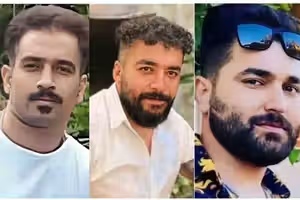
Tavakoli previously served as a judge in the “Khaneh Isfahan” (Isfahan House) case, another protest-linked case in Isfahan that ended with the execution of Saleh Mirhashemi, Majid Kazemi and Saeed Yaghoubi in May 2023.

  • Iran Executes Three Political Prisoners After Sham Trial

    Iran Executes Three Political Prisoners After Sham Trial

  • Don’t Let Us Die, Plead ‘Esfahan House’ Prisoners Facing Execution

    Don’t Let Us Die, Plead ‘Esfahan House’ Prisoners Facing Execution

The lawyer said the defendants in the Alikhani Square case were denied access to independent lawyers during the trial stage and were represented by court-appointed attorneys.

The lawyer also said the court blocked defense lawyers from accessing the full case files.

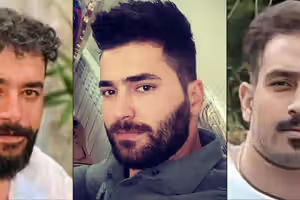
The 12 protesters sentenced to death are mostly very young men. Three were born in 2007 and were around 17 or 18 at the time of the January 2026 protests. Several others were born between 2004 and 2006, and one is an Afghan national. Two brothers are among those facing execution.

The judiciary has not publicly responded to the allegations about denial of access to independent counsel and case files.

The case fits a pattern seen in several protest-linked capital cases in Iran, where the reported deaths of security personnel or pro-government forces have been followed by broad arrests, charges carrying the death penalty and claims by families, lawyers and rights groups that defendants were denied fair trial guarantees.

Rights groups have warned that Iran’s use of death sentences in protest cases has become a tool of intimidation, particularly after periods of unrest, with executions used to send a message far beyond the individual defendants.

  • Five more protesters sentenced to death in central Iran

    Five more protesters sentenced to death in central Iran

  • Iran executes two January protesters as post-war crackdown continues

    Iran executes two January protesters as post-war crackdown continues

Amnesty International said in February that at least 30 people were facing the death penalty over alleged offences linked to the January 2026 protests, including eight people sentenced to death after expedited and “grossly unfair” trials.

The Center for Human Rights in Iran said in April that at least 22 political prisoners had been executed in six weeks, including 10 people detained during the January protests, in cases it said were marked by secretive proceedings, torture, forced confessions and lack of due process.

Human Rights Watch said the January unrest was met with mass killings, arbitrary arrests and severe communications restrictions, with thousands of protesters and bystanders believed to have been killed after protests escalated on January 8.

The new Isfahan case raises the number of protest-linked prisoners facing imminent execution and adds to fears that Iran’s judiciary is accelerating capital punishment in cases tied to the January uprising.