Iranian religious singer abducted and killed - IRGC media
Hamidreza Rajabzadeh, a pro-establishment Iranian religious singer, was abducted and killed after being missing for several days, the IRGC-affiliated Tasnim news agency reported on Saturday.

Hamidreza Rajabzadeh, a pro-establishment Iranian religious singer, was abducted and killed after being missing for several days, the IRGC-affiliated Tasnim news agency reported on Saturday.

Iranian cleric Mohammad-Bagher Kharrazi was summoned to the Special Clerical Court after calling for the Islamic Republic to be replaced by a more hardline “Islamic government” and outlining plans to mobilize a 250,000-strong network capable of surrounding government sites.
Iranian hardliners are intensifying pressure on authorities to enforce compulsory hijab, as recent cafe closures and online campaigns raise fears of a renewed crackdown despite widespread defiance of the dress code.
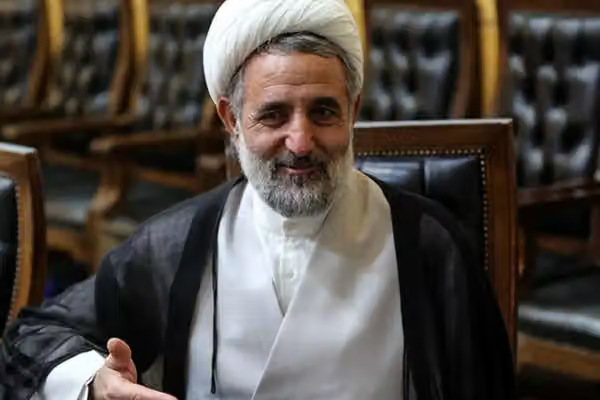
A cleric tied by marriage to Iran's ruling family has declared the Islamic Republic obsolete, telling followers that a shadow government already exists and urging them to build a 250,000-strong network to replace the system with an "Islamic government."

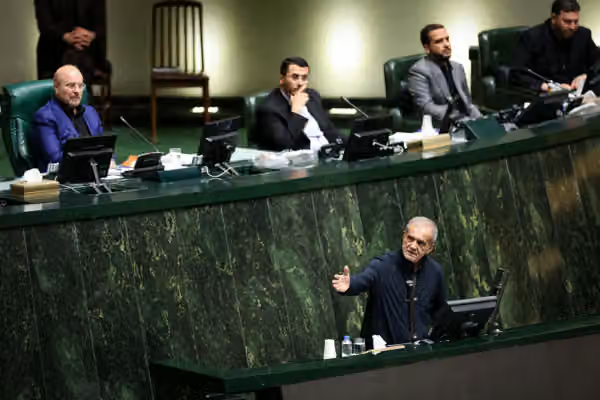
Iran's parliament has become all but irrelevant since the war, as power has shifted further toward the Revolutionary Guards and decision-making has moved ever deeper behind closed doors amid the unresolved leadership transition.

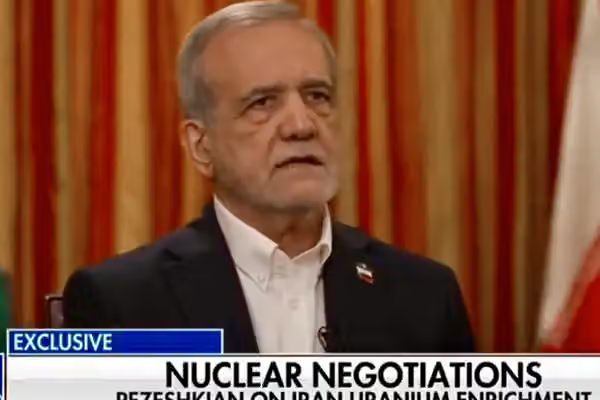
Iranian President Masoud Pezeshkian was taken to a secret Tehran location and allowed only minutes in a dark, tinted-window car with a man presented as Supreme Leader Mojtaba Khamenei, sources familiar with the episode told Iran International.

Donald Trump's decision to abandon a planned large-scale military strike against Iran has accelerated regional diplomatic efforts to revive US-Iran negotiations, while deepening political divisions inside Tehran over engagement with Washington.

Formal backchannel negotiations between Iranian and Western envoys resumed in Muscat on Monday after President Donald Trump suspended strikes on Iran's energy infrastructure over the weekend, even as Tehran publicly denied direct contacts with Washington.

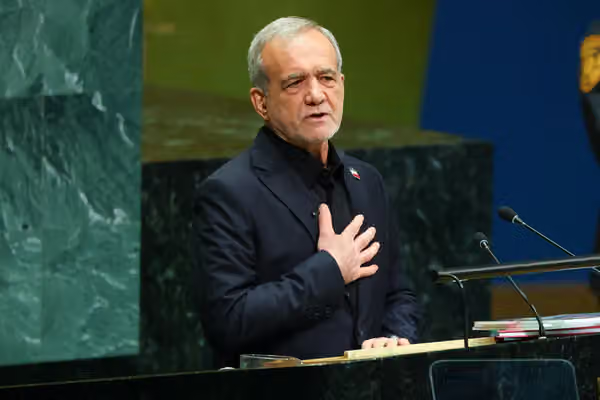
Iran’s Supreme Leader Mojtaba Khamenei has warned President Masoud Pezeshkian that his next resignation would be accepted, a relative of Khamenei by marriage said in a video released Monday, prompting sharp denials and political backlash.

Iranian parliament speaker Mohammad Bagher Ghalibaf said authorities rushed to announce Ali Khamenei’s death and call supporters onto the streets after “overseas media” broke the news, fearing the situation on the streets could otherwise “take a completely different turn.”

A gathering of thousands of teenagers at a Tehran mall to meet a popular YouTuber exposed a widening blind spot in Iran, some sociologists suggested: a generation whose values, social lives and sources of authority increasingly lie beyond the state's understanding.

Signs of reluctance to widen the conflict are emerging in Tehran, with conservative politicians and media urging restraint even as they accuse the United States and Israel of orchestrating Ukraine's attack on an Iranian vessel.

Iran's state broadcaster has ignored a formal order from its own watchdog to stop censoring senior officials, highlighting the gap between the country's formal institutions and where authority is exercised in practice.

Three prominent political prisoners held in Tehran's Evin prison issued a joint statement accusing the establishment of using regional war as a cover to escalate domestic repression and attempt to rebuild its lost authority through executions.

Amid threats of war and mounting fears of economic collapse, Iran's government is seeking to reinforce its case for moderation in a fractured and deeply polarized political landscape.

A newspaper close to Mohammad Bagher Ghalibaf, Iran's chief negotiator with Washington, is asking whether China quietly neutralized Tehran's most feared economic weapon: the oil shock through the Strait of Hormuz that never came.

The pause in US airstrikes has opened a new debate in Tehran over whether the military lull should be used to revive diplomacy or intensify pressure on Washington before another round of fighting begins.

The suspension of US and Iranian attacks has revived hopes for diplomacy, but in Tehran the military lull has exposed a widening divide over whether the Islamic Republic should negotiate with Washington or press what hardliners see as a battlefield advantage.

A widening scandal over the secret network used to move Iran's oil revenues around international sanctions has triggered growing criticism after senior officials acknowledged that intermediaries misappropriated at least $1.6 billion, with some fleeing the country.

Nearly half of Iranian internet users said they were angered by the country's recent internet shutdown during the conflict with the US, while most opposed unrestricted internet access for government officials, according to a survey commissioned by the communications ministry.

Iran’s government has publicly accused the state broadcaster of censoring President Pezeshkian’s remarks in which he said the late Supreme Leader Ali Khamenei privately ordered officials to negotiate with the United States despite publicly ruling out talks with Washington.

President Donald Trump’s increasingly explicit threats of a wider Iran war have fueled anxiety and speculation inside the country, as analysts and social media users debate whether the conflict is approaching a more destructive and unpredictable phase.