• العربية
  • فارسی
Brand
  • Iran Insight
  • Politics
  • Economy
  • Analysis
  • Special Report
  • Opinion
  • Podcast
  • Iran Insight
  • Politics
  • Economy
  • Analysis
  • Special Report
  • Opinion
  • Podcast
  • Theme
  • Language
    • العربية
    • فارسی
  • Iran Insight
  • Politics
  • Economy
  • Analysis
  • Special Report
  • Opinion
  • Podcast
All rights reserved for Volant Media UK Limited
volant media logo
TEHRAN INSIDER

We live through decisions we don't make

Tehran Insider
Tehran Insider

Firsthand reports from contributors inside Iran

Jul 8, 2026, 21:59 GMT+1
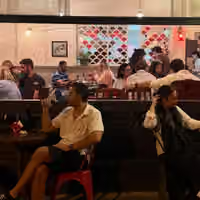
Visitors at a book fair in Tehran pass an installation showing the faces of children killed in the Minab school attack in the early hours of US-Israeli strikes on Iran

The strangest feeling in Tehran today is not fear or even despair. It is the sense that the fate of our country is being decided everywhere except by the people who live in it.

We watch as others decide whether there will be war or peace, confrontation or diplomacy, isolation or some grand bargain. We analyse statements, follow rumours and wait for signals from politicians and commanders.

But somewhere along the way, ordinary Iranians seem to have disappeared from the conversation.

Earlier this week, the familiar cycle began again: attacks near the Strait of Hormuz, US retaliation and then President Trump declaring that the agreement meant to end the crisis was dead. The same Iranian leaders he had called reasonable enough to negotiate with were suddenly “crazy” and “dishonourable.”

Watching from Tehran, it is difficult to know what we are supposed to make of it all. We can only wait to find out what happens next.

The city itself has returned to something resembling normal life. It is not the Tehran of the war, when streets emptied and every sound carried a threat. Cafes and restaurants are open again. People go to work, sit in traffic, pick up and put back fruit they can no longer afford—and, of course, curse those they blame for making life so miserable.

But beneath that return of noise is a strange numbness.

Before the war, some politicians at least spoke about listening to society. Few people believed them, but the language existed: reconciliation, reform, understanding people’s anger. Now even the performance has disappeared.

The same state that can negotiate with those it describes as enemies seems unable or unwilling to begin any meaningful conversation with its own society.

The contrast was visible after Khamenei’s death. The state showed how quickly and effectively it could mobilise when it wanted to: streets filled, ceremonies organised, a national moment of mourning created.

But many families whose children were killed during the January protests were denied something far simpler: the ability to grieve freely, to hold funerals without pressure, to mourn without fear.

It all might have been easier if the outside world offered a different answer. But it rarely does.

President Trump says his goal is denuclearisation. That’s it. Governments obviously pursue interests, not justice. But for those of us living with the consequences, it is another reminder that Iran is often discussed as a problem to solve rather than a society of millions trying to breathe.

So it can feel as if there is no one to trust and no one truly listening. The collective anger has turned into something closer to disbelief and despair. Maybe that is why Tehran looks the way it does now. Not defeated, not dead, not even quiet. Just tired.

People continue because they have no choice. They already protested in 2022. They protested again in January. They risked prison, bullets and death. There is no obvious next step that has not already been tried.

So life goes on, but with very few plans. Nobody knows what tomorrow looks like.

We have not given up on our country. We’re just coping with the realisation that everyone else seems to have a say in its future before we do.

Most Viewed

US imposes new Iran sanctions as officials say Hormuz deal is near
1

US imposes new Iran sanctions as officials say Hormuz deal is near

2
PODCAST

Ending Iran war could expose regime to its greatest threat yet, experts say

3

Mecca pact ties three Sunni powers together as Iran-backed attacks loom

4
ANALYSIS

US miscalculated Iran’s resilience and hurt deal prospects, expert says

5
INSIGHT

What the Pentagon learned from the Iran war

Banner
Banner
Banner

Spotlight

  • Iran’s reality TV boom abroad captures a generation in limbo
    ANALYSIS

    Iran’s reality TV boom abroad captures a generation in limbo

  • What the Islamic Republic does to its women footballers
    ANALYSIS

    What the Islamic Republic does to its women footballers

  • Iran moves to ratify Caspian Sea pact with seabed rights still unsettled
    INSIGHT

    Iran moves to ratify Caspian Sea pact with seabed rights still unsettled

  • Ending Iran war could expose regime to its greatest threat yet, experts say
    PODCAST

    Ending Iran war could expose regime to its greatest threat yet, experts say

  • US miscalculated Iran’s resilience and hurt deal prospects, expert says
    ANALYSIS

    US miscalculated Iran’s resilience and hurt deal prospects, expert says

  • What the Pentagon learned from the Iran war
    INSIGHT

    What the Pentagon learned from the Iran war

•
•
•

More Stories

Twelve prisoners at risk of execution in Isfahan protest case, lawyer says

Jul 8, 2026, 12:47 GMT+1
100%

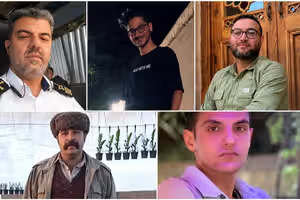
Twelve protesters in Isfahan face imminent execution after Iran’s Supreme Court upheld death sentences in a case built around the alleged killing of four Basij members, a lawyer familiar with the case told Iran International.

The case stems from protests on January 8 at Alikhani Square in Isfahan, where authorities said four Basij members were killed.

According to the lawyer, 59 people were initially arrested after the incident.

The lawyer said 23 of those detained were sentenced to between five and 10 years in prison, even though they were not accused of directly taking part in the deaths and appeared to have been added to the case to strengthen the prosecution’s broader narrative.

Twelve others were sentenced to death.

The lawyer said the Supreme Court upheld the death sentences on July 5 and the case has now been sent to the sentence enforcement branch of the Isfahan Revolutionary Court, raising fears that the executions could be carried out soon.

The prosecutor in the case is Mohammad Nakhjavan, according to the information received. The judges are Mohammad Barati-Dorcheh and Mohammad Tavakoli, also known as Vakili.

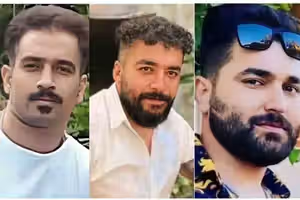
Tavakoli previously served as a judge in the “Khaneh Isfahan” (Isfahan House) case, another protest-linked case in Isfahan that ended with the execution of Saleh Mirhashemi, Majid Kazemi and Saeed Yaghoubi in May 2023.

  • Iran Executes Three Political Prisoners After Sham Trial

    Iran Executes Three Political Prisoners After Sham Trial

  • Don’t Let Us Die, Plead ‘Esfahan House’ Prisoners Facing Execution

    Don’t Let Us Die, Plead ‘Esfahan House’ Prisoners Facing Execution

The lawyer said the defendants in the Alikhani Square case were denied access to independent lawyers during the trial stage and were represented by court-appointed attorneys.

The lawyer also said the court blocked defense lawyers from accessing the full case files.

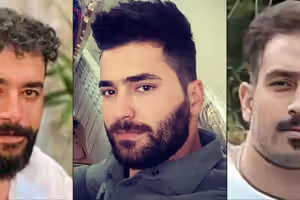
The 12 protesters sentenced to death are mostly very young men. Three were born in 2007 and were around 17 or 18 at the time of the January 2026 protests. Several others were born between 2004 and 2006, and one is an Afghan national. Two brothers are among those facing execution.

The judiciary has not publicly responded to the allegations about denial of access to independent counsel and case files.

The case fits a pattern seen in several protest-linked capital cases in Iran, where the reported deaths of security personnel or pro-government forces have been followed by broad arrests, charges carrying the death penalty and claims by families, lawyers and rights groups that defendants were denied fair trial guarantees.

Rights groups have warned that Iran’s use of death sentences in protest cases has become a tool of intimidation, particularly after periods of unrest, with executions used to send a message far beyond the individual defendants.

  • Five more protesters sentenced to death in central Iran

    Five more protesters sentenced to death in central Iran

  • Iran executes two January protesters as post-war crackdown continues

    Iran executes two January protesters as post-war crackdown continues

Amnesty International said in February that at least 30 people were facing the death penalty over alleged offences linked to the January 2026 protests, including eight people sentenced to death after expedited and “grossly unfair” trials.

The Center for Human Rights in Iran said in April that at least 22 political prisoners had been executed in six weeks, including 10 people detained during the January protests, in cases it said were marked by secretive proceedings, torture, forced confessions and lack of due process.

Human Rights Watch said the January unrest was met with mass killings, arbitrary arrests and severe communications restrictions, with thousands of protesters and bystanders believed to have been killed after protests escalated on January 8.

The new Isfahan case raises the number of protest-linked prisoners facing imminent execution and adds to fears that Iran’s judiciary is accelerating capital punishment in cases tied to the January uprising.