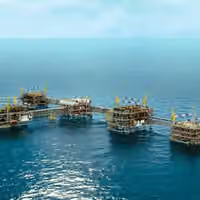
File photo from Saudi Aramco website shows Marjan offshore field
Saudi Aramco has hired a US engineering firm to upgrade an offshore oil field it shares with Iran, which has fallen far behind several neighbors in developing shared energy reserves.
KBR said on October 6 that it would provide engineering and project execution services for offshore processing facilities, gas compression and power systems at Marjan in the Persian Gulf. The work is intended to maintain production capacity and improve associated-gas processing. The company did not disclose the contract’s value.
The award follows a major Saudi expansion at the reservoir. Aramco said the Marjan project added 300,000 barrels a day of production capacity at the end of 2025. The expansion was designed to bring the field’s capacity to 800,000 barrels a day.
Iran calls its side of the reservoir Forouzan. Iran Open Data estimated Iranian production at about 35,000 barrels a day in a January 21 assessment, attributing the country’s wider difficulties developing shared fields to underinvestment and management constraints.
Saudi Arabia has also expanded its gas-processing infrastructure. Aramco said the Tanajib plant began operations in December 2025 and was expected to reach a raw-gas processing capacity of 2.6 billion cubic feet a day in 2026, handling supplies from both Marjan and Zuluf.
On the Iranian side, the Oil Ministry’s SHANA news agency reported in February that a project to collect gas otherwise burned off at Forouzan and other offshore fields was 76% complete. It said operations were expected to begin in 2028, subject to financing.
Saudi Arabia and Kuwait advance disputed gas project
Saudi Arabia and Kuwait are also moving ahead with development of the Durra offshore gas field, which Iran calls Arash and claims a share of.
Industry publication MEED reported in August that Al-Khafji Joint Operations had awarded contracts for two offshore packages and one onshore package worth an estimated $6.7 billion. The venture is jointly owned by Aramco Gulf Operations Company and Kuwait Gulf Oil Company, subsidiaries of the two countries’ state energy companies.
Iran says part of the field extends into its waters and that it should participate in development. Saudi Arabia and Kuwait reject that claim and maintain that rights to the field belong exclusively to them.
Iran’s wider production gap
The disparity extends to fields Iran shares with other neighbors. In its January assessment, Iran Open Data estimated UAE production from shared oil fields at 130,000 barrels a day, against 58,000 for Iran.
It put Iraq’s extraction from shared oil fields at roughly twice Iran’s and Qatar’s oil-layer output from the South Pars/North Field reservoir at 13 times Iran’s.
Oman was an exception: the assessment put each country’s production from the Hengam field, known as West Bukha in Oman, at about 10,000 barrels a day.
Iran’s national crude production has since fallen sharply during the war. The International Energy Agency estimated output at 2.16 million barrels a day in August, down from 3.59 million in February—a decline of about 40%.
FILE PHOTO: Tankers sail in the Persian Gulf, near the Strait of Hormuz, as seen from northern Ras al-Khaimah, near the border with Oman’s Musandam governance, amid the U.S.-Israeli conflict with Iran, in United Arab Emirates, March 11, 2026.
The US Treasury sanctioned 17 vessels and their owners Thursday under Operation Economic Outcast, saying the action effectively neutralizes most of Iran’s remaining shadow fleet.
In a statement, Treasury said the ships had carried millions of barrels of Iranian crude, petroleum products and petrochemicals to markets in South and East Asia. The network spanned more than a dozen jurisdictions and relied on international front companies.
Thursday’s broader Iran-related sanctions targeted six individuals, 27 entities and 22 vessels in total, including the 17 ships highlighted by Treasury. The additional targets included five Indian nationals and a Turkish national, along with companies including India’s Samudra Marine Services and SSPL Solutions and the UAE’s Hessonite Ship Management.
“Treasury is starving the tyrannical regime in Tehran of the money it uses to wage war in the region, and we will continue exposing those who enable the regime’s oil sales,” said Secretary of the Treasury Scott Bessent. “No enabler of Iranian sanctions evasion is safe from the full force of Treasury’s authorities.”
Among the targets were the Cameroon-flagged Shenzhen, which Treasury said had transported more than 3.5 million barrels of Iranian crude since November 2025, and the Vanuatu-flagged Tina 5, which carried more than 1.5 million barrels in August. Designated companies include firms in China, Hong Kong, the Marshall Islands and the British Virgin Islands.
Treasury said vessels regularly enter and leave the network, and pledged to continue monitoring attempts to evade sanctions.
Thursday’s measures, issued under Executive Order 13902, freeze the targets’ assets under US jurisdiction and generally prohibit US persons from dealing with them. Foreign financial institutions risk secondary sanctions for knowingly facilitating significant transactions for designated parties.
Treasury also removed the Hakuna Matata and Pinocchio from its sanctions list after they left Iran’s shadow fleet and were sold to non-sanctioned, US-aligned operators. Both vessels had been listed in June 2025.
Launched on August 24 and dubbed Economic D-Day, Operation Economic Outcast seeks to isolate Iran’s revenue and financial networks by increasing pressure on foreign companies and governments that sustain trade with Tehran.
The campaign expanded sanctions exposure across digital assets, technology, gold, aviation and shipping, threatening foreign businesses with exclusion from the US financial system. The broader authorities do not automatically sanction every foreign business in those sectors, but allow Washington to designate additional targets.
On October 1, Washington widened the campaign to Iran’s automotive and rail industries, sanctioning major manufacturers including Iran Khodro and SAIPA.
Treasury said the US military blockade, dwindling oil shipments outside it and widening sanctions were leaving Tehran with fewer options to stabilize its economy.
Iran’s central bank governor, Abdolnaser Hemmati, said Tuesday that the economy was still functioning and rejected what he described as US predictions of collapse.
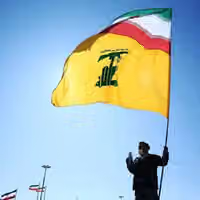
Reports that the Islamic Republic sent $200 million to Lebanon's Hezbollah have drawn anger from Iranians struggling with rising living costs, low wages and medicine shortages, according to messages sent to Iran International.
Citizens accused the authorities of prioritizing financial support for regional allies over the needs of Iranians, contrasting the reported payment with their own incomes, government subsidies and mounting household expenses.
In messages, several people described struggling to afford basic necessities, while others questioned why the Islamic Republic was directing resources abroad during Iran's economic crisis.
Hezbollah payments dwarf Iranian wages
"You give each Hezbollah family 8 billion rials, but deposit a 5000,000-rial food allowance for each Iranian and then take even that back a few hours later. This country's money belongs to its people, not Hezbollah," one citizen said.
Another compared the payments with compensation given to Iranian soldiers.
"A soldier who spent eight months under missile fire with no way to escape received seventy million rials in combat pay. Then you gave Hezbollah 8 billion rials from our money," the citizen said.
Reuters reported on October 7, citing two people with direct knowledge, that Hezbollah received $200 million from Iran in September and planned initial payments of $3,000 per family, prioritizing approximately 50,000 families displaced by the war.
At an exchange rate of approximately 2.67 million rials per dollar on Iran's open market, $3,000 amounts to roughly 8 billion rials.
A teacher in Tehran with 18 years of experience compared the payments with his annual salary.
"My salary for an entire year is about 3 billion rials, yet you gave 8 billion rials of our money to the Lebanese," the teacher said.
A local government employee with 29 years of service and a master's degree said his total monthly income was 350 million rials.
Citizens in Neyshabur and Malard also criticized the reported payments, saying the Islamic Republic was directing national resources toward allied groups abroad while Iranians faced poverty and declining purchasing power.
Islamic Republic officials have not formally confirmed the reported $200 million transfer, and the US government has rejected the account.
"Hezbollah has been decimated and caused misery for hundreds of thousands of innocent Lebanese. It is now trying to save face with fake stories about cash influxes from Iran," US State Department spokesperson Tommy Pigott said in a statement. "It can claim whatever it wants, but the money is not there."
Families sell belongings to afford basic necessities
Several citizens described the financial pressures facing their families, including difficulties paying for medicine, food and other essentials.
One person said her husband and son had been forced to sell their mobile phones to cover household expenses, contrasting the family's financial difficulties with the reported funding for Hezbollah.
Another described the rising cost of medication for her father.
"I bought just three blood pressure and heart medications for my father, and they cost 85 million rials. I didn't have enough money to buy the rest of his medicines. Insulin is also unavailable. Previously, these medicines did not even cost 5 million rials," the citizen said.
Other citizens described struggling to afford food and household expenses despite receiving government subsidies and food vouchers.
One person said the authorities treated modest increases in food assistance as a financial burden while continuing to spend substantial sums supporting allied groups in Lebanon.
Anger over Islamic Republic's spending priorities
Some calculated how many Iranian households could benefit from the reported $200 million payment, arguing that the money could help tens of thousands of families struggling with living expenses.
One person directed criticism at Supreme Leader Mojtaba Khamenei over the allocation of national resources.
"You have abandoned your own nation and are giving the Iranian people's money to the Lebanese. It is not your father's inheritance. Charity begins at home," the citizen said.
Another questioned the priorities of President Masoud Pezeshkian and his deputy, saying their public emphasis on serving Iranians conflicted with the financial support directed toward Hezbollah.
The citizen also expressed concern that such funding could contribute to continued armed conflict and civilian deaths.
Several others described the reported payment as part of the Islamic Republic's longstanding policy of financing allied armed groups across the Middle East.
Reuters reported in June that Hezbollah was awaiting additional financial support from Iran after suffering heavy losses in its war with Israel.
The US Treasury Department previously said Iran had transferred over $1 billion to Hezbollah during the first 10 months of 2025.
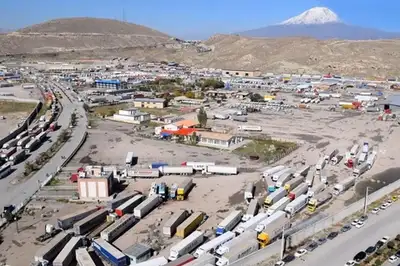
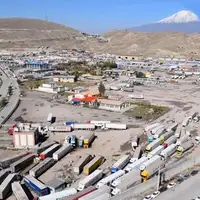
File photo: Trucks at the Bazargan border crossing between Iran and Turkey, with Mount Ararat in the background.
The widening reach of US sanctions across Iran’s transport and industrial networks has raised alarms in Tehran that Washington is seeking to close off the alternative trade routes the country has relied on to circumvent years of economic pressure.
Recent US measures have targeted Iran’s national railway system and major automakers including Iran Khodro and SAIPA, alongside foreign facilitators involved in their supply chains, while pressure has also expanded across aviation, maritime transport and financial networks.
The pattern has prompted some Iranian commentators to warn of what they describe as “network encirclement”: rather than trying to stop Iranian trade at a single chokepoint, sanctions raise the cost of moving money and goods across multiple routes simultaneously.
But Iranian economists and industry analysts are divided over how much additional pressure that can produce after years in which businesses have adapted to sanctions, and whether domestic dysfunction now poses a greater threat to industry than new US designations.
Closing alternative routes
Moderate outlet Khabar Online described the emerging strategy as “network encirclement,” arguing that modern economic blockades do not require borders to be physically sealed.
Instead, pressure can be applied simultaneously through financial sanctions, transport restrictions, higher insurance and compliance costs, and measures targeting companies and intermediaries that facilitate trade.
The importance of alternative routes was illustrated in a recent report by Mehr News Agency examining how Iran has sought to compensate for restrictions on maritime trade and rising insurance costs in the Persian Gulf.
The report highlighted truck traffic through northwestern crossings including Bazargan, Astara and Jolfa, connecting Iran with Turkey, the Caucasus and Russia. It argued that expanding land and rail corridors could reduce dependence on maritime shipping.
But Washington is increasingly targeting some of those alternatives as well.
Recent US sanctions have included Iran’s national railway system and major automakers, while also targeting facilitators in the UAE, Turkey, Hong Kong and India involved in supply chains.
Donya-e-Eghtesad described the measures as an expansion of pressure from maritime routes to overland trade, including networks used to obtain automotive parts.
An economy that has learned to adapt
Whether that approach can substantially increase pressure on Iran is less clear.
Industry analysts cited by Donya-e-Eghtesad said major Iranian automakers have developed extensive domestic sourcing after years of sanctions and reduced dependence on direct relationships with foreign manufacturers.
Eqtesad News went further, arguing that the latest measures against automakers and rail companies may carry greater political and psychological significance than immediate economic consequences.
Iran’s automotive industry has operated without direct partnerships with major international manufacturers for more than eight years and already relies heavily on intermediaries to obtain foreign components, it said.
The outlet argued that sanctions may therefore be producing diminishing returns, while domestic problems including price controls, supply-chain mismanagement and regulatory bottlenecks increasingly constrain production.
Economist Rasoul Safarahang made a similar argument in Khabar Online, saying an economy that has spent years adapting to sanctions is likely to respond to additional pressure by developing informal workarounds rather than immediately altering government policy.
Pressure extends to aviation
Aviation represents another potential pressure point because of its dependence on international maintenance, insurance, fuel and other services.
Iranian media have reported that US restrictions now cover 27 Iranian airlines, potentially affecting not only passenger travel but also time-sensitive cargo and the movement of industrial equipment and other goods.
Khabar Online estimated that restrictions on commercial aviation could cause between $3.5 billion and $5.2 billion in losses through reduced trade, tourism and supply-chain disruption, although the report did not provide sufficient detail to independently assess that estimate.
The outlet argued that longer transport times and more expensive alternative routes could ultimately feed through into higher domestic prices.
The debate in Iranian media therefore reflects two competing assessments of Washington’s strategy.
One sees sanctions as closing the routes Iran has used to adapt to earlier restrictions. The other sees an economy already so accustomed to sanctions that additional designations produces less leverage, while Iran’s own structural economic problems pose the greater threat.
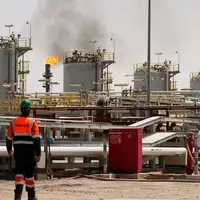
The Zubair Oil Field in Basra, Iraq, April 6, 2026.
China’s independent refiners are turning to Iraqi crude to replace dwindling Iranian supplies as a US blockade chokes Tehran’s exports, forcing some of Iran’s biggest oil customers to seek barrels elsewhere.
The shift is a sign of the blockade’s widening impact. Iran loaded no new crude or condensate onto tankers in September, although previously exported Iranian oil continued arriving in China, according to Homayoun Falakshahi, Head of Crude Oil Analysis at Kpler.
Of nearly 90 million barrels that initially made it out, only around 10 million remain to be discharged in China, Falakshahi said.
Once those barrels and the payments for them are exhausted, Iran risks losing not only a crucial export market but one of its main sources of dollars.
Chinese refiners that once absorbed more than one million barrels per day of Iranian crude are now buying Iraq’s Basrah Heavy and Basrah Medium as they search for replacement supplies.
Iran loses a crucial outlet
China’s independent refiners have long provided Tehran with a critical market for oil sold under US sanctions, drawn in part by steep discounts on Iranian barrels.
Iran loaded an average of around 250,000 barrels per day of crude and condensate in August, Falakshahi said. In September, that fell to zero.
“I think that’s the first since the revolution, actually, 1979 revolution,” he said, describing the impact of the blockade as “very much brutal.”
The turn toward Iraq shows what is happening as Iranian supply disappears: buyers that relied heavily on Tehran’s crude are finding replacement barrels elsewhere.
The financial squeeze comes next
The full financial impact of the blockade has yet to reach Tehran.
Chinese buyers typically have one to two months to pay for Iranian crude, Falakshahi said, meaning payments for oil already exported could continue until around mid-December.
“After that, it’s zero revenue from oil sales,” he said, assuming the blockade remains in place.
Oil sales are Iran’s main source of foreign exchange, and despite sanctions, Falakshahi said the country is still paid mainly in dollars for its crude.
In recent years, Iran had typically generated around $2 billion to $3 billion per month from oil sales, he said. The prospect of losing those inflows is already weighing on Iran’s currency.
“The revenues have not yet dropped to zero,” Falakshahi said. “It’s just the expectation that they will drop to zero in December that is causing that.”
Once the remaining payments end, the pressure will “probably ... only accelerate,” he added.
Can Iran find another way out?
Iran has spent years developing methods to circumvent US sanctions, leaving open the possibility that some crude could still reach China through less transparent channels.
Max Meizlish, senior research analyst at the Foundation for Defense of Democracies and a former US Treasury official, said the increase in Chinese purchases of Iraqi crude could be entirely legitimate, but cautioned against assuming that reported origin always establishes where the oil was produced.
Iraq has previously been used to obscure the origin of Iranian crude, he said.
“Iraqi crude has been used as a vehicle for Iran to mask the source of its crude,” Meizlish told Iran International.
“It’s entirely possible that this is a legitimate ordinary increase by China of Iraqi crude,” he added, while saying data on the source of Chinese imports should be viewed “with a little bit of skepticism or with a critical eye.”
Even if Iran does move crude through Iraq, the larger constraint is scale.
Falakshahi said transporting 50,000 to 100,000 barrels per day through Iraq could require around 5,000 trucks. At 100,000 barrels per day, Iran would be replacing only around 5% to 7% of what it previously sold by tanker.
“It would be just a portion of that,” he said.
Iran’s own response also points to the difficulty of replacing those exports.
Falakshahi said Tehran has rapidly reduced oil production toward the level needed to meet domestic demand, while 20 to 25 empty tankers remain inside the blockade zone despite being available to load crude.
During an earlier blockade, Iran continued loading tankers in apparent anticipation that restrictions would eventually ease. This time, the vessels are remaining empty.
Kpler also understands that tankers beginning to move inside the blockade zone have received radio warnings from the US Navy against continuing, Falakshahi said.
“This is something that did not happen during the first blockade,” he said.
Iran may still find ways to move smaller volumes or disguise the origin of some crude. What those workarounds have not demonstrated is an ability to replace the tanker trade being lost.
The buyers are still there. So is their demand for oil. But increasingly, the barrels they are buying are coming from somewhere else.
And as the remaining Iranian oil already at sea dwindles, the impact of the blockade is shifting from Iran’s export terminals to its finances.
Iran’s Bank Parsian, under US sanctions, used its foreign-exchange arm to move millions of dollars abroad through a network of intermediaries, according to an Iran International investigation based on leaked internal correspondence and transaction records.
The documents, covering the period from November 2022 to May 2023, show how Iran’s central bank and other financial institutions used Parsian Exchange, also known as Sarrafi Parsian, to facilitate payments outside Iran.
The transactions involved multiple layers of banks, companies and individuals, according to the records.
Bank Parsian is a private-sector Iranian bank that the US Treasury designated in October 2018, in an action against a network of companies financing the Basij paramilitary force.
The correspondence shows that four years after the designation, Bank Parsian was still arranging international payments through layered channels.
In most cases, no foreign currency actually left Iran. Foreign currency proceeds from oil, petrochemical and other exports were held in accounts overseas. At Bank Parsian’s instruction, Parsian Exchange transferred funds held in those accounts to overseas bank accounts designated by Iranian importers.
But the payments did not appear to come from the Iranian government, sanctioned banks or the Central Bank of Iran (CBI). Instead, they appeared to originate from private companies, with Parsian Exchange acting as an intermediary.
The process
In a typical transaction documented in the files, an Iranian importer—such as carmaker Iran Khodro—sought foreign currency from the CBI to pay a supplier overseas.
The CBI sold the foreign currency to Bank Parsian, according to the documents. The funds were then held at another Iranian bank in an account belonging to a separate individual or company, described in the records as a “trustee”.
The documents showed that Parsian Exchange facilitated the movement of this money between foreign accounts.
Many of the recipient accounts identified in the documents were held at banks in the United Arab Emirates, China and Hong Kong.
The documents show that, by structuring the transactions through these layers, Parsian Exchange obscured the money trail.
Iran International found no evidence that the banks in the UAE and China knowingly facilitated Iran’s efforts to circumvent US sanctions.
Bank Parsian and Parsian Exchange did not respond to Iran International’s requests for comment.
People behind the letters
Parsian Exchange is a subsidiary of Bank Parsian. The bank directly owns 90% of the company, with the remaining roughly 10% held through Parsian Financial Group, its investment arm.
Iran International identified 33 instruction letters in the leaked documents that directed the movement of UAE dirhams, Chinese yuan and US dollars, with a total value of roughly $36 million.
Almost all the letters were signed by Alireza Alaei, Bank Parsian’s head of international affairs. He joined Parsian Exchange’s board as vice chairman in early 2020 and has served as chairman since mid-2020.
Many of the letters were addressed to Rasoul Salehi Oskouei, Parsian Exchange’s chief executive. Official records show he joined the company’s board in early 2018 and has served as vice chairman and chief executive since early 2020.
Salehi Oskouei had also served at another bank-owned exchange company. More than 12 years before joining Parsian Exchange, he sat on the board of Sepehr Exchange, an affiliate of Bank Saderat, from early 2006 to mid-2008
A review of Parsian Exchange’s current and former executives shows a recurring pattern of ties to Bank Parsian and Setad, the economic conglomerate controlled by Iran’s supreme leader.
Alaei joined the company’s board in early 2020 as a representative of Tamin Andish Pars, a Bank Parsian affiliate, and remains on the board. He also served on the board of Parsis Kish starting in 2015, representing Parsian Insurance.
Hesam Shams Alam, who served on Parsian Exchange’s board from 2010 to 2014, had also sat on the board of Bank Parsian. In 2013, he joined the board of Tadbir Investment Group as a representative of Tadbir Industry and Mine Development, an affiliate of Setad.
Instructions for payments
The letters follow a consistent pattern. Alaei sent them to the international departments of other Iranian banks, including Saman, Shahr, Eghtesad Novin, Tourism Bank, Bank Melli and Bank Mellat, all sanctioned by the United States.
The letters were typically sent about 10 days after the banks purchased foreign currency from the Central Bank of Iran. In its letters to the other banks, Bank Parsian said the foreign currency had been “purchased from the central bank” and was being held “in a trustee account” at the recipient bank.
This is where Parsian Exchange came in. Bank Parsian asked the third-party bank to transfer the funds through Parsian Exchange to the ultimate beneficiary.
The subject line of each letter described the funds as being transferred via an intermediary, meaning the payment abroad was made in the name of a private individual or company rather than an Iranian bank or the state.
In a letter dated early 2023, Alaei sent a letter to the international division of the Tourism Bank. He asked the bank to transfer $990,000 held in a trustee account to an account belonging to SEALION General Trading Limited. A review of public records shows the company was active in Hong Kong.
In May 2023, Alaei asked Tourism Bank’s international affairs division to transfer $750,000 to an account held by SAHERI TRADING LIMITED, also registered in Hong Kong.
Bank-owned exchanges
More than 500 licensed exchange companies are currently registered in Iran, 28 of them owned by banks.
By revenue, Parsian Exchange ranks second among them.
Adjusted to September 2026 prices, Melli Exchange, affiliated with Bank Melli, reported annual operating revenue of 1,253 trillion rials. Parsian Exchange ranked second with 1,168 trillion rials, followed by Omid Sepah Exchange, affiliated with Bank Sepah, with 1,129 trillion rials.
Iranian banks began setting up exchange companies more than two decades ago.
Sepehr Exchange, owned by Bank Saderat, was the first exchange company established by an Iranian bank on 25 July 2004. Parsian Exchange followed two weeks later.
Sepah, the state-owned bank with long-standing ties to the armed forces, owns three separate exchange companies. Bank Melli also operates Melli Exchange.
Sanctions
Parsian Exchange has never been named on the US sanctions list. Under US rules, however, a company owned 50 percent or more by a sanctioned entity is automatically covered by the same sanctions, so US persons are already barred from dealing with it.
In April 2026 the U.S. Treasury sanctioned a company it identified as Bank Parsian’s “rahbar”—a private firm that manages the bank’s overseas payments—and in July 2026 an exchange house it said had contracts with the bank.
The United States has targeted bank-owned exchange companies since 2008, when it sanctioned the exchange arm of the Export Development Bank of Iran.
For about a decade, no new sanctions were imposed targeting exchange companies linked to the Islamic Republic until 2018.
By September 2026, the United States had sanctioned a total of 20 exchange companies based in Iran, including six bank-owned exchanges: Export Development Exchange, Dey Exchange, Sina Exchange, and Hekmat Iranian, Ansar and Omid exchanges, all three of which are subsidiaries of Bank Sepah.
More than three years after Joe Biden took office as president, Washington sanctioned five Iranian exchange companies on June 25, 2024: Hekmat Iranian Exchange, affiliated with the former Hekmat Iranian Bank; Omid Exchange, affiliated with Bank Sepah; Sadaf Exchange; Siavash Nourian Exchange; and Atropars Exchange.
It was the largest round of sanctions targeting Iranian exchange houses since Trump left office.
After Trump returned to the presidency, a new wave of sanctions on Iranian exchange houses began in 2025. By September 2026, the United States had sanctioned 11 more exchange houses.