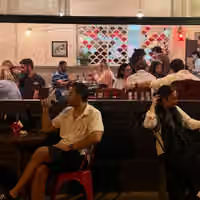
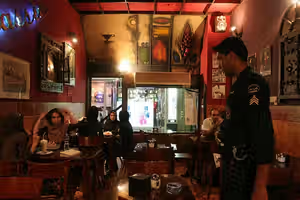
Demolished sidewalk planters outside cafes on Sanaei Street in Tehran.
In the quiet hours of Wednesday morning, municipal crews swept through Sanaei Street in central Tehran with sledgehammers, reducing sidewalk planters, benches, and concrete borders outside local cafes to rubble.
Just days earlier, authorities had affixed heavy metal seals to the doors of several cafes that had become popular gathering places for young people - 1401, Theory, Jo Cafe, Dobareh, Sam Cafe, Maan, and Nook. Now, even the physical footprint of these gathering spots was being erased.
The scene along Sanaei is not an isolated urban redevelopment project; it is the visible edge of an expanding domestic front. As the Islamic Republic navigates profound geopolitical vulnerability, military standoff, and international isolation, its security apparatus has turned inward with renewed vigor. The target is the physical fabric of daily life—the informal, everyday spaces where citizens meet, breathe, and quietly subvert official ideology.
The erasure of the 'Patogh'
In Iranian urban culture, the patogh - a hangout spot, whether a neighborhood coffee shop, a shaded bench, or a specific street corner- holds a special resonance. Central Tehran, with its historical universities, cultural venues, and tree-lined avenues, has long served as a sanctuary for students and young professionals seeking conversation away from state surveillance.
Cafes in this district do not merely sell coffee; they operate as vital breathing rooms in a pressure-cooker society. They are spaces where women routinely drop their headscarves, where independent acoustic music plays quietly, and where social networks form organically.
To the security state, these hubs represent something far more dangerous than simple rule-breaking: they are unmonitored incubator spaces for civil defiance.
By dismantling the planters and outdoor ledges where young people once congregated, the state is conducting a campaign of physical depatterning. The objective is simple: raise the friction of gathering, eliminate opportunities for unscripted human interaction, and force citizens back into the isolation of private homes.
From central cafes to northern bazaars
The systematic clearing of social life is not confined to central Tehran's bohemian quarters. In the northern district of Tajrish—a bustling commercial hub anchored by its traditional bazaar, the Imamzadeh Saleh shrine, and the thoroughfares leading toward the Saadabad Palace—a parallel push is underway.
Here, the crackdown targets street musicians, artisans, and informal vendors whose presence gives the district its distinctive kinetic energy.
"Plainclothes men carrying two-way radios came up to me last week while I was playing," a young handpan musician who performed near Tajrish Square told Iran International. "They told me bluntly: 'The time for these antics is over. There will be none of this in the streets anymore.'"
For many, performing or vending in Tajrish was not a lifestyle choice, but a last resort. Following the internet blackouts imposed during recent nationwide unrest, thousands of small online businesses, home-craft pages, and digital storefronts collapsed overnight. Young artisans, women-headed households, and unemployed graduates migrated to the pavements of Tajrish to sell handmade goods or play music for passing crowds.
Now, even that economic and social retreat is being shut down. Vendors near the shrine report periodic sweeps by security personnel and vigilantes ordering them to pack up their "sinful stalls" under threat of physical violence.
The asymmetry of public space
What makes this campaign so striking to Tehran residents is its stark selectivity.
While young people face sledgehammers and security sweeps for sitting on a sidewalk ledger or strumming a guitar, state-aligned groups enjoy unrestricted access to the city’s major arteries. For months, heavily subsidized groups have set up nightly ideological gatherings, loud ceremonial processions, and roadside stands with full logistical backing from the state.
This spatial double standard reveals the regime's broader urban philosophy: public space in Iran is not a shared civic commodity, but a state monopoly. The streets are permitted to be loud, crowded, and disruptive—provided that noise serves the government's narrative. The moment a street corner becomes a site for quiet civilian autonomy, it is treated as a security threat.
The historical pattern: Internal repression as external defense
This tightening grip on everyday life follows a familiar pattern in post-revolutionary Iran. Historically, whenever the Islamic Republic faces severe external threats or internal crises, its immediate response is to signal total domestic control.
The destruction of cafe seating and the silencing of street performers occur alongside a sharp escalation in judicial violence, including a surge in executions and political detentions. The message directed at society is unified across every medium: the state retains absolute authority over who walks the street, who speaks, and who lives.
Yet, despite the shattered concrete on Sanaei Street and the quieted plazas of Tajrish, Tehran's urban ecosystem remains stubbornly resilient. The urge to assemble, connect, and reclaim small fragments of normal life has repeatedly outlasted physical destruction—proving that while a government can tear up a sidewalk, controlling the social life that flows over it is a far more difficult task.
Three prominent political prisoners held in Tehran's Evin prison issued a joint statement accusing the establishment of using regional war as a cover to escalate domestic repression and attempt to rebuild its lost authority through executions.
Abolfazl Ghadyani, a veteran Islamic Revolution-era official turned fierce critic of Tehran; Mohammad Najafi, a human rights lawyer jailed for exposing a protester's death in custody; and Reza Valizadeh, an Iranian-American journalist and former Radio Farda contributor, issued the joint statement from Tehran's Evin prison.
The three political prisoners said the Islamic Republic was accelerating executions to inflict revenge on defenseless citizens for military setbacks against international adversaries.
"The corrupt regime of the Islamic Republic has once again turned war into a license to kill citizens," the prisoners wrote. "Whatever collapsed of its hollow authority on the battlefield, it is now trying to rebuild on the gallows."
Political prisoners Abolfazl Ghadiani (right), Mohammad Najafi (middle) and Reza Valizadeh
Executions described as 'begging for authority'
Executing protesters following show trials does not represent the administration of justice but rather "begging for authority on a path of blood," the signatories wrote.
They said Iranian authorities were rushing executions to take out frustrations on ordinary citizens that they could not exact on the US and Israel, seeking to crush any protesting voice.
"Today the hereditary regime of Mojtaba Khamenei, who like his father is a bloodthirsty and criminal tyrant who shared and partnered in all his father's crimes and plunder, has fallen from governance to tunnel-keeping," the statement said.
The prisoners added that the regime and its military-security cliques, unable to manage severe economic and social crises, were relying on a triad of "execution, crackdown, and imprisonment" to control the population outside their power centers.
Isfahan hangings spark grief and anger
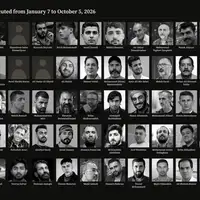
The statement follows the executions of two young protesters early on Tuesday, Amirhossein Safari and Abolfazl Sepahi, who were hanged in Isfahan amid a heavy security deployment around Alikhani Square.
The two men were among 12 defendants convicted in the Alikhani Square case stemming from clashes during protests in January. Their hangings brought the total number of individuals executed in the case to four, following the executions of Golmohammad Mohammadi and Erfan Esfandiari on July 19. Eight others remain under sentence of death.
The hangings in Isfahan triggered widespread grief, anger, and public defiance across Iranian cities and abroad. Witnesses described crowds gathering near Alikhani Square overnight despite intimidation by security forces, while messages across social media described the executions as a crime that hardened public resolve rather than suppressed dissent.
UN human rights experts led by Special Rapporteur Mai Sato had urged Iranian authorities on Monday to halt the executions, warning that closed-court trials based on televised confessions violated basic international legal standards.
The joint statement from Evin prison comes amid a broader surge in death sentences and executions across Iran over the past year, particularly following the January protests and escalating regional conflict.
Data compiled by Iran International shows that the Iranian judiciary has executed more than 50 political prisoners since the beginning of the current Iranian year, with dozens more facing execution.
Rights groups and civil society leaders have issued repeated warnings over the escalation. Amnesty International reported that at least 60 people, including three individuals under the age of 18 at the time of their alleged offenses, face imminent execution in Iran.
The three Evin prisoners concluded their statement by warning that no government achieves security or legitimacy through "the accumulation of corpses and a fear production line," adding that if the ruling establishment fails to yield to the public will, "Iran will become more ruined."
A US Army AH-64 Apache attack helicopter takes off at an undisclosed location in the Middle East in this image posted by US Central Command on X on July 25, 2026.
US President Donald Trump's most likely response to the conflict with Iran will be to intensify air strikes against a broader range of targets rather than withdraw or launch a ground invasion, former senior Pentagon official David Des Roches told Iran International TV.
Speaking on Iran International's Titre Aval (The Lead) program on Wednesday, Des Roches said the United States had limited military options after adopting an air campaign and argued Trump was unlikely to accept the political cost of ending the operation without achieving his objectives.
Three options
"The United States went in with an air power-only strategy," said Des Roches, now an associate professor at the Near East South Asia Center for Security Studies.
"That usually is flawed because once you do that, and if you look historically at how we've used an air power-led strategy in Korea, Vietnam, even World War II, but I think the illustrative point is Kosovo."
"If you don't achieve your strategic goals initially against a small target set, your options are to either introduce another element of warfare, and we don't have time to do that. To have a credible ground invasion force would take a year to build up, or you bomb more intensively."
"You widen the target list to include dual-use infrastructure, like bridges, the power grid, the national communications, television, and radio. This is what the US did against Serbia to stop the massacre of Muslims in Kosovo, or you leave."
"Those are really your three options, and I think that President Trump does not relish the prospect of leaving. That's too close to Joe Biden."
David Des Roches (left), associate professor at the Near East South Asia Center for Security Studies, speaks with Iran International TV presenter Niusha Saremi during the network's Titre Aval program on July 29, 2026.
More strikes likely
Des Roches said he believed the White House was most likely to increase military pressure rather than expand into ground operations.
"So I think, you know, he doesn't really have the ability to introduce another domain of warfare," he said.
"But really, I think his main option is to try to increase pain on the regime, and I think that that will mean an expansion into the targets towards dual-use targets and an expansion of intensive bombing to include not just areas adjacent to the Persian Gulf, but also areas inland, and especially the capital Tehran."
Asked about reports that Trump had been advised against escalating the conflict because of concerns about US weapons stockpiles, Des Roches said he believed political and economic factors were more important than military constraints.
"Some, but I think it's not really driven by military action or missile inventories," he said.
"I think it's political and economic. So we have midterm elections coming up. The Islamic Republic knows this. The leaders within the Islamic Republic know it, and they have calculated that if they can draw the war out, keep gasoline prices high, that President Trump will be in a worse position, or may even be impeached and removed."
"I think that they're kind of overplaying their hand."
Des Roches said recent Iranian actions might not reflect a unified government position.
"I'm not sure if the actions we're seeing reflect a unitary position of the Iranian government, but rather the actions of different factions of the Iranian government, probably the Revolutionary Guard, who are vying for supremacy and are trying to wreck any possibility for negotiations."
He argued that an end to the conflict would shift public attention inside Iran toward domestic issues.
"Obviously, if peace breaks out, then the focus within Iran goes from a national rally around the flag, oppose the Zionist entity and the Great Satan, towards looking at things like where has all the money gone over the year? Why is Tehran running out of water when the Revolutionary Guard controls the major construction companies in the country, and why are their children driving Lamborghinis in Spain and ours are having a hard time getting water in Tehran?"
"So it's a challenging period, but I think the hardliners, particularly in the Revolutionary Guard, are at risk of severely overplaying their hand."
Asked whether regime change had become part of US strategy, Des Roches said he believed Trump was pursuing a different approach from previous US interventions.
"My view is President Trump's theory of victory is not that the US will impose a new regime the way we did, for example, in Iraq, because that didn't work out well."
"I think he feels that economic pressure will lead the Iranians to have their own regime change."
Des Roches said Trump appeared to believe the anti-government protests in late 2019 had brought Iran close to internal political change.
"I think he feels that in December that was about to happen. It was only the violence of the Revolutionary Guard and the Basij, the massacres of between 1,300 and 4,000 Iranians - we don't know the exact number - that would have done it."
"I think that's why we're here now. It's not because Netanyahu led it. It's because, in the face of what he saw as a vindication of his policy, I think he believes that had he remained president after 2020, regime change would have been accomplished from within by about 2022."
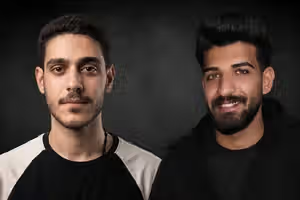
Amirhossein Safari (left) and Abolfazl Sepahi were executed for their alleged role in killing of security forces during Iran's widespread January protests
I wrote what follows just after midnight, unable to sleep at the thought of more executions at dawn. It is now early morning. The news has hit hard. I can't rewrite these words now. They belong to the hours before that hope disappeared. I leave them as they are.
It is three o'clock in the morning and I am trying not to fall asleep. By the time the dawn call to prayer reaches my window, three young Iranians may be dead.
I know there is nothing I can do. Still, sleep feels like a kind of surrender. So I keep refreshing whatever scraps of internet still work, hoping to see a message saying the executions have been postponed, that the rumours were wrong, that someone, somewhere, changed their mind.
The three young men have spent weeks waiting for this night. Convicted over their alleged role in the January protests, they now face the possibility of being taken to the gallows before most of Iran has opened its eyes.
Their names are spreading quickly, far beyond their hometown of Isfahan. That is why so many of us are awake.
Videos circulating online show heavy security around Isfahan's Alikhani Square, where scaffolding has been erected ahead of the possible public hangings. Small groups of people hover nearby despite the risks. They know they are unlikely to stop anything, but they go anyway.
There is something profoundly human about it: standing in the darkness simply because another person should not have to die alone.
The authorities would probably describe it as law enforcement. Most people I know call it something else: state killing. The only thing in Iran that never pauses.
War or peace, summer or winter. Presidents come and go, mediators arrive and leave. Bombs fall. Ceasefires are declared. The scaffold remains.
That continuity has become its own form of terror. Executions are part of our lives because the state has made them part of our lives. Deliberately.
Tonight feels different only because people know where to look. Some are watching the square from nearby streets. Others, like me, stare at flickering phone screens. We tell ourselves that daylight would make it harder.
As if numbers could somehow interrupt a machinery that has spent decades perfecting itself. It is an irrational hope. But hope often is.
People outside Iran often ask why sanctions, assassinations or bombs have not broken this system. Well, perhaps look at Alikhani Square.
Bombs can destroy buildings. They cannot, on their own, dismantle a system that has learned to absorb them. Ordinary people are different. They are the only force capable of challenging it from within. So the regime continues to reserve its greatest brutality for us.
The call to prayer will come soon. I still do not know whether I will sleep before then. I tell myself that once the sun is up there will be more eyes on the streets, more phones recording, more people standing nearby.
I convince myself that staying awake might help. I know it won’t. But tonight it feels unbearable not to try.
Iranian social media users and news outlets have praised archaeologist Hamideh Choubak after Alamut Castle was added to UNESCO’s World Heritage List, highlighting her 25 years of work excavating and protecting the historic site.
The UNESCO listing has drawn renewed attention to Choubak’s role in identifying, documenting and conserving the fortress complex, located 120 miles northwest of Tehran, and preparing it for World Heritage status.
Alamut Castle and Related Fortifications became Iran’s 30th UNESCO World Heritage property when it was inscribed on July 26 during the committee’s 48th session in Busan, South Korea.
Images of Choubak crying as the decision was announced were widely shared online, with users praising her decades-long commitment while criticizing the prominence given to government officials at the ceremony.
Zeinab Karimian, an Iranian journalist who formerly worked for the official news agency IRNA, said the inscription was the result of Choubak’s 25 years of “perseverance, yet once again, the front row was filled by male officials who will serve as ministers or deputy ministers for only a few years, while she remained in a corner.”
“History forgets the names of those who occupy the seats, but not those who devoted their lives to this land.”
Many social media users also praised Choubak as a symbol of professional dedication, saying the UNESCO listing had finally brought overdue recognition to decades of largely unseen work.
“I wish people like Dr. Hamideh Choubak could be multiplied—people who love this country’s land and heritage,” communications specialist Negar Arab wrote on X.
The Asr-e Iran news website also published a tribute to Choubak titled “25 years of effort and love for Iran’s cultural heritage.”
The outlet said she had devoted much of her career to researching and protecting Alamut, describing the UNESCO decision as the culmination of years of work.
“Alamut’s inscription may be only a piece of news, but for a woman who devoted more than a quarter of a century of her life to this mountain and fortress, this moment marks the end of a long journey and the beginning of Alamut’s lasting place in global memory,” it wrote.
Twenty-five years at Alamut
Choubak began archaeological excavations at Alamut Castle in 2001.
Her research continued over 25 years and included 16 excavation seasons at the main fortress, surrounding areas and several associated castles.
Her team uncovered buried sections of the complex and identified the functions of different structures.
The excavations revealed the castle’s prison, main entrance, observatory and central courtyard.
Researchers also identified Molasara, believed to have been used by Hassan-i Sabbah and other Ismaili leaders, as well as storage facilities, irrigation systems and communication routes.
Studies of six neighboring castles indicated that the fortifications had operated as an integrated network.
Botanical research conducted during the excavations also challenged some common accounts about the use of hashish during Hassan-i Sabbah’s era.
Choubak said the site had been reduced to little more than a mound of earth after years of erosion and neglect when excavations began.
Only parts of its walls remained visible.
Over the following decades, the main structures were identified, documented, conserved and restored as part of efforts to prepare Alamut for UNESCO recognition.
Protecting Alamut from development
Choubak was also praised for opposing projects that could have damaged the site and its surrounding historical landscape.
She resisted plans to construct a road, a cable car and other developments within the protected area, and sought to prevent unauthorized land occupation and construction.
Choubak, who serves as director of the Alamut World Heritage base, has said the complex was more than a military fortress.
It was also a center of government, science and culture during the Ismaili period, she said.
She pointed to the presence of scholars including Nasir al-Din al-Tusi, as well as the castle’s library and scientific activities, as evidence of its broader cultural importance.
Asr-e Iran also highlighted Choubak’s archaeological work in the ancient city of Jiroft and the Jazmourian region.
Those excavations led to the identification of a mosque, bazaar, public square, cemetery, water-distribution network and industrial workshops.
Choubak, born in 1952 in Bushehr in southern Iran, is an archaeologist specializing in the Islamic period. She studied archaeology at the University of Tehran, completing her master’s degree in 1983 with a thesis on Islamic ceramics, before earning a PhD in Islamic archaeology from Tarbiat Modares University.
Her career has included work at Iran’s Archaeological Center, the Glassware and Ceramic Museum, the Tehran Cultural Heritage Center and the Research Institute of Archaeology.
Choubak has participated in and led numerous excavations across Iran, including at Rey, Tepe Hissar, Hormuz, Jiroft and Kish.
An elderly patient sits in a hospital ward in Iran.
A growing number of Iranians are financing healthcare with debt as medical costs rise beyond household incomes, a new Eghtesad Online report found, while authorities prioritize medical preparations for the Shiite pilgrimage, Arbaeen.
Iranians are increasingly borrowing money, delaying treatment and bargaining over medical bills as healthcare costs outpace household incomes, according to a new report by Eghtesad Online, while authorities say medicines and medical supplies are fully secured for Arbaeen, the annual pilgrimage commemorating the 40th day after the death of third Shiite imam.
The report describes a healthcare system where treatment increasingly begins not with a doctor's diagnosis but with offers to activate credit, pay in installments or use discount codes. From dental care and physiotherapy to psychotherapy, prescription drugs and online consultations, households are increasingly financing healthcare with future income.
"The issue is not just the growth of a few startups or advertisements by a few clinics; the issue is the shrinking liquidity of households, where a patient is forced to borrow from next month's income to pay for today's pain," the report said.
When treatment depends on payday
Conversations in doctors' offices, the report said, increasingly focus on affordability rather than treatment. Patients ask whether insurance will cover consultation fees or whether doctors can charge less, while physicians report seeing people who postpone laboratory tests, imaging scans and prescriptions after paying for the initial visit.
"Is this charged at the private rate? Doesn't insurance cover it? Can't you charge a little less?" are now common questions at reception desks, according to the report, which said patients bargain "not out of habit, but out of necessity."
Long-term treatment is particularly vulnerable. Patients stop physiotherapy midway, discontinue psychotherapy after only a few sessions or ration medication so it lasts longer, turning what the report called "a shortage of cash into a shortage of treatment."
Official figures for the current Iranian year have not yet been released, but the latest available data showed healthcare accounted for 8.7% of urban household spending and 9.8% of rural household spending in 2024.
Mental health becomes a luxury
Financial pressures are especially visible in mental healthcare, where patients increasingly align appointments with payday.
A therapist meets with a patient in Iran, where rising treatment costs are making mental healthcare less affordable.
"Can I pay for this session at the end of the month?" is among the requests therapists now hear regularly, according to the report. Others ask, "My salary is deposited on the 10th. Can I pay for two sessions together?" or explain, "I can't come every week for now. I'll come twice a month."
The report said psychotherapy is intended to help people cope with anxiety, exhaustion and the pressures of daily life, yet "the cost of the session itself has become one of those anxieties." Social media users quoted in the report described calculating rent, loan payments, medicine and food costs before deciding whether they could afford therapy.
Dental care has become another symbol of the trend. Clinics increasingly advertise installment plans for implants, orthodontics and root canals, while online pharmacies and health platforms now offer credit for medicines and health-related products.
"Toothache does not wait for next month's paycheck," the report said, describing installment payments as both an opportunity to obtain treatment and a warning that essential healthcare costs are increasingly becoming future debt.
Officials warn of shortages
The financial pressures coincide with warnings from lawmakers about Iran's pharmaceutical sector.
Salman Es’haqi, spokesperson for parliament's Health and Treatment Committee, described medicine shortages as a "serious and critical" issue, citing sanctions, the recent war and disruptions to imports of pharmaceutical raw materials. He warned that unstable access to medicines could cost lives.
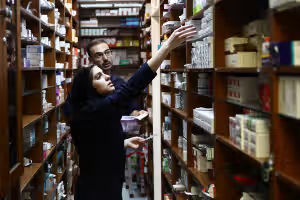
Other lawmakers have linked shortages to delays in foreign currency allocations and cash shortages affecting imports, while pharmacists have said weak oversight has allowed some medicines to be diverted from official distribution channels into the unofficial market.
Medical support for Arbaeen
Despite those concerns, officials have repeatedly emphasized that healthcare resources for Arbaeen will be fully available.
Medical supplies and pharmaceuticals are loaded for shipment from Iran to Iraq ahead of the Arbaeen pilgrimage in 2019.
Jafar Miadfar, head of Iran's Emergency Organization, said authorities had no concerns about supplying medicines and intravenous fluids for pilgrims. He said around 300,000 units of intravenous fluids had been allocated and medicine stocks positioned at six border crossings ahead of the pilgrimage.
Earlier, Iranian Red Crescent chief Pirhossein Kolivand said medicines and medical equipment had been dispatched for Arbaeen and that five hospitals in Iraq along the Najaf-Karbala route would provide care for Iranian pilgrims.