Tehran uses war as cover to ramp up executions, political prisoners say
Three prominent political prisoners held in Tehran's Evin prison issued a joint statement accusing the establishment of using regional war as a cover to escalate domestic repression and attempt to rebuild its lost authority through executions.
Abolfazl Ghadyani, a veteran Islamic Revolution-era official turned fierce critic of Tehran; Mohammad Najafi, a human rights lawyer jailed for exposing a protester's death in custody; and Reza Valizadeh, an Iranian-American journalist and former Radio Farda contributor, issued the joint statement from Tehran's Evin prison.
The three political prisoners said the Islamic Republic was accelerating executions to inflict revenge on defenseless citizens for military setbacks against international adversaries.
"The corrupt regime of the Islamic Republic has once again turned war into a license to kill citizens," the prisoners wrote. "Whatever collapsed of its hollow authority on the battlefield, it is now trying to rebuild on the gallows."
Political prisoners Abolfazl Ghadiani (right), Mohammad Najafi (middle) and Reza Valizadeh
Executions described as 'begging for authority'
Executing protesters following show trials does not represent the administration of justice but rather "begging for authority on a path of blood," the signatories wrote.
They said Iranian authorities were rushing executions to take out frustrations on ordinary citizens that they could not exact on the US and Israel, seeking to crush any protesting voice.
"Today the hereditary regime of Mojtaba Khamenei, who like his father is a bloodthirsty and criminal tyrant who shared and partnered in all his father's crimes and plunder, has fallen from governance to tunnel-keeping," the statement said.
The prisoners added that the regime and its military-security cliques, unable to manage severe economic and social crises, were relying on a triad of "execution, crackdown, and imprisonment" to control the population outside their power centers.
Isfahan hangings spark grief and anger
The statement follows the executions of two young protesters early on Tuesday, Amirhossein Safari and Abolfazl Sepahi, who were hanged in Isfahan amid a heavy security deployment around Alikhani Square.
The two men were among 12 defendants convicted in the Alikhani Square case stemming from clashes during protests in January. Their hangings brought the total number of individuals executed in the case to four, following the executions of Golmohammad Mohammadi and Erfan Esfandiari on July 19. Eight others remain under sentence of death.
The hangings in Isfahan triggered widespread grief, anger, and public defiance across Iranian cities and abroad. Witnesses described crowds gathering near Alikhani Square overnight despite intimidation by security forces, while messages across social media described the executions as a crime that hardened public resolve rather than suppressed dissent.
UN human rights experts led by Special Rapporteur Mai Sato had urged Iranian authorities on Monday to halt the executions, warning that closed-court trials based on televised confessions violated basic international legal standards.
Surge in capital punishment draws global alarm
The joint statement from Evin prison comes amid a broader surge in death sentences and executions across Iran over the past year, particularly following the January protests and escalating regional conflict.
Data compiled by Iran International shows that the Iranian judiciary has executed more than 50 political prisoners since the beginning of the current Iranian year, with dozens more facing execution.
Rights groups and civil society leaders have issued repeated warnings over the escalation. Amnesty International reported that at least 60 people, including three individuals under the age of 18 at the time of their alleged offenses, face imminent execution in Iran.
The three Evin prisoners concluded their statement by warning that no government achieves security or legitimacy through "the accumulation of corpses and a fear production line," adding that if the ruling establishment fails to yield to the public will, "Iran will become more ruined."
A US Army AH-64 Apache attack helicopter takes off at an undisclosed location in the Middle East in this image posted by US Central Command on X on July 25, 2026.
US President Donald Trump's most likely response to the conflict with Iran will be to intensify air strikes against a broader range of targets rather than withdraw or launch a ground invasion, former senior Pentagon official David Des Roches told Iran International TV.
Speaking on Iran International's Titre Aval (The Lead) program on Wednesday, Des Roches said the United States had limited military options after adopting an air campaign and argued Trump was unlikely to accept the political cost of ending the operation without achieving his objectives.
Three options
"The United States went in with an air power-only strategy," said Des Roches, now an associate professor at the Near East South Asia Center for Security Studies.
"That usually is flawed because once you do that, and if you look historically at how we've used an air power-led strategy in Korea, Vietnam, even World War II, but I think the illustrative point is Kosovo."
"If you don't achieve your strategic goals initially against a small target set, your options are to either introduce another element of warfare, and we don't have time to do that. To have a credible ground invasion force would take a year to build up, or you bomb more intensively."
"You widen the target list to include dual-use infrastructure, like bridges, the power grid, the national communications, television, and radio. This is what the US did against Serbia to stop the massacre of Muslims in Kosovo, or you leave."
"Those are really your three options, and I think that President Trump does not relish the prospect of leaving. That's too close to Joe Biden."
David Des Roches (left), associate professor at the Near East South Asia Center for Security Studies, speaks with Iran International TV presenter Niusha Saremi during the network's Titre Aval program on July 29, 2026.
More strikes likely
Des Roches said he believed the White House was most likely to increase military pressure rather than expand into ground operations.
"So I think, you know, he doesn't really have the ability to introduce another domain of warfare," he said.
"But really, I think his main option is to try to increase pain on the regime, and I think that that will mean an expansion into the targets towards dual-use targets and an expansion of intensive bombing to include not just areas adjacent to the Persian Gulf, but also areas inland, and especially the capital Tehran."
Asked about reports that Trump had been advised against escalating the conflict because of concerns about US weapons stockpiles, Des Roches said he believed political and economic factors were more important than military constraints.
"Some, but I think it's not really driven by military action or missile inventories," he said.
"I think it's political and economic. So we have midterm elections coming up. The Islamic Republic knows this. The leaders within the Islamic Republic know it, and they have calculated that if they can draw the war out, keep gasoline prices high, that President Trump will be in a worse position, or may even be impeached and removed."
"I think that they're kind of overplaying their hand."
Des Roches said recent Iranian actions might not reflect a unified government position.
"I'm not sure if the actions we're seeing reflect a unitary position of the Iranian government, but rather the actions of different factions of the Iranian government, probably the Revolutionary Guard, who are vying for supremacy and are trying to wreck any possibility for negotiations."
He argued that an end to the conflict would shift public attention inside Iran toward domestic issues.
"Obviously, if peace breaks out, then the focus within Iran goes from a national rally around the flag, oppose the Zionist entity and the Great Satan, towards looking at things like where has all the money gone over the year? Why is Tehran running out of water when the Revolutionary Guard controls the major construction companies in the country, and why are their children driving Lamborghinis in Spain and ours are having a hard time getting water in Tehran?"
"So it's a challenging period, but I think the hardliners, particularly in the Revolutionary Guard, are at risk of severely overplaying their hand."
Asked whether regime change had become part of US strategy, Des Roches said he believed Trump was pursuing a different approach from previous US interventions.
"My view is President Trump's theory of victory is not that the US will impose a new regime the way we did, for example, in Iraq, because that didn't work out well."
"I think he feels that economic pressure will lead the Iranians to have their own regime change."
Des Roches said Trump appeared to believe the anti-government protests in late 2019 had brought Iran close to internal political change.
"I think he feels that in December that was about to happen. It was only the violence of the Revolutionary Guard and the Basij, the massacres of between 1,300 and 4,000 Iranians - we don't know the exact number - that would have done it."
"I think that's why we're here now. It's not because Netanyahu led it. It's because, in the face of what he saw as a vindication of his policy, I think he believes that had he remained president after 2020, regime change would have been accomplished from within by about 2022."
A man gestures toward a giant anti-Trump billboard during a nightly state-backed rally in Tehran, July, 25, 2026
Amid threats of war and mounting fears of economic collapse, Iran's government is seeking to reinforce its case for moderation in a fractured and deeply polarized political landscape.
On July 29, the administration's official daily, Iran, published four opinion pieces by representatives of four moderate and conservative parties, presenting the collection as evidence of a new political accord.
The paper argued that "the traditional pattern of political competition between Iran's two major blocs has fundamentally shifted," concluding that "what seems to have 'ended' is not reformism or principlism as political identities, but the confrontational style of rivalry that had turned these blocs into near-enemies."
The optimism sits uneasily with political reality.
Hardliners routinely accuse President Masoud Pezeshkian and Parliament Speaker Mohammad Bagher Ghalibaf of betraying the country because of their relatively pragmatic approach to negotiations and the confrontation with the United States, while state television, dominated by ultraconservatives, has repeatedly censored key remarks by both men.
Nor did the initiative reflect the country's current balance of political power. The contributors came from four parties that have largely been sidelined since at least 2020 and no longer reflect the real distribution of influence in presidential or parliamentary politics.
The ultraconservative Paydari Party, arguably the most influential ideological force in today's parliament, and the centrist Executives of Reconstruction Party were both absent, whether by exclusion or choice.
The paper nonetheless argued that "the pressures of war and national security crises pushed both sides toward cooperation, reducing polarization and enabling decisions that required broad consensus."
Yet it also acknowledged that Paydari—described as "a small but loud minority" enjoying disproportionate influence through state broadcasting—stood outside the initiative.
Rather than demonstrating broad political consensus, the exercise illustrated its limits. Three of the four essays were written not by party leaders but by deputies or senior members of organisations that have played only marginal roles in Iranian politics for nearly two decades.
The four contributors differed in emphasis but converged on a common message.
Mahmoud Vaezi argued that, amid hybrid warfare and economic pressure, Iran needed rationality, restraint and an end to factional competition. Alireza Khojastehpour called for what he described as "revolutionary rationality." Mohammad Sadegh Javadi-Hessar framed moderation as a religious imperative, while Mohammad Ali Amani argued that resilience depended less on military power than on social cohesion.
Collectively, the essays portrayed moderation as a strategic necessity rooted in political experience, revolutionary reasoning and religious ethics. Extremism was presented as corrosive, narrowing political choices, deepening polarization and eroding public trust.
Yet the initiative may reveal less about the emergence of a new political consensus than about the administration's effort to reinforce its case for a more moderate course.
Facing the prospect of war, worsening economic pressures and relentless attacks from powerful hardline factions, Pezeshkian appears to be seeking validation for a strategy that many of the country's most influential political actors remain unwilling to embrace.
The country's most influential ultraconservative factions, their media allies and an IRGC that increasingly acts as a political institution in its own right were absent from the discussion.
They are also the actors least likely to look to the government's flagship newspaper for lessons in moderation.
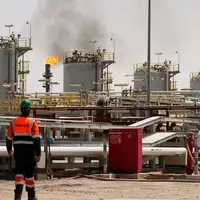
A worker walks past oil pipes at a refinery in Wuhan, Hubei province March 23, 2012.
A newspaper close to Mohammad Bagher Ghalibaf, Iran's chief negotiator with Washington, is asking whether China quietly neutralized Tehran's most feared economic weapon: the oil shock through the Strait of Hormuz that never came.
Khorasan Daily, published in Tehran and Mashhad for nearly a century, asked this week whether China's sharp cut in crude purchases "ruined Iran's Strait of Hormuz strategy" or was simply a commercial response to a war zone.
The question would be unremarkable in a Western think tank. In a paper aligned with the man running Iran's negotiations, it reads as something else: the talks camp auditing, in public, the war camp's central weapon.
The shock that never came
For decades, Iranian crisis planning has rested on one assumption: disrupt the Strait of Hormuz, through which a fifth of the world's oil normally flows, and crude rockets past $200 a barrel, forcing the world to restrain Washington. During the current war, the strait has indeed been closed to Iranian exports and contested for weeks. The spike never arrived.
Khorasan's explanation is the buyer, not the seller. China purchases heavily discounted Iranian crude in calm periods, then pivots to Strategic Petroleum Reserve (SPR) drawdowns and Russian pipeline oil the moment escalation begins, draining the drama out of the market. Western and regional reporting describes the same pattern as a deliberate "shock absorber" policy designed to neutralize Persian Gulf risk.
The paper offered two readings of Beijing's behavior. In the darker one, "real market power shifted from the producer to the largest consumer, and Iran's game was effectively neutralized by its biggest customer."
In the gentler one, China simply stepped back from a market where war-risk premiums would have bankrupted its refiners, "rather than entering intense price bidding with other global buyers."
A question from the talks camp
Where the analysis comes from matters as much as what it says. Khorasan sits in the orbit of Ghalibaf, who is not only Tehran's lead negotiator with the United States but also officially holds the China portfolio in Iran's foreign relations.
A paper in his camp questioning whether the Hormuz card still works is, in effect, an argument for his own project: if the economic weapon no longer detonates, negotiation is not weakness but arithmetic.
That may also explain the analysis's careful landing. Khorasan concluded that Beijing's buffers, reserve drawdowns and reduced refinery runs, are temporary and unsustainable without causing domestic inflation and fuel shortages.
"China did not necessarily act within a framework of ruining Iran's game," the paper wrote. Beijing's retreat "changed the traditional formula from a rapid oil shock to a gradual attrition, but it did not eliminate the core impact of the conflict on the market." The conclusion spares the partner its patron cannot afford to alienate.
Reformist and centrist outlets took the argument further. Shargh noted that while China and Russia provide diplomatic protection and veto cover at the UN Security Council, neither has any intention of entering a military or financial confrontation with Washington on Iran's behalf.
Khabar Online asked whether the two powers are helping Iran withstand Western pressure or using the confrontation as leverage in their own dealings with Washington.
Etemad and Donya-ye Eqtesad went at the doctrine itself: an energy-shock strategy assumes the customer has no alternatives, a premise they argue no longer holds.
The war camp pushes back
The other side of Iran's establishment read the same data and refused the conclusion. Tasnim, Javan and Kayhan, the outlets closest to the camp that favors fighting on, rejected the notion that Beijing "ruined Iran's strategy," reframing the story around Western supply strain and the slow grind of market friction, the "gradual attrition" that Khorasan itself conceded is still working on the world economy.
The dispute is not really about China. It is about which lever Iran has left. The war camp needs the Hormuz card to be live, because it is the argument for endurance. The talks camp needs it to be spent, because that is the argument for a deal.
What Khorasan put in print is that Iran's biggest customer may have already settled the question, and that the answer favors the men at the table.
Amirhossein Safari (right) and Abolfazl Sepahi (left), who were executed in Isfahan on July 28, 2026 after being convicted in the Alikhani Square case.
The execution of two more protesters early Tuesday triggered widespread grief, anger and defiance across Iran, with many saying the hangings had strengthened, rather than broken, their resolve to oppose the Islamic Republic.
People in Isfahan and cities across Iran described staying awake through the night in the hope that the executions would be halted, mourning the two men after dawn and praising those who gathered despite a heavy security presence around the execution site.
Amirhossein Safari and Abolfazl Sepahi were among 12 young men sentenced to death in what became known as the Alikhani Square case, stemming from clashes during nationwide protests in Isfahan on January 8.
Iranian authorities accuse the defendants of killing four security personnel, as well as arson and vandalism. Rights groups and United Nations experts have questioned the fairness of the proceedings, citing allegations of coerced confessions, closed court hearings and the defendants' young ages.
Iran's judiciary news agency Mizan said Safari and Sepahi were executed early Tuesday, bringing the number of people put to death in the case to four after Golmohammad Mohammadi and Erfan Esfandiari were executed on July 19. Eight other defendants remain under sentence of death.
"They chased people through the alleyways of Isfahan last night," one witness said. "People were running through the streets, and the officers followed them. They did not even spare a thought for those mothers."
Witnesses said security forces maintained a heavy presence around Alikhani Square throughout Monday night after reports that an iron scaffold had been erected there. Social media accounts described confrontations between officers and people who had gathered in the hope of preventing the executions.
Iranians in London also gathered outside the Iranian embassy Monday night to protest the executions, extending demonstrations over the hangings beyond Iran's borders.
'We stayed awake until morning'
Many of the messages focused on the hours before dawn, describing a night spent waiting for news from Isfahan.
"We wished until sunrise that morning would never come to Isfahan," one person wrote.
Another summed up the night in historical terms: "Write in history that people in Iran fought with their bare hands until 5 a.m. to save two of their fellow citizens."
Messages from Bandar Abbas, Pardis, Khomein and other cities suggested many people viewed the gatherings in Isfahan as a sign that opposition to the executions had spread well beyond the city.
"The people of Isfahan showed that when the next call comes, millions across the country will return to the streets," one resident of Bandar Abbas said. "We fight for freedom even with empty hands."
Another resident of Bandar Abbas added: "Thank you to the people of Isfahan for gathering and showing that we are still standing together and still remember everyone who has been executed."
One student said news of the executions overshadowed an examination.
"I did not even know what I was writing during my exam," the student said. "All I could think about were the young men who were executed in Isfahan last night."
Grief turns to defiance
Many reactions expressed sympathy for the families of the two men while arguing the executions would intensify rather than suppress dissent.
"My heart breaks for the families of those two young men who watched them being executed," one message said.
Others said the executions had strengthened their determination.
"We are saddened by these executions, but we are not afraid," one resident of Pardis, near Tehran said. "We have become angrier. We will return to the streets soon."
Another reaction echoed that sentiment: "Did you think executing our brothers and sisters would make us retreat or become afraid? It has only made us more determined."
Several people criticized governments engaged in diplomacy with Tehran for failing to do more to stop the executions.
"Countries that have influence over the authorities, why do they do nothing to stop these executions?" one message asked.
Others addressed US President Donald Trump directly, questioning why preventing executions had not featured more prominently in negotiations with Iran.
International pressure
The public reaction followed an appeal by United Nations experts led by Special Rapporteur Mai Sato, who urged Iranian authorities on Monday to halt the executions of the remaining defendants.
"Sentencing 12 people to death in one hearing, in a closed courtroom and without clarity as to each defendant's individual responsibility violates established fair trial standards," the experts said.
The experts said the convictions relied heavily on confessions broadcast on state television, while Revolutionary Court hearings were held behind closed doors and the judgments were never made public.
They also said several defendants had reportedly been subjected to arbitrary detention, enforced disappearance and, in some cases, ill-treatment.
Amirhossein Safari (left) and Abolfazl Sepahi were executed for their alleged role in killing of security forces during Iran's widespread January protests
I wrote what follows just after midnight, unable to sleep at the thought of more executions at dawn. It is now early morning. The news has hit hard. I can't rewrite these words now. They belong to the hours before that hope disappeared. I leave them as they are.
It is three o'clock in the morning and I am trying not to fall asleep. By the time the dawn call to prayer reaches my window, three young Iranians may be dead.
I know there is nothing I can do. Still, sleep feels like a kind of surrender. So I keep refreshing whatever scraps of internet still work, hoping to see a message saying the executions have been postponed, that the rumours were wrong, that someone, somewhere, changed their mind.
The three young men have spent weeks waiting for this night. Convicted over their alleged role in the January protests, they now face the possibility of being taken to the gallows before most of Iran has opened its eyes.
Their names are spreading quickly, far beyond their hometown of Isfahan. That is why so many of us are awake.
Videos circulating online show heavy security around Isfahan's Alikhani Square, where scaffolding has been erected ahead of the possible public hangings. Small groups of people hover nearby despite the risks. They know they are unlikely to stop anything, but they go anyway.
There is something profoundly human about it: standing in the darkness simply because another person should not have to die alone.
The authorities would probably describe it as law enforcement. Most people I know call it something else: state killing. The only thing in Iran that never pauses.
War or peace, summer or winter. Presidents come and go, mediators arrive and leave. Bombs fall. Ceasefires are declared. The scaffold remains.
That continuity has become its own form of terror. Executions are part of our lives because the state has made them part of our lives. Deliberately.
Tonight feels different only because people know where to look. Some are watching the square from nearby streets. Others, like me, stare at flickering phone screens. We tell ourselves that daylight would make it harder.
As if numbers could somehow interrupt a machinery that has spent decades perfecting itself. It is an irrational hope. But hope often is.
People outside Iran often ask why sanctions, assassinations or bombs have not broken this system. Well, perhaps look at Alikhani Square.
Bombs can destroy buildings. They cannot, on their own, dismantle a system that has learned to absorb them. Ordinary people are different. They are the only force capable of challenging it from within. So the regime continues to reserve its greatest brutality for us.
The call to prayer will come soon. I still do not know whether I will sleep before then. I tell myself that once the sun is up there will be more eyes on the streets, more phones recording, more people standing nearby.
I convince myself that staying awake might help. I know it won’t. But tonight it feels unbearable not to try.