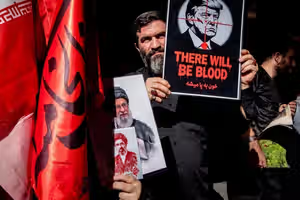
Iran lawmakers call for retaliation over Khamenei killing, end to US MoU
About 180 Iranian lawmakers called on Tuesday for Iran to treat its memorandum of understanding with the United States as terminated after US President Donald Trump declared the agreement over.
In a statement, the lawmakers pledged to continue pursuing retaliation for the killing of former Supreme Leader Ali Khamenei and other senior Iranian officials.
They also urged parliament's leadership to immediately establish a special committee to review negotiations with the United States and oversee implementation of conditions set by Supreme Leader Mojtaba Khamenei.
The statement said parliament would pursue legislation on the "management and governance" of the Strait of Hormuz and measures to strengthen Iran's defence doctrine.
The lawmakers also voiced support for the armed forces, particularly over what they described as Iran's exercise of sovereignty over the Strait of Hormuz.
The Iran war has yet to trigger an exodus of entrepreneurs from the Persian Gulf, but falling investment, rising costs and slower funding are beginning to test the region’s heavily financed startup strategy, Bloomberg reported on Tuesday.
Abu Dhabi, Dubai, Riyadh and Doha have spent years trying to build globally competitive technology sectors through sovereign wealth, tax incentives, accelerator programs and direct investment.
Despite attacks in the region and renewed fighting between the United States and Iran, founders have largely remained in the region and government-backed programs continue to attract applicants.
None of the 27 companies selected for the February intake of Hub71, Abu Dhabi’s startup program, withdrew after the conflict began, according to Bloomberg. The program’s latest cohort also received a similar number of applications and was the first made up entirely of companies from outside the United Arab Emirates.
The financial effects, however, may not yet be fully visible. Middle East and North African startups raised $1.35 billion in the first half of 2026, down more than 20% from a year earlier, according to data platform Magnitt. The number of deals fell even more sharply to 214, while second-quarter activity dropped to its lowest level in at least two years.
“I don’t believe that the impact of the war has come into the numbers yet, that will come in Q3 and Q4,” Magnitt chief executive Philip Bahoshy told Bloomberg TV, adding that investors were already shifting their attention from early-stage companies toward more established businesses.
Some startups are also facing higher fuel, shipping and insurance costs, worsening cash flow and longer delays in receiving payments. Bloomberg cited one investor as saying that a sovereign investor withdrew a $1 million commitment from a funding round when the war began.
Regional governments are continuing to spend heavily. Hub71 offers successful applicants $140,000 in investment and incentives, while Qatar expanded its Fund of Funds program from $1 billion to $3 billion before the conflict. Startup Qatar has awarded more than $51 million to 45 companies, including 11 since the fighting began.
The Persian Gulf’s startup markets remain smaller than established centers in the United States, Europe and Asia, with limited late-stage financing, technology listings and specialist talent. But founders and investors told Bloomberg that access to capital, lower costs and government support continued to outweigh the risks for many companies.
Iranian lawmakers attend a parliament session in Tehran on July 13, the first plenary meeting in more than four months, chaired by Deputy Speaker Hamidreza Hajibabaei.
Iran's parliament voted two outspoken critics of negotiations with the United States out of senior posts on its National Security and Foreign Policy Committee on Tuesday, a day after lawmakers returned to the chamber for the first time in more than four months.
Mahmoud Nabavian lost his position as the committee's first deputy chairman, while Ebrahim Rezaei was replaced as the committee's spokesperson, according to the committee's annual leadership vote.
Ebrahim Azizi was elected committee chairman, Abbas Moghtadaei and Amir Hayat-Moghaddam were chosen as first and second deputy chairmen, Hassan Ghashghavi was elected spokesperson, and Behnam Saeedi and Yaghoub Rezazadeh became the committee's secretaries.
Critics of US negotiations
Nabavian and Rezaei had emerged as two of parliament's most vocal opponents of negotiations with Washington during and after the conflict with the United States and Israel.
Nabavian repeatedly argued that any agreement with Washington would amount to an "absolute loss" for Iran and said the country's experience of negotiations had only brought "broken promises, deception and benefits for the enemy."
He also criticized Parliament Speaker Mohammad Bagher Ghalibaf and Foreign Minister Abbas Araghchi.
Earlier this month, Nabavian also vowed to oppose what he described as a "coup," accusing unnamed political rivals of trying to sideline hardline forces.
Rezaei also said Iran was not intimidated by what he described as threats from US President Donald Trump and that the country was "ready to fight any evil."
Nabavian also came under scrutiny after reading excerpts on state television from what he described as secret correspondence from Supreme Leader Mojtaba Khamenei on negotiations with the United States. The broadcast was cut off as he continued speaking.
Nabavian said Khamenei had repeatedly objected to the course of the talks and set conditions that were not reflected in the Iran-US memorandum of understanding, including securing compensation from the United States, preserving Iran's uranium enrichment program and maintaining exclusive Iranian control over the Strait of Hormuz. He also said Khamenei wanted Iran to begin charging some ships to transit the waterway.
State broadcaster IRIB later said Nabavian's references to classified correspondence could warrant legal action. Ghalibaf adviser Amir Ebrahim Rasouli subsequently called on authorities to identify the source of what he described as confidential state information provided to Nabavian.
The committee reshuffle came a day after parliament returned to session, with Deputy Speaker Hamidreza Hajibabaei presiding instead of Ghalibaf.
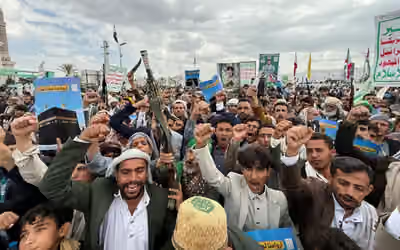
More than 250 lawmakers attended the session, during which legislators chanted slogans calling for revenge for the killing of former supreme leader Ali Khamenei and other senior officials killed in US and Israeli strikes.
Hardline lawmakers affiliated with the Paydari Front had spent months criticizing Ghalibaf for parliament's inactivity, accusing him of preventing lawmakers from meeting in order to avoid parliamentary action against negotiations with the United States. They also repeatedly called for Araghchi's resignation over the talks.
Ghalibaf's office said at the time that the suspension of parliamentary sessions had followed instructions from security authorities.
US military personnel and contractors in the Middle East were targeted in a coordinated phone-tracking campaign before and during the Iran war, the Financial Times reported on Tuesday, citing telecom data, cybersecurity experts and officials familiar with the matter.
“Iran absolutely has capabilities to get real-time, immediate, and continuous location information,” Gary Miller, a senior research fellow at cybersecurity watchdog Citizen Lab, told the FT.
“It would surprise me very much if Iran were not using SS7, or mobile network access in the region, to track US users.”
Telecom networks under pressure
Middle Eastern telecom networks, according to the report, blocked repeated requests known as SS7 pings, which can reveal the approximate location of phones roaming outside their home networks.
Two cybersecurity experts who reviewed the data told the FT the activity appeared to be part of a coordinated effort to locate specific devices.
The tracking attempts came in the build-up to the US-Israeli attack on Iran in late February and continued during the early days of the conflict, when Iran launched missile and drone attacks on US forces and military installations across the region.
A person familiar with the matter told the FT that Persian Gulf officials suspected Iran or allied groups had exploited roaming agreements with regional mobile operators to track US personnel.
Separately, a US official speaking anonymously said actors linked to Iran were also believed to have used commercial advertising databases to locate phones in Iraqi Kurdistan.
US lawmakers renew security concerns
US Central Command told Congress in April that it had received multiple threat reports about adversaries exploiting commercial location data to monitor or target US personnel deployed in the region.
However, Centcom said it had taken force-protection measures to safeguard its forces, while a US official told the FT there was no evidence that data tracking had played a significant role in attacks.
At least some blocked tracking attempts could be linked to an Iranian mobile operator based on a shared technical fingerprint.
“This appears to be very specific user targeting,” Miller told the FT. “They are targeting specific devices.”
The Iranian embassy in London did not immediately respond to the newspaper's request for comment.
The report also said Iran was suspected of using commercially available advertising technology to identify hotels housing US government employees and contractors.
Advertising identifiers assigned to smartphones can enable devices to be tracked without directly compromising the phones themselves.
US lawmakers cited by the FT said the findings underscored longstanding concerns about the military's exposure through commercial location data.
Ron Wyden, a Democratic senator, said he had warned successive administrations for years about the national security risks, while Republican Representative Pat Harrigan said legislation was needed to prevent technology companies from selling location data linked to government employees.
German security authorities are investigating indications of possible surveillance activities and preparations for attacks linked to the Iran war, German-language newspaper Handelsblatt reported on Tuesday, citing the Interior Ministry.
A ministry spokesperson said federal security agencies were closely monitoring developments related to the Middle East and were examining various leads concerning suspected reconnaissance activities or preparations for possible attacks.
The spokesperson said the agencies were working closely with Germany's regional authorities and international partners to continuously assess the threat environment.
The review comes after the publication of an Iranian "retaliation list" that included German Chancellor Friedrich Merz among a number of foreign leaders identified as targets for revenge.
The ministry said it had taken note of the publication and its threats, adding that security measures provided by the Federal Criminal Police Office (BKA) were being continuously reviewed and adjusted where necessary.
According to the ministry, the latest escalation between the United States and Iran has not, at this stage, led to a deterioration of Germany's already elevated security assessment.
The ministry also pointed to what it described as Iran's reliance on asymmetric tactics, including intelligence gathering, intimidation of regime opponents abroad and the mobilization of supporters.
It cited Lebanon's Hezbollah, the Palestinian militant group Hamas and Yemen's Houthis as groups aligned with Tehran's so-called "Axis of Resistance."
On Saturday, Tehran municipality-affiliated newspaper Hamshahri published an image of 13 world leaders, including Merz, claiming they were on the Islamic Republic’s revenge list.
It showed them in prison uniforms in crosshairs, alongside the caption: “Revenge is certain.”
The image also showed European leaders Giorgia Meloni, Friedrich Merz, Emmanuel Macron and Keir Starmer.
Italian Foreign Minister Antonio Tajani told Iran International on Monday that the threat against the Italian prime minister was unacceptable, adding that, “Italy is not fighting against Iran, so we do not understand this attack against Italy.”
The image also depicted US and Israeli officials, including US President Donald Trump and Israeli Prime Minister Benjamin Netanyahu.
File photo shows a healthcare worker assisting a woman using a wheelchair up a ramp at a medical facility in Iran.
Many Iranians with disabilities have lost their living allowances after the State Welfare Organization halted payments from June citing a budget shortfall, the labor-focused news agency ILNA reported on Monday, adding that caregiver and hygiene subsidies have also been delayed.
The cuts, the outlet said, reflected the Islamic Republic's failure to support people covered by the welfare system, particularly those with disabilities, during a deepening economic crisis.
“For me, the question is why they cut my living allowance when even they say my disability is severe and I have developed pressure sores,” 44-year-old Hossein, whose payments stopped last month, told ILNA.
Hossein said the State Welfare Organization also provides no meaningful assistance with medication costs and refused to reimburse expenses from a surgery because it was performed during the past year.
The worsening economic situation, he added, had also reduced the ability of charities to support people with disabilities.
Rising costs deepen hardship
Many people with disabilities, ILNA said, are unable to work and depend largely on modest welfare stipends and subsidies for their livelihoods.
The report argued that deteriorating conditions stem from ineffective state policies and a lack of equal social, economic and political opportunities, warning that services become even more limited outside the capital.
The economic downturn, coupled with sharply higher healthcare and medicine costs, has placed additional strain on people with disabilities, many of whom require continuous medical treatment, rehabilitation services and specialized equipment.
In May, Khabar Online news outlet reported that rising prices for hygiene and medical supplies had affected around 45,000 people living with spinal cord injuries. Prices for essential items including sterile dressings, catheters, catheter bags, syringes and medicines for pressure sores had increased two- to three-fold.
Subsidies cover only days of expenses
Raheleh, a 45-year-old woman with a spinal cord injury, told that the monthly hygiene subsidy of 15 million rials ($8.2) was far below what was needed.
Silhouettes of people with disabilities gather inside a public building in Iran.
“I have to use disposable catheters every day, and this amount only covers one week or 10 days. It cannot cover the whole month ... I have never had the opportunity to work, so in these conditions of inflation I have no salary,” she said.
She described the monthly caregiver allowance of 42 million rials ($23) as “close to nothing” given her medical expenses, adding that doctor visits, diagnostic tests and transportation costs leave her unable to meet basic needs by the middle of each month.
Fatemeh Abbasi, deputy head of rehabilitation at the State Welfare Organization, said in May that the agency had requested an 80% to 90% increase in caregiver allowances, but implementation depends on government approval.