Russia says Iran erred by agreeing to nuclear deal sanctions 'trap'
Russia Foreign Minister Sergei Lavrov (right) and Iran's former foreign minister Mohammad Javad Zarif
Moscow was surprised by Iran's agreement to the so-called UN snapback sanctions mechanism of a 2015 international nuclear deal, Russian Foreign Minister Sergei Lavrov said, describing it as a legal trap for Tehran.
“To be honest, we were surprised. But if our Iranian partners accepted this formulation - which, frankly, was a legal trap - we had no grounds to object,” Lavrov told reporters in Moscow.
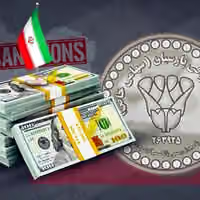
Last month, UN sanctions were reimposed on Iran after France, Germany, and the United Kingdom triggered the so-called snapback mechanism, accusing Tehran of spurning diplomacy and nuclear inspections.
The snapback mechanism was part of the Iran nuclear deal, formally known as the Joint Comprehensive Plan of Action (JCPOA). It allows any participant, including the five permanent members of the UN Security Council plus Germany, to reimpose UN sanctions on Iran in the event of alleged violations, without the possibility of a veto.
Iran denies seeking a nuclear weapon and calls the new sanctions aggressive and illegal.
Hardliners in Iran have long criticized Zarif for accepting the JCPOA’s snapback mechanism, viewing it as a concession that ultimately enabled the reimposition of sanctions.
“That provision was, in fact, agreed upon during the final stage of the direct negotiations" between Iran's then top diplomat Mohammad Javad Zarif and his US counterpart John Kerry, Lavrov added.
“The other participants were essentially observers at that point, watching the US and Iran reach an agreement."
“What happened instead is that Iran did not breach the deal, yet the United States withdrew from it, and the Europeans failed to meet their commitments,” Lavrov said.
Fate of the deal
The United States withdrew from the Iran nuclear deal in 2018 during first President Donald Trump’s administration. In response, Iran gradually reduced its compliance with the JCPOA and in 2019 began enriching uranium at higher levels.
Zarif expressed frustration with Russia’s role in a leaked 2022 interview, saying, “When the JCPOA was signed, Russia made every possible effort in the final week to prevent the agreement from being concluded.”
Israel launched a surprise military offensive in June, striking Iran’s military and nuclear facilities and targeting top officials. Iran retaliated with waves of drone and ballistic missile attacks.
The United States entered the conflict on June 22 with strikes on key nuclear sites in Natanz, Fordow, and Isfahan, and later brokered a ceasefire between Iran and Israel after 12 days of fighting on June 24.
Following the attacks, Iran halted cooperation with the International Atomic Energy Agency (IAEA).