On September 4, the emir of Qatar received Iranian President Masoud Pezeshkian's verbal message in a meeting in Doha with Iran's top diplomat Abbas Araghchi, the Qatari state news agency confirmed at the time.
Informed sources told Iran International that the message, sent upon Khamenei’s instruction, was a request for Sheikh Tamim bin Hamad to mediate between Tehran and Western powers to avert the reimposition of UN sanctions under the so-called “snapback” mechanism.
Sheikh Tamim has been asked to facilitate contacts with the United States and the E3 (France, Germany, UK) to resume nuclear diplomacy and prevent the return of sanctions, Iran International has learned.
According to the sources, Tehran is showing greater flexibility over discussions concerning the whereabouts and handling of its highly enriched uranium stockpiles, an issue it had refused to broach with interlocutors after recent US airstrikes.
UN nuclear watchdog
Foreign Minister Araghchi will meet with IAEA Director General Rafael Grossi in Cairo on Tuesday, Iranian foreign ministry spokesman Esmail Baghaei confirmed on Monday.
He said the meeting will aim to wrap up negotiations on the framework of Iran-IAEA cooperation.
The developments come amid intensified scrutiny from UN inspectors. The UN nuclear watchdog has said it has lacked visibility into the status or location of Iran’s highly enriched uranium since attacks on Iranian enrichment facilities began in mid-June.
The IAEA reported in August that Iran held roughly 440.9 kg of 60% enriched uranium, enough, if further refined, for around ten nuclear devices.
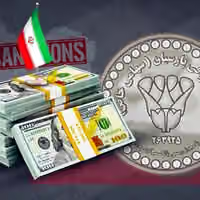
Diplomatically, the stakes are rising. Britain, France and Germany triggered the snapback mechanism under UN Security Council Resolution 2231 in late August, setting a timetable under which sanctions relief will lapse unless extended by another resolution.
The E3 are still pressing Iran to meet three conditions before the end of the month, which could allow for a temporary delay in sanctions snapback and create space for new negotiations.
These include allowing UN inspectors access to nuclear sites damaged in Israeli strikes, clarifying the status of its enriched uranium stockpile, and entering direct talks with the United States.
South Korea's resolution to lift sanctions
As the Council president for September, South Korea on Monday finalized a draft resolution that would permanently lift international sanctions on Iran. However, the resolution is unlikely to be adopted, Reuters reported citing diplomats.
South Korea’s draft is not an initiative of its own, but a legal requirement under Resolution 2231 which endorsed the 2015 nuclear deal with Iran and is due to expire on October 18.
According to Resolution 2231, sanctions are presumed to return automatically unless the Council votes to keep them lifted. That is why the Council president must first table a resolution to “permanently lift” sanctions as its failure is what triggers the automatic re-imposition.
The procedural step comes as part of the so-called “snapback” mechanism. Under the process, the Security Council must vote by late September on whether to make sanctions relief permanent.
For the resolution to pass, it would need at least nine votes in favor and no vetoes from the five permanent members: the United States, Britain, France, Russia, and China.
The adoption of the resolution is largely regarded as highly unlikely, as Washington and its European allies remain adamant that Tehran has failed to live up to its obligations.
If no member tabled a resolution within ten days of the process being launched, it fell to South Korea, as Council president for September, to act. Seoul’s move on Monday meets that requirement, though no vote date has yet been set.