A man and woman sit by the grave of their loved one, Tehran, Iran, July 3, 2025
Diplomatic prospects between Iran and the West appear increasingly bleak, with Tehran’s political class voicing growing skepticism that a negotiated breakthrough is still possible.
“The hostile posture of the three European powers and the cautious approach of China and Russia—Iran’s tactical partners—have made a return to diplomacy increasingly unlikely,” wrote Etemad columnist Noushin Mahjoub in her July 17 column.
Mahjoub dismissed Beijing’s role as a potential mediator, arguing that Tehran’s own actions—halting cooperation with the IAEA and clinging to hardline red lines—have left diplomacy with “few prospects.”
Former parliamentary foreign relations chief Heshmatollah Falahatpisheh echoed that view.
“The activation of the trigger mechanism means an end to diplomatic relations between Iran and Europe,” he told the moderate daily Etemad. “And countries like China and Russia, facing their own tensions with the US, cannot be effective mediators.”
He pointed to their passivity during the recent 12-day war with Israel and proposed Oman or Qatar as more realistic options—if Iran recommits to the Non-Proliferation Treaty (NPT).
Searching for way out
But with US officials insisting that only direct engagement is acceptable, the question of mediation may already be obsolete.
Iran’s path out of the current crisis likely hinges not on finding the right go-between, but on its own willingness to fundamentally shift course.
Political analyst Hassan Beheshtipour offered a possible framework, arguing that Tehran needs to embrace a strategy that balances deterrence, confidence-building and responsiveness to major powers.
“Iran’s situation has grown more precarious following accusations by three European states that it undermined nuclear safeguards,” he wrote in the moderate daily Arman Melli, calling for a phased “suspension-for-suspension” model.
“Iran would pause enrichment for one year, while the other side progressively lifts sanctions and releases frozen assets. Afterward, Iran would cap enrichment at 67.3%, while retaining technical capability for higher levels,” Beheshtipour proposed.
Iran remains the only non-nuclear state enriching uranium to 60%—a level close to weapons-grade. But Washington appears adamant that no enrichment is acceptable inside Iran.
Window closing
Tehran is left at a familiar but increasingly perilous crossroads.
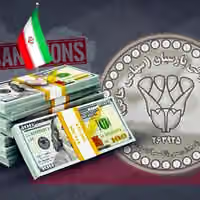
The Islamic Republic must either relinquish its revolutionary doctrine to avoid punishing sanctions—or brace for deeper isolation that even China and Russia won’t be able to counterbalance.
Abandoning its ideological identity would transform the ruling system beyond recognition. But choosing resistance without compromise would come at a steep cost: greater hardship for ordinary Iranians and a further erosion of state legitimacy.
Tehran’s long-favored third option—stalling, hedging and tactical ambiguity—may no longer be sustainable. The economy may be too fragile, global patience too thin.
Leader’s defiance
President Pezeshkian’s proposed workaround—reviving barter trade with select neighbors—offers little in the way of real relief. It is a dated, impractical system unlikely to serve any party’s long-term interests.
Yet Supreme Leader Ali Khamenei shows no sign of blinking. This week, he reiterated that Iran is prepared for military and diplomatic action but provided no endorsement of diplomacy with adversaries.
Mistrust runs deep, and Khamenei loyalists miss no opportunity to amplify it.
“Decades of experience and US arrogance, aided by its lackey Israel, show that they want to bring misery upon us and erase our glorious history,” former vice president and hardliner Masoud Zaribafan told Khabar Online.