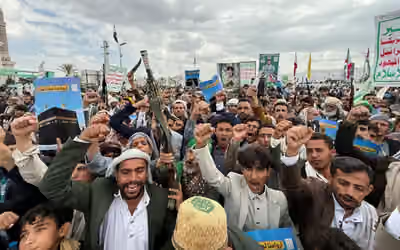
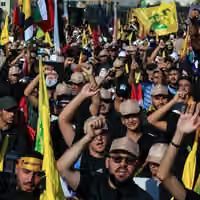
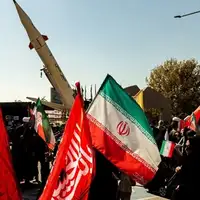
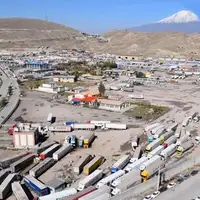
Crowds in Iran's northwestern city of Zanjan, June 2025
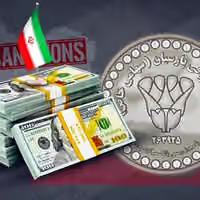
Tehran’s commentariat is sounding the alarm over the economic toll of renewed United Nations sanctions that European powers say they could trigger against Iran by the end of August.
The sanctions were lifted as part of a nuclear deal in 2015, which effectively unraveled in 2018 when the United States, under President Donald Trump, withdrew from it.
French Foreign Minister Jean-Noël Barrot announced on Tuesday that the E3 (France, Britain, and Germany) would trigger the so-called snapback mechanism built into that deal unless tangible progress is made on a new nuclear agreement.
“If the snapback mechanism is activated and the suspended resolutions reimposed, all UN member states—including China and Russia—will be obligated to cooperate in enforcing sanctions against Iran, and cannot opt out of compliance,” Jahan-e Sanat, Iran’s leading economic daily, warned in an editorial quoting international relations expert Ali Bigdeli.
Escalation and uncertainty
Such warnings are dismissed as signs of weakness by more hardline voices in Iran—who are instead ramping up combative rhetoric.
IRGC-affiliated Tasnim News on Tuesday warned that Iran could raise uranium enrichment from 60% to 90%, and may use its enriched uranium stockpile for what it called “non-prohibited military purposes.”
The report, widely circulated across Iranian media, was quietly removed within hours.
Foreign Ministry spokesman Esmaeil Baqaei had said a day earlier that Tehran’s response to a potential snapback would be “proportionate,” leaving the audience to guess the specifics.
Former lawmaker Heshmatollah Falahatpisheh accused Iranian diplomats of lacking expertise and slammed hardliners for propagating what he called false narratives.
“President Pezeshkian must end his passiveness in foreign policy and rescue national interests from the grip of radicals,” he wrote in the moderate daily Arman Melli, harshly criticizing the original 2015 nuclear agreement and those who signed it.
The big “if”
Prominent reformist daily Sharq quoted analyst Mohammad Irani warning of a “political earthquake” and the effective closing of the door on diplomacy.
As Europe seeks to redefine its role—after a period of watching from the sidelines—a snapback of UN sanctions would foreclose the possibility of a Tehran-Washington agreement, Irani warned.
As commentary deepens, some voices are drawing attention to the fragile assumptions behind Iran’s current posture—and the risks of miscalculation.
“The snapback poses one of Iran’s most serious challenges—politically and economically," analyst Mehdi Pazouki wrote in Arman Melli, adding that the troubled waters could be navigated if Tehran turns to “realistic and proactive diplomacy."
That “if” looms large, Pazouki warned, given the growing absence of realism in Tehran’s foreign policy.