Cleric summoned after calling to replace Islamic Republic with ‘Islamic government’
Iranian cleric Mohammad-Bagher Kharrazi was summoned to the Special Clerical Court after calling for the Islamic Republic to be replaced by a more hardline “Islamic government” and outlining plans to mobilize a 250,000-strong network capable of surrounding government sites.
Judiciary spokesperson Asghar Jahangir said on Saturday that legal proceedings began immediately after Kharrazi's recent remarks and that he had now been summoned to the court, which handles cases involving members of the clergy.
“Immediately after his recent remarks, legal action was initiated to prosecute him,” Jahangir said, adding that Kharrazi's case was under criminal investigation and further details would be released after the proceedings.
‘Islamic Republic doesn't work anymore’
In a video released this week, Kharrazi said the Islamic Republic had “reached a stage where, in this form, it simply doesn't work anymore” and said his organization had already drawn up plans for replacing it with an “Islamic government.”
Kharrazi, who heads the Hezbollah of Iran organization, said his group had produced 60 volumes of plans covering state institutions and had maintained what he described as a “shadow government.”
He also outlined a recruitment drive intended to build a nationwide network of 250,000 supporters, saying it could “surround all the ministries” and converge on Tehran following a single announcement.
“Mr. Khamenei and the government must understand that a 250,000-strong organization stands ready to move,” he said.
Kharrazi also attacked President Masoud Pezeshkian, calling him a “buffoon” who “understands nothing,” and said his government “will not reach its end.”
Claims about Khamenei
Kharrazi is tied by marriage to Iran's ruling family: his sister is married to Masoud Khamenei, a brother of Supreme Leader Mojtaba Khamenei.
He has also presented himself as a longtime confidant of the new supreme leader, saying he has known him for four decades and held numerous private meetings with him. In his latest remarks, Kharrazi said Mojtaba Khamenei's thinking was “far more radical than his father's.” His accounts of private conversations and the supreme leader's views cannot be independently verified.
The leader's office had already publicly rejected earlier remarks Kharrazi attributed to Mojtaba Khamenei, including that Pezeshkian's next resignation would be accepted, describing them as unauthenticated and false.
Iran's President Masoud Pezeshkian (left), Parliament Speaker M.B. Ghalibaf, and Judiciary Chief Mohseni-Ejei attend a funeral ceremony for slain Supreme Leader Ali Khamenei in July 2026.
Ending the Iran war could expose the Islamic Republic to one of its greatest vulnerabilities, experts say, as Tehran confronts a battered post-war economy that may strain its ability to finance the institutions underpinning its rule.
From a strictly economic perspective, former US Treasury official and sanctions strategist Miad Maleki says the greater danger to the regime may emerge once the fighting stops and it must govern a country burdened by soaring inflation, reconstruction costs and years of economic decline.
"If the conflict ends today, then you're going to see the economic effect of the war doing its work," Maleki told Eye for Iran.
"That would be very scary if I was an Iranian regime official, having to face the reality of a post-war economy."
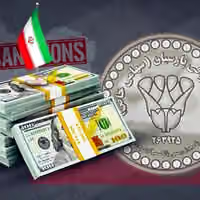
Maleki argues Iran is already inside what he describes as a "tipping zone," where years of inflation, currency depreciation and economic mismanagement have steadily eroded purchasing power.
The question, he says, is no longer simply whether the government can continue paying salaries, but whether those salaries still buy enough to sustain loyalty.
"The salary might keep coming," he said. "You just won't be able to afford very basic needs."
The scale of that pressure is reflected in official consumer-price data.
In June, food and non-alcoholic beverage prices were nearly 134% higher than a year earlier, while prices for oils and fats rose about 278% and meat about 172%, according to data from the Statistical Center of Iran.
Those increases squeeze not only ordinary households, counterterrorism and security specialist Roger Macmillan argues, but also lower-ranking members of the Basij, IRGC conscripts and their families—people drawn from the same society on which the state relies to maintain internal security and suppress dissent.
"The real question isn't how much damage a bomb can do," he said. "It's what happens when the money stops moving."
Iran's financial center of gravity
Military pressure has dominated discussion of Iran for months, with much of the debate centered on missile stockpiles, drone production and how long it might take Tehran to rebuild its military capabilities.
Macmillan argues that focus overlooks something more fundamental.
"They are built to absorb military pressure," he said. "But are they able to absorb payroll pressure?"
His argument is not that economic pressure alone will weaken the regime. Rather, he says policymakers should focus on disrupting the broader financial ecosystem that allows the Islamic Republic to function, from government payrolls to military-linked economic networks.
"We need to be looking at the financial center of gravity, which is not just the payroll but also the military bonyads," he said.
Bonyads are powerful quasi-official foundations that expanded after the 1979 Islamic Revolution, with some of the largest developing extensive holdings in sectors including banking, construction, manufacturing, agriculture and energy.
Major foundations enjoy significant economic privileges and limited public oversight, and several are overseen by or closely connected to institutions under the Supreme Leader.
Some have also served as important patronage networks and maintained extensive economic links with Iran's political and security establishment.
For Macmillan, the question is not simply how much revenue those networks generate. It is whether they can continue supporting rank-and-file security forces if inflation keeps eroding wages while the government takes on the additional burden of rebuilding a post-war economy.
"What we need to look at is how we can remove the will, shatter the cohesion and the will of the foot soldiers from the Basij and from the IRGC, and separate them from the state," he said.
The argument represents a different way of thinking about pressure on Iran.
Rather than asking only how much military capability can be destroyed, Macmillan and Maleki argue policymakers should also consider how much financial strain the Islamic Republic can absorb before maintaining the institutions that enforce its rule becomes increasingly difficult.
Peace itself could reduce some war-related economic pressures, particularly if it improves trade conditions or is accompanied by sanctions relief. But Maleki argues it would also force Tehran to confront accumulated economic problems while meeting the costs of reconstruction.
For him, that may be precisely where the regime is most vulnerable.
"The most punishing thing they can do to this regime is send it back to govern Iran in a state of peace and face the reality they had to kill their way out of," Maleki said.
Paul J. Saunders, President and CEO, Center for the National Interest
Washington likely underestimated Iran’s ability to withstand the initial US-Israeli strikes, making a negotiated settlement harder to achieve and deepening mistrust, foreign-policy expert Paul Saunders told Iran International.
The United States appeared to believe that military force would quickly weaken the Iranian government and compel Tehran to accept an agreement closer to US terms, Paul Saunders, president and CEO of the Center for the National Interest, said in an interview in Washington DC.
“I think the administration probably … overestimated how easy it would be to use force to bring about a successful agreement,” Saunders said.
Washington and Tehran remain divided over efforts to end the conflict, with the Strait of Hormuz at the center of competing military and diplomatic calculations. Recent reports have offered conflicting accounts of whether an agreement to reopen the waterway is imminent.
Strikes complicated diplomacy
“Targeting Iran’s leadership did more than escalate the military campaign,” Saunders said. “It also posed a direct threat to the survival of the Islamic Republic, making it harder for Washington to persuade Tehran to compromise.”
“I think that, from my point of view, it would have been better not to execute the strike on the Iranian leadership,” Saunders said, adding that the decision increased mistrust and left Washington in a weaker position to negotiate after the initial military action.
The US-Iran Memorandum of Understanding, signed in June, was a 14-point interim framework to end hostilities, restore commercial passage through the Strait of Hormuz, remove the US naval blockade and negotiate a final agreement within 60 days.
In July, Iran suspended implementation of its commitments under the MoU, accusing Washington of effectively abandoning its own obligations.
“In order to get a deal, we needed to have a government to negotiate with,” Saunders said. “When that government is really damaged and destabilized … will that new regime be sufficiently powerful that it will be able to make concessions to the United States?”
Trump has described Iran as being under a “third regime,” arguing that successive layers of the country’s leadership were killed in US and Israeli strikes and that the officials now in charge were different and more reasonable than their predecessors.
Iran’s internal response
Saunders said the political effects of the war extended beyond negotiations to Iran’s domestic response. He said it was predictable that Iranian society would rally behind the state when facing an external attack, even if many people remained unhappy with their government.
“Regardless of how angry or frustrated people might be with their own government, the only thing that they actually want less than their own government interfering in their lives … is someone else’s government doing it,” Saunders said.
“The Iranian government is responding to a threat to its survival, while Iranian society is reacting to an external attack. At the same time, the US president and the American public are weighing how much risk and cost the conflict justifies,” he added.
The conflict is important to Washington but not existential for the United States, Saunders said. He added that the administration had shown sensitivity to growing public concern over the costs of continuing the campaign.
Hormuz remains central
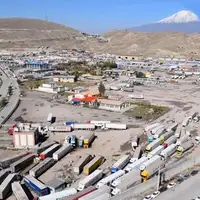
The Strait of Hormuz remains central to Iran’s leverage and to efforts to end the conflict. Commercial traffic through the waterway has fallen sharply, while Iran is also bearing substantial economic costs from the disruption.
Saunders said traders had so far expected the strait to reopen, limiting the immediate impact on global oil prices. But he warned that the economic consequences could become far more serious if the disruption persisted and refiners were forced to adapt to reduced supplies.
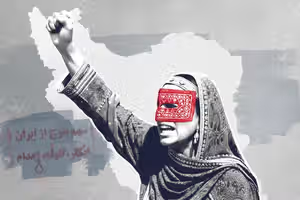
Iranian hardliners are intensifying pressure on authorities to enforce compulsory hijab, as recent cafe closures and online campaigns raise fears of a renewed crackdown despite widespread defiance of the dress code.
Last week, hardline lawmaker Mohammad Naghd-Ali told parliament that another member had told him he cries after every parliamentary session because of the current state of women's dress.
Naghd-Ali fiercely criticized President Masoud Pezeshkian's administration for refusing to implement the controversial hijab law approved in 2024, saying the government was allowing what he described as "nudity” and “immorality" to spread.
Although the new legislation was finalized in 2024, its implementation has been suspended following a decision by the Supreme National Security Council, reportedly out of concern that enforcing it could trigger unrest similar to the nationwide protests that erupted after Mahsa Amini's death in 2022.
Existing compulsory-hijab rules, however, remain legally in force.
Hardline activists have likewise blamed Pezeshkian for what they portray as the country's cultural decline.
"If Pezeshkian's incompetent and secular government continues for another two years, even today's level of dress will become something people long for," conservative commentator Hassan Abbasi wrote on social media. "Pezeshkian is standing against God's command on hijab and wants to return Iran's cultural climate to the Pahlavi era."
Social media campaign seeks broader crackdown
Hardline activists have also intensified an online campaign demanding tougher enforcement.
In recent days they have circulated videos showing unveiled women in tight-fitting sleeveless tops serving customers at a well-known restaurant in Tehran—scenes that would have been almost unimaginable in the capital and other cities until only a few years ago. Such activists frequently describe these styles as "nudity" or "body display."
One hardline X user, allegedly tied to a state institution, wrote: "The first step in confronting unveiled women is confronting cafes and establishments that violate social norms." According to the post, enforcement is currently focused mainly outside Tehran but will gradually expand across the capital.
Hardline journalist Fereshteh Sadeghi similarly shared a photograph of an unveiled woman shopping outside Tehran and criticized those arguing that hijab should not be discussed while the country faces broader security challenges.
"They tell us not to talk about hijab in the middle of a war and not even to take pictures. Then when are we allowed to speak?" she wrote.
Yet Sadeghi also acknowledged the state's failure to restore widespread headscarf compliance.
"The battle to force the hijab back onto women is over; you can't force the hijab on their heads," she wrote in another post, while arguing that authorities should at least establish dress regulations to prevent what she called "body display."
Hijab as a political symbol
For many hardliners, compulsory hijab is not only a religious obligation but also a defining political symbol of the Islamic Republic.
"Hijab is the flag of Islam. Muslim society is recognized through hijab," conservative social media activist Alireza Akbari wrote.
Supporters of compulsory veiling frequently cite a ruling by Supreme Leader Ali Khamenei, who described unveiling as forbidden both religiously and politically.
Journalist Mehrdad Khadir argued in an article published by Asr-e Iran that women's dress is no longer among the public's primary concerns.
"The way women and girls dress is not a concern for the majority of people," he wrote. "The face of the city has changed, and it will not return to what it once was."
According to Khadir, the country's real concerns are the threat of war and the collapse in living standards.
"In the current circumstances," he wrote, "it is unlikely—indeed impossible—that the authorities would surrender their judgment to those tears and turn an issue that has effectively been settled back into a national crisis. If there is anything worth crying over, it is the collapse of people's purchasing power."
Resistance through everyday life
Although enforcement has eased in many areas over recent years, critics argue that this should not be mistaken for legal liberalization because compulsory hijab laws remain fully in force even if they are not consistently applied.
The social landscape has nevertheless changed dramatically. Many women who continue to wear the hijab have also moved away from the traditional all-black chador and highly conservative appearance. Styles often described online as “hijab style” combine headscarves with colorful clothing, modern designs and fashion accessories.
Hardliners reject these styles as well, arguing that they contradict hijab's original purpose of discouraging attention and preserving modesty.
Opponents of compulsory veiling, meanwhile, say the increasingly visible presence of unveiled women reflects persistence rather than freedom.
"The type of clothing women wear in public still depends on the neighborhood, how they travel, even the day and time," one X user wrote. "The fact that we now see bolder styles is the result of the relentless struggle of brave women who accept the risks of dressing that way. Nothing has actually been liberated."
Dozens of people detained over Iran's January protests remain in a security ward in the country's northwest, with more than half still awaiting hearings or serving prison sentences of up to five years, the US-based Human Rights Activists News Agency (HRANA) reported on Friday.
HRANA said 54 detainees were being held in Ardabil prison, near Iran's border with Azerbaijan. Of those, 25 have been sentenced to between six months and five years and three months in prison, while 29 remain in custody without having had a hearing in their cases.
Among those convicted, Ahmad Seifi received the longest sentence of five years and three months, while Milad Ashkani was sentenced to four years. Three others received sentences of three years and six months, according to HRANA.
Prosecutors seek harsher sentences
An informed source told HRANA that Ardabil prosecutor Jalal Afaghi considered the sentences handed to 10 of those convicted too lenient and had asked Iran's Supreme Court to increase their punishments.
HRANA said full details of the charges, proceedings and courts responsible for the sentences had not been made public.
Some of the detainees have also been denied telephone calls and family visits, while relatives have faced restrictions in seeking information about their cases or requesting temporary release, the rights group said.
Hundreds detained in northwestern province
Around 800 people were arrested in Ardabil province during the January protests, according to HRANA. The group said about 500 were released during the first 10 days and roughly another 250 were later freed after posting bail or other forms of security.
The cases form part of a much broader judicial crackdown following the protests. Rights groups have estimated that more than 60,000 people were detained across Iran, while some independent sources have put the number summoned, detained or interrogated at more than 100,000.
Iranian judiciary spokesman Asghar Jahangir said in February that authorities had issued more than 10,000 orders sending cases for prosecution and around 9,000 indictments against people detained during the unrest.
The report comes amid mounting international concern over prosecutions and executions connected to the protests.
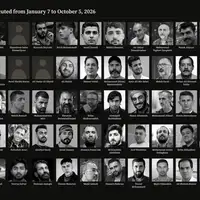
UN human rights chief Volker Türk said this week that Iran had executed at least 56 people on national security-related charges since March 19, including 27 in protest-related cases. He urged Iranian authorities to halt executions and move towards abolishing the death penalty.
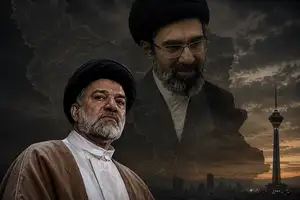
AI-generated illustration depicting Mohammad-Bagher Kharrazi (foreground) and Iran's Supreme Leader Mojtaba Khamenei (background) against a map of Iran and Tehran's skyline.
A cleric tied by marriage to Iran's ruling family has declared the Islamic Republic obsolete, telling followers that a shadow government already exists and urging them to build a 250,000-strong network to replace the system with an "Islamic government."
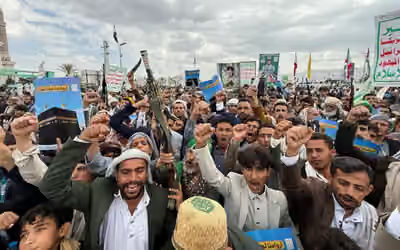
The roughly five-minute video of Mohammad-Bagher Kharrazi, released Wednesday, shows the head of the Hezbollah of Iran organization addressing a religious gathering, the kind of mosque pulpit from which much of Iran's clerical politics is conducted. What he delivered from it was not a sermon but an organizational plan.
"Before Mr. Saeed Jalili ever said 'I make the shadow government,' we had formed the shadow government, and we still have it... We have 60 thick volumes of plans covering the smallest details of every organ and institution," Kharrazi said, brushing aside the hardline politician who popularized the term.
"We have prepared plans for implementing the guardianship system, even for how to convert the Islamic Republic into an Islamic government. We have the organization and the planning. But because this transition has not happened, they are taking the Islamic Republic from us”
The Islamic Republic, he told the crowd, "has reached a stage where, in this form, it simply doesn't work anymore."
The arithmetic of a takeover
What separates the video from ordinary hardline grievance is that Kharrazi laid out numbers, methods and targets.
Each follower, he said, should recruit 17 people, and each of those another 17. "If we do this and organize at least 250 people in every city, with a thousand cities that makes 250,000 people," he said.
He offered to bankroll the first gathering himself, "at Hezbollah's own expense," promised a meeting of one hundred thousand, and told the audience the network would "surround all the ministries." The crowd answered with a salavat, the blessing on the Prophet that in such gatherings signals assent.
At another point he set the threshold at 530 organizers per city, a figure drawn not from arithmetic but from devotion: in the abjad letter-numerology cherished in his circles, he ties the number to the name of Fatemeh, the Prophet's daughter. The two figures do not reconcile, and may not be meant to.
He then described the endgame: "With one announcement, everyone comes to Tehran, and that single announcement will finish the work. Mr. Khamenei and the government must understand that a 250,000-strong organization stands ready to move."
The government of President Masoud Pezeshkian, he assured his listeners, "will not reach its end. Have no doubt."
Contempt for the republic, president by president
Kharrazi's case against the republic half of the Islamic Republic was delivered as a roll call. "Why should Mr. Hashemi win a vote in this country? Why should Mr. Ahmadinejad win a vote in this country? Why should Mr. Rouhani win a vote? Why should Mr. Pezeshkian win a vote?" The list, spanning nearly every president of the past four decades, implied that the office itself, not its occupants, is the error.
For the current occupant he reserved open abuse, calling Pezeshkian "this buffoon" who "understands nothing," and cursing the physician he blamed for promoting him: "God damn the accursed Marandi, Khamenei's doctor, who foisted Pezeshkian on the nation."
He damned the Guardian Council for approving such candidates, a complaint carrying its own footnote: the same council disqualified Kharrazi himself when he tried to run for president in 2013.
The faithful, he complained, have been reduced to carrying other men's loads. "Hezbollahi forces in this country have become pack mules," he said.
"What business do we have being pack mules for Ghalibaf, who understands nothing of the religion of Islam?"
‘Mojtaba is more radical than his father’
The video's most consequential claims concern the man Kharrazi presents as his patron. Describing "forty years of friendship, not mere acquaintance, and numerous private meetings," he told the crowd that the new supreme leader wants what he wants: "Mojtaba's thinking is far more radical than his father's."
He offered what he framed as an insider's history: that Mojtaba Khamenei was cast out of his father's office for three years by its deputy chief of staff, confined to his home and reduced to ferrying intelligence letters, with even some of his circle pushed away.
Kharrazi claimed credit for protecting the movement through that period: "They wanted to tear out Hezbollah by the roots. I did not let them."
None of these accounts can be independently verified, and they describe a man who has not been seen or heard in public since his selection five months ago.
The claims also come with a fresh credibility problem attached. Only days earlier, the leader's office publicly branded Kharrazi's previous quotations of Mojtaba Khamenei, that Pezeshkian's next resignation after 28 attempts would be accepted, as unauthenticated and false, warning that such material "serves the objectives of the ill-wishers and sworn enemies of the Iranian nation." Pezeshkian denied the resignation as well.
Kharrazi's response to that rebuke may be the most revealing sentence he has produced.
In a statement styled like a senior cleric's communique, he said he accepts the denial "out of respect" for the late and current leaders, "but we hope that after the important coming changes in those offices, this denial will still stand."
The changes he has in mind are not abstract. In the same week, Kharrazi announced that the new leader intends to remove Mohammad-Bagher Zolghadr as secretary of the Supreme National Security Council and hand the post to Mohsen Rezaei, his military aide.
"They are going to replace Mr. Zolghadr, and Mr. Mohsen Rezaei will take his place," he said, adding that Foreign Minister Abbas Araghchi has been told he has no right to intervene in the negotiations. A man rebuked for speaking in the leader's name answered by announcing the leader's next appointments.
The family and the record
Kharrazi, 65, is as embedded in the Islamic Republic's aristocracy as a cleric can be. His father, Ayatollah Mohsen Kharrazi, sits in the Assembly of Experts; his uncle, Kamal Kharrazi, ran Iran's diplomacy for years and headed its Strategic Council on Foreign Relations until died from injuries sustained in recent Israeli airstrikes in April; his brother Sadegh is a veteran diplomat; his sister is married to Masoud Khamenei, another of Ali Khamenei's sons.
Reuters has reported that the Nobitex cryptocurrency exchange, sanctioned by Washington for helping the Revolutionary Guards evade sanctions, belongs to the Kharrazi family.
His own record is a catalogue of the spectacular. In his 2013 presidential bid he promised to lift sanctions within months, to recover "the territories separated from Iran," from Tajikistan to Azerbaijan, without a drop of blood, and to triple the value of Iran's crashed currency, vowing to bring the dollar from above 3,000 tomans back down to 1,000.
The Guardian Council struck him from the ballot, and even before it did, the Hezbollah coordination council of East Azarbaijan province publicly disowned his group, accusing him of misusing the movement's name and the leader's, and reminding him that by the leader's own explicit guidance, any private quotation attributed to him is to be considered untrue. Thirteen years later, the leader's office is issuing him the same reminder about a different Khamenei.
In clips that went viral this year, he proposed building a nuclear bomb and detonating it in the Atlantic to send a tsunami toward the American coast, and mused about igniting a race war inside the United States.
He studied under Mohammad-Taghi Mesbah-Yazdi, the late theorist whose school long argued that the republic's elections were a concession to be outgrown, which is to say the manifesto is not his invention, only its loudest current recital.
Three readings of one video
The puzzle is not what Kharrazi said but what it means that he can keep saying it. In a state that imprisons filmmakers and poets for far less, a man has now twice in one week put words in the supreme leader's mouth, insulted the president on camera and announced a plan to encircle the ministries, without a knock on his door.
However it is read, the collision at the heart of the video is documented on both sides. The government's own leaked polling shows a society that has drifted decisively from clerical rule, with barely nine percent wanting things to stay as they are. The loudest organizing energy inside the system, on this week's evidence, wants to move the opposite way.
One reading is that the leader's office will now be forced to do more than issue denials, and that Kharrazi's next video will be his last.
A second is bleaker for the system: that there is no functioning leader capable of silencing anyone, and the in-law is filling a vacuum with his own voice.
A third, voiced in exile commentary, is that Kharrazi is not speaking for the present leadership at all but building a following for the day the question of who leads is reopened, including a future in which his own brother-in-law's household sits closer to the throne.
Under any of the three, the fact stands: five months into the new reign, the most detailed public plan for ending the Islamic Republic has come not from its opponents but from inside its founding family's circle, and it points toward more theocracy, not less.