• العربية
  • فارسی
Brand
  • Iran Insight
  • Politics
  • Economy
  • Analysis
  • Special Report
  • Opinion
  • Podcast
  • Iran Insight
  • Politics
  • Economy
  • Analysis
  • Special Report
  • Opinion
  • Podcast
  • Theme
  • Language
    • العربية
    • فارسی
  • Iran Insight
  • Politics
  • Economy
  • Analysis
  • Special Report
  • Opinion
  • Podcast
All rights reserved for Volant Media UK Limited
volant media logo

US backs Iraq pipeline plans to bypass Hormuz

Jul 17, 2026, 19:24 GMT+1
An Islamic Revolutionary Guard Corps speedboat patrols near a commercial tanker in the Strait of Hormuz in this file photo.

US-backed plans to revive an oil pipeline linking Iraq and Syria have gained new urgency as Iran's closure of the Strait of Hormuz and attacks on shipping disrupt regional exports and drive oil prices higher.

The US State Department on Wednesday welcomed Iraq's and Syria's decision to prioritize reconstruction of the Iraq-Syria crude oil pipeline, describing it as a strategically important regional infrastructure project and backing a US-led international consortium to carry out the technical and financial work.

The department said the rehabilitated pipeline would initially be capable of transporting 2 million barrels of crude per day from Iraq to Mediterranean export markets, calling the announcement "an important milestone" for the region and for relations between Baghdad and Damascus.

The renewed push comes during the US-Iran war, which has sharply reduced traffic through the Strait of Hormuz, a waterway that carried about one-fifth of global oil supplies before the conflict.

US ambassador to Turkey and special envoy for Syria and Iraq Tom Barrack said Iraqi Prime Minister Ali al-Zaidi's plans to develop alternative export corridors were aligned with broader regional efforts involving Syria, Jordan, Turkey, Lebanon and Egypt.

He said the projects could make Hormuz "an afterthought" for Iraq within two years.

Chevron is in advanced discussions with Los Angeles-based TI Capital and Qatar's UCC Holding to form a consortium for a pipeline network linking southern Iraqi oilfields to the Mediterranean through Syria, the Financial Times reported.

The proposed system would include one line running north from southern Iraq toward Kirkuk and another extending west to the Syrian port of Baniyas.

In parallel, Iraq's cabinet has approved preliminary studies of routes from Basra through Haditha to either Baniyas or Turkey's Mediterranean export terminal at Ceyhan. The approvals do not create binding financial or contractual obligations for Iraq's Oil Ministry.

US Representative Joe Wilson, a Republican from South Carolina, praised Barrack's efforts, saying pipelines through Syria and Turkey could help replace export capacity threatened by Iran's actions around Hormuz.

He estimated the broader network could eventually transport 2.5 million barrels per day to the Mediterranean or Turkey and reduce Baghdad's dependence on Tehran.

Oil prices have climbed during the renewed fighting, with Brent crude settling at $88 a barrel on Friday, its highest level in a month.

The proposed routes remain subject to feasibility studies and would face significant financing, construction and security challenges before becoming operational.

Most Viewed

US imposes new Iran sanctions as officials say Hormuz deal is near
1

US imposes new Iran sanctions as officials say Hormuz deal is near

2

Mecca pact ties three Sunni powers together as Iran-backed attacks loom

3
PODCAST

Ending Iran war could expose regime to its greatest threat yet, experts say

4
ANALYSIS

US miscalculated Iran’s resilience and hurt deal prospects, expert says

5
INSIGHT

What the Pentagon learned from the Iran war

Banner
Banner
Banner

Spotlight

  • US miscalculated Iran’s resilience and hurt deal prospects, expert says
    ANALYSIS

    US miscalculated Iran’s resilience and hurt deal prospects, expert says

  • What the Pentagon learned from the Iran war
    INSIGHT

    What the Pentagon learned from the Iran war

  • Iran hardliners push renewed hijab crackdown despite widespread defiance

    Iran hardliners push renewed hijab crackdown despite widespread defiance

  • A Khamenei in-law is openly recruiting to replace the Islamic Republic

    A Khamenei in-law is openly recruiting to replace the Islamic Republic

  • Executions in Isfahan renew calls to end German city partnership

    Executions in Isfahan renew calls to end German city partnership

  • Iran's energy crisis is political, not seasonal
    ANALYSIS

    Iran's energy crisis is political, not seasonal

•
•
•

More Stories

Iran hardliners blamed as cost of US strikes mounts

Jul 17, 2026, 16:04 GMT+1
•
Behrouz Turani
100%
An image released by Iranian media showing a bridge in the Persian Gulf port city of Bandar Khamir, destroyed by US strikes, July 17, 2026

Moderate voices in Iran are sharpening their criticism of hardline calls for continued confrontation with the United States, arguing that diplomacy has become a patriotic necessity as renewed war exacts mounting economic and human costs.

The debate has intensified since Iran targeted a vessel near the Strait of Hormuz last week, prompting a renewed US military campaign that has included days of strikes on ports, bridges, airports and military facilities across Iran’s southern provinces.

Even as US Vice President JD Vance and Iranian Parliament Speaker and chief negotiator Mohammad-Bagher Ghalibaf have continued to defend diplomacy backed by military preparedness, the fighting has persisted and the prospect of a wider conflict has grown.

The criticism has been directed in part at ultrahardline figures such as Qom Seminary Chancellor Alireza Arafi, who has called for further war against the United States and an end to negotiations.

Two recent commentaries—one by former lawmaker and former National Security Committee chairman Heshmatollah Falahatpisheh, the other by political analyst Abdolrahman Fathollahi—reflect the growing push to hold hardliners accountable for the costs of confrontation.

While one focuses on political responsibility for failed diplomacy, the other highlights the burden borne by communities on Iran’s southern frontier.

‘Defeating diplomacy’

Writing in the moderate daily Toseh Irani, Falahatpisheh accused hardline factions of using what he called a distorted interpretation of religion to obstruct diplomatic opportunities.

“I believe part of these two major wars against Iran was the result of this very definition of religious beliefs by extremists, who are now turning to distorting religion to defeat diplomacy,” he wrote.

He argued that the same factions had repeatedly promised better outcomes while blocking agreements that could have reduced tensions.

“They are the exact same people who blocked two good agreements during the major periods of 2021 and 2022, claiming they would forge a better deal,” he wrote. “But in practice, not only was no agreement achieved, but two major wars were imposed on Iran.”

Falahatpisheh called for the prosecution of those he said had turned diplomatic opportunities into military conflict.

‘Patriotism from a safe distance’

A second commentary, published Thursday in Shargh, shifted the focus from political responsibility to the human cost of confrontation.

Under the title The Country’s Future and the Triangle of Extremism, Costs, and Responsibility, Fathollahi warned about the toll of intensifying US airstrikes on Iran’s southern coastal provinces.

He pointed to public campaigns calling for outspoken opponents of negotiations to be sent to the front lines, accusing them of practising what he described as “patriotism from a safe distance.”

“One certainly cannot beat the drums of war from the safe margins of the capital behind podiums, while dumping the costs of those decisions onto the people living in the front lines,” Fathollahi wrote, highlighting the plight of communities bearing the brunt of the fighting over the Strait of Hormuz.

The comments come after a week of US strikes on infrastructure across Iran’s Persian Gulf provinces, where dozens have been killed or injured and many more affected by transport disruption, electricity blackouts and water shortages during the height of summer.

For Fathollahi, the question is no longer simply one of military strategy but whether Iran’s leaders are willing to change course before the costs grow even higher.

“Rethinking certain political approaches and utilizing all expert and diplomatic capacities is not a choice,” he concluded, “but a necessity to safeguard national interests and reduce the costs imposed on society.”

UK outlaws support for IRGC under new national security powers

Jul 17, 2026, 12:02 GMT+1
100%

Britain formally designated Iran’s Islamic Revolutionary Guard Corps as a threat to national security on Friday, making public support for the organization or assistance to it punishable by up to 14 years in prison.

The IRGC was designated alongside the Iran-linked Islamic Movement of Companions of the Right and Russia’s GRU Volunteer Corps, the first organizations placed under powers created by the National Security (State Threats) Act 2026.

The designations took effect on July 17 after Parliament approved an order submitted by Home Secretary Shabana Mahmood four days earlier.

  •  UK says support for Iran's IRGC outlawed under new state threats law

    UK says support for Iran's IRGC outlawed under new state threats law

Under the new law, it is now a criminal offence to express support for the groups, including by glorifying or encouraging activity that threatens the safety of the United Kingdom.

Providing assistance or accepting money or another material benefit from a designated organization can also lead to prosecution. Those convicted could face prison sentences of up to 14 years.

People who commit sabotage, arson or other hostile acts on behalf of the groups could be charged separately under the National Security Act 2023 and face life imprisonment.

The designation is distinct from banning an organization under Britain’s terrorism legislation. It is designed specifically to address hostile activity linked to foreign governments, including espionage, political interference, intimidation, sabotage and physical attacks.

  • Wave of Iran plots drove UK action against IRGC, terror law tsar says

    Wave of Iran plots drove UK action against IRGC, terror law tsar says

The government says the new framework will make it easier to prosecute people working for foreign organizations because prosecutors will not always have to establish a direct connection between an individual act and a foreign government.

Outgoing Prime Minister Keir Starmer said when the measures were announced that Britain would not be allowed to become “a playground for states who want to spread fear, division and violence on our streets.”

“We have already taken tough action against the Iranian regime and those linked to it, and against Russian operatives and networks targeting our country,” he said. “These new powers will make it easier to prosecute and lock up anyone carrying out their dirty work here in Britain.”

The IRGC is one of the Islamic Republic’s most powerful military and political institutions. Its overseas Quds Force oversees Tehran’s relationships with allied armed groups and has been accused by British authorities of directing operations against dissidents, journalists and Jewish or Israeli-linked targets in Europe.

The British government said the Islamic Movement of Companions of the Right had claimed responsibility for seven attacks this year against Persian-language media and locations linked to Jewish and Israeli communities in Britain.

Those incidents included an antisemitic arson attack that damaged four ambulances belonging to the Jewish emergency service Hatzola in Golders Green, north London, on March 23.

British authorities said Quds Force members were behind the organization and had “almost certainly” directed its attacks across Europe. The allegations have not been tested in court.

The government has also cited at least 20 potentially lethal Iranian-backed plots identified by the domestic intelligence agency MI5 over a one-year period.

“Iran and Russia are using proxies and thugs to do their dirty work on our shores,” Mahmood said when she announced the intended designations. “We will find you, and we will lock you up.”

The third designated organization, the GRU Volunteer Corps, is described by Britain as a network controlled by Russian military intelligence that recruits people online to carry out arson, sabotage, harassment and other hostile activity.

Foreign Secretary Yvette Cooper said the use of proxies by Iran and Russia to conduct operations on British soil was “reprehensible.”

The designation marks a significant escalation in Britain’s response to the IRGC. Rather than banning the organization as a terrorist group, the government has created a separate route to prosecute support, recruitment, financing and operational assistance linked to hostile foreign-state activity.

Bridges and military sites hit as US-Iran fighting intensifies in southern Iran

Jul 17, 2026, 08:26 GMT+1
100%
US personnel stand aboard the M/T Wen Yao during a verification boarding in the Gulf of Oman on July 16, in an image released by US Central Command.

The sixth day of fighting since the collapse of the Iran-US ceasefire ended with five bridges hit in southern Iran, US forces turning back three commercial vessels near the Strait of Hormuz, and President Donald Trump declaring that Washington was “winning big in Iran.”

The developments unfolded along three parallel fronts: Iranian attacks on US facilities across the Persian Gulf, continued US strikes inside Iran and an intensifying contest over control of the Strait of Hormuz.

Iran said it launched drone attacks on US facilities in Kuwait and Bahrain early Friday, after a sixth consecutive night of American strikes on Iranian military targets.

Iran’s army said it targeted US force deployment and logistics centers in Kuwait, Iran’s IRGC-affiliated Fars news agency reported.

In Bahrain, the army said it struck US helicopters and reconnaissance aircraft at Sakhir Air Base. Sirens sounded in the country for the second time on Friday, according to the Interior Ministry.

In Qatar, several booms were heard after the government sent a second security alert to mobile phones, Reuters reported. The Defense Ministry said Qatar was intercepting several air attacks, while the Interior Ministry said a child was injured by shrapnel from an intercepted missile.

US Central Command has not confirmed the reported attacks in Kuwait or Bahrain.

At the same time, US forces continued striking targets in southern Iran.

CENTCOM said US fighter jets, drones and warships used precision munitions to hit dozens of military targets, including coastal surveillance and air defense sites, logistics infrastructure and maritime capabilities near Bandar Abbas and on Qeshm Island.

Hamshahri, a newspaper owned by Tehran Municipality, reported that five bridges in Hormozgan province were hit in the latest wave of attacks.

The death toll from strikes on bridges in Bandar Khamir rose to seven, Iran’s IRGC-affiliated Tasnim news agency reported. Iranian media also reported damage to a power substation on Kish Island and attacks on transport infrastructure in Bandar Abbas and Bandar Khamir.

The reports could not be independently verified.

Control over Strait of Hormuz

As the two sides exchanged attacks on land, their confrontation also deepened at sea.

CENTCOM said US forces redirected three commercial vessels attempting to breach the naval blockade against Iran, disabled another that failed to comply with orders and boarded the M/T Wen Yao in the Gulf of Oman to verify compliance.

US Defense Secretary Pete Hegseth shared an image from the boarding and wrote that Iran “does not control” the Strait of Hormuz.

CENTCOM said the strait and surrounding waters remained free and open, except for vessels attempting to violate what it called the US “steel wall” blockade.

Iran’s Revolutionary Guards, however, said Tehran remained in full control of the waterway and would prevent oil and gas exports through it for as long as US attacks continued.

Trump cast the military and maritime operations as signs of US momentum.

“You will see the fruits of that labor very, very shortly,” he said after declaring that Washington was “winning big in Iran.”

The possibility of a wider regional conflict emerged more clearly on Friday, when the Revolutionary Guards said they had struck a US special operations command center in Syria’s al-Tanf region, destroying a radar system and several helicopters and killing US personnel.

US Central Command has not confirmed the report.

As Tehran debates, Iran's south lives the war

Jul 15, 2026, 17:30 GMT+1
•
Behrouz Turani
100%
A screen-grab from a video published by citizen journalist Vahid Online, purporting to show the aftermath of a US strike on Iran's southeastern port city of Chabahar, July 15, 2026

A week of heavy fighting has left parts of Iran’s southern coast looking unmistakably like a war zone. Yet in Tehran, many still struggle to believe the country is at war.

Watching explosions on television and social media from hundreds of kilometers away, many see the confrontation with the United States as another familiar cycle of pressure that may yet give way to negotiations.

Fatemeh Rajabi, the news anchor who first reported the U.S. strikes on ports and military sites in southern Iran on the YouTube program Hasht-e Shab, says many in the capital find it difficult to grasp that a war is unfolding along the northern shores of the Persian Gulf — the region they casually refer to as “down under.”

Reporter Ali Pakzad, who visited the area during the strikes, says missiles hit targets from Abadan near the Iraqi border to Chabahar and Saravan near Pakistan.

He described damaged fishing vessels, battered ports and communities whose livelihoods have been shattered by attacks documented in the program’s footage.

That contrast lies at the heart of an investigative report by journalist Mira Ghorbanifar in Toseh Irani, titled The South in the Fire of War and Ashes of Ceasefire.

Ghorbanifar writes that explosions now puncture the dawn along Iran’s southern coast. Smoke rises from damaged docks, charred dhows lie abandoned, and fish markets once full of noise now speak only of “a war for which no one has yet chosen a definite name.”

While officials speak of “understandings,” “ceasefires” and “crisis management,” she argues, people in Iran’s south are grappling with damaged infrastructure and disrupted shipping, trying to adapt to what increasingly resembles a war of attrition.

She also asks whether the so-called Islamabad Understanding still exists. Is the fighting along Iran’s southern coast part of the same hundred-day conflict, or the start of a new phase of controlled escalation? And can both sides return to negotiations before crossing a point of no return?

The concerns extend well beyond independent journalists.

Government-aligned newspapers have increasingly questioned whether Iran can sustain a prolonged confrontation while struggling to protect civilians and critical infrastructure.

Moderate daily Sharq describes the country’s predicament as “structural and accumulated,” arguing that damaged infrastructure, naval disruption and collapsing logistics have left even minor shocks capable of triggering major crises.

Centrist Etemad warns that public trust has eroded while the state remains unprepared for cascading emergencies.

Economic newspapers have echoed those warnings.

Jahan Sanat argues that Iran’s deterrence is steadily weakening under sustained pressure, while Donya-ye Eghtesad says military decisions are increasingly driven by political necessity rather than strategic advantage, leaving the country more vulnerable in a prolonged conflict.

Washington-based analysts Mohammad Ghaedi and Farzin Nadimi have voiced similar concerns in interviews with Persian-language media abroad.

Ghaedi argues that Iran’s governing system “has repeatedly refused to learn from past mistakes,” pointing to what he sees as a widening disconnect between insulated decision-makers and citizens bearing the costs of conflict.

Nadimi says Iran is confronting the United States at “a moment of maximum structural fragility,” with deterrence eroding and escalation driven more by political necessity than strategic advantage.

“Iran is not in a position to manage a prolonged conflict,” he warns, adding that every new attack “burns away another part of Iran’s deterrent capability.”

Even hardline media have shown hints of concern. Resalat recently urged Iran to “rebuild its defensive capacity” after recent military losses — a rare acknowledgement from a conservative newspaper that the country’s deterrence has been weakened.

For now, the divide remains striking. In Tehran, politicians and commentators continue to debate negotiations, ceasefires and diplomatic understandings.

Along the southern coast, many residents have already stopped asking what to call the conflict. They are simply living through it.

Two Iranians at the World Cup final – and neither represents the Islamic Republic

Jul 15, 2026, 13:27 GMT+1
•
Arash Sohrabi
100%
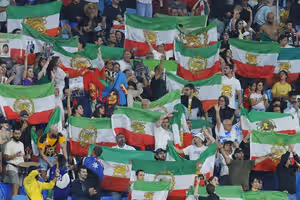
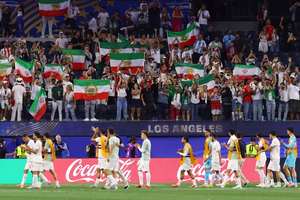
Iranian fans during the Team Melli match against New Zealand at Los Angeles Stadium, Inglewood, California, on June 15, 2026

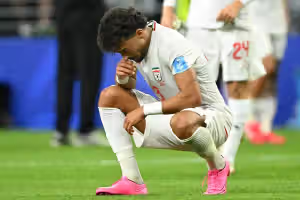
Iran's national team exited the World Cup in the group stage, yet two Iranians may still command Sunday's final: an exiled violinist on the halftime stage and the referee tipped for the whistle. Neither arrives representing the Islamic Republic.

When the whistle blows for halftime at MetLife Stadium on Sunday, July 19, football's first-ever World Cup halftime show will begin – an 11-minute spectacle curated by Coldplay's Chris Martin, headlined by Madonna, Shakira, Justin Bieber, BTS and Burna Boy, with conductor Gustavo Dudamel and the PS22 Chorus.

And if the past week's frenzy in the Persian-speaking world is to be believed, somewhere in that lineup will stand Bijan Mortazavi, the Iranian violin virtuoso, with his famous white violin.

The story first surfaced through Persian-language music outlets, which reported that FIFA had selected Mortazavi for a live performance during the final's interval.

Skepticism followed almost immediately. FIFA's official announcements listed the marquee names but made no mention of the 68-year-old Iranian, and veteran music journalists would only call it the closest rumor to reality.

Then Mortazavi himself all but ended the debate. He posted a photograph alongside Chris Martin and Gustavo Dudamel, describing an "excellent and fruitful" first rehearsal with the New York Philharmonic, an image Coldplay fan accounts quickly carried around the world.

FIFA has yet to publish his name. But artists do not rehearse with the show's musical director and its conductor by accident, and reports say he will perform one of his instrumental works, with a solo passage on the white violin that has been his visual signature for three decades.

The news set Persian social media alight. Posts declaring "It's confirmed" drew hundreds of thousands of views within hours, and the pride quickly turned pointed.

Users contrasted an artist whose albums are still denied release permits inside Iran standing on the world's biggest stage, while the officials who ban his music watch from a country at war and in crisis. Others noted the bitter symmetry: Iran's team went home; Iran's music reached the final.

That symmetry stings because the national team's bond with its own public has frayed. After the side's elimination – three draws in three games – many Iranians described the failure less as a sporting loss than as a verdict on players seen as siding with the government during the nationwide protests, with defender Ramin Rezaeian's name recurring most often.

  • Iran’s lion-and-sun flag at center of FIFA row before 2026 World Cup

    Iran’s lion-and-sun flag at center of FIFA row before 2026 World Cup

  • Iran bows out of World Cup amid flags, Pride and protest

    Iran bows out of World Cup amid flags, Pride and protest

Unlike past tournaments, the matches drew few public gatherings inside Iran, and some openly welcomed the exit. When Shoja Khalilzadeh's late goal against Egypt was ruled offside by five centimeters, users linked it mockingly to his past pledge to dedicate goals to the Supreme Leader.

For millions of Iranians, representation has quietly migrated from the federation's badge to individuals in the diaspora, and Mortazavi embodies that shift.

Born in Sari in 1957, he began violin at three, trained in Tehran under masters including Parviz Yahaghi, and – in a fitting twist – played as a youth goalkeeper, part of Iran's junior national football setup, before music won out.

He left Iran after high school, studied in England, moved to the United States in 1979 and settled in California, where his blend of Persian melody and Western pop made him the best-known Iranian violinist in the world. In 1994 he became the first Iranian artist to headline Los Angeles' Greek Theatre.

  • Can Iranians cheer Team Melli without cheering the state?

    Can Iranians cheer Team Melli without cheering the state?

  • Citizens tell Iran football team it lost the public long ago

    Citizens tell Iran football team it lost the public long ago

He may not be the only Iranian at MetLife on Sunday. Alireza Faghani – born in Kashmar and the first man to referee at four men's World Cups – is widely reported as FIFA's leading candidate to take charge of the final itself.

Faghani left Iran for Australia in 2019, a move linked to his support for the protest movement, and now officiates under the Australian flag. State media in Tehran has attacked him – even censoring footage of him receiving his 2025 Club World Cup final medal – while many Iranians claim him proudly as their own.

No World Cup has ever had a halftime show. Shakira's "Waka Waka" in 2010, Ricky Martin's "La Copa de la Vida" in 1998 and Jung Kook's Qatar 2022 performance all belonged to the ceremonies, never to the final's interval. 

Which means that if Mortazavi walks out on Sunday, he will not just be the first Iranian on a World Cup final stage. He will be part of the first such stage ever built.

  • Thumbs up: Iranian football referee's pose alongside Trump stokes ire

    Thumbs up: Iranian football referee's pose alongside Trump stokes ire

If FIFA's final appointments hold, Sunday could end with an Iranian raising a violin at halftime and another raising the whistle for kickoff – two men who left, on the one stage the country's team could not reach.

Millions inside Iran will likely watch them the way they watch most things now: on any screen but state television's.