• العربية
  • فارسی
Brand
  • Iran Insight
  • Politics
  • Economy
  • Analysis
  • Special Report
  • Opinion
  • Podcast
  • Iran Insight
  • Politics
  • Economy
  • Analysis
  • Special Report
  • Opinion
  • Podcast
  • Theme
  • Language
    • العربية
    • فارسی
  • Iran Insight
  • Politics
  • Economy
  • Analysis
  • Special Report
  • Opinion
  • Podcast
All rights reserved for Volant Media UK Limited
volant media logo

Araghchi congratulates ex-Venezuela envoy to US on foreign minister appointment

Jul 16, 2026, 06:13 GMT+1

Iranian Foreign Minister Abbas Araghchi congratulated Félix Plasencia on Thursday on his appointment as Venezuela’s minister of foreign relations and foreign trade.

Plasencia previously served as Venezuela's representative to the United States.

Araghchi said he hoped the longstanding ties between Iran and Venezuela would deepen during Plasencia’s tenure.

He also thanked outgoing minister Yván Gil for his role in strengthening bilateral relations and wished him success as Venezuela’s new science and technology minister.

Most Viewed

US imposes new Iran sanctions as officials say Hormuz deal is near
1

US imposes new Iran sanctions as officials say Hormuz deal is near

2
PODCAST

Ending Iran war could expose regime to its greatest threat yet, experts say

3

Mecca pact ties three Sunni powers together as Iran-backed attacks loom

4
ANALYSIS

US miscalculated Iran’s resilience and hurt deal prospects, expert says

5
INSIGHT

What the Pentagon learned from the Iran war

Banner
Banner
Banner

Spotlight

  • Iran’s reality TV boom abroad captures a generation in limbo
    ANALYSIS

    Iran’s reality TV boom abroad captures a generation in limbo

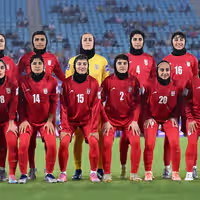
  • What the Islamic Republic does to its women footballers
    ANALYSIS

    What the Islamic Republic does to its women footballers

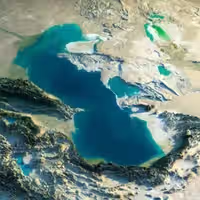
  • Iran moves to ratify Caspian Sea pact with seabed rights still unsettled
    INSIGHT

    Iran moves to ratify Caspian Sea pact with seabed rights still unsettled

  • Ending Iran war could expose regime to its greatest threat yet, experts say
    PODCAST

    Ending Iran war could expose regime to its greatest threat yet, experts say

  • US miscalculated Iran’s resilience and hurt deal prospects, expert says
    ANALYSIS

    US miscalculated Iran’s resilience and hurt deal prospects, expert says

  • What the Pentagon learned from the Iran war
    INSIGHT

    What the Pentagon learned from the Iran war

•
•
•

More Stories

Iran hardliners cry foul as Ghalibaf camp gains ground

Jul 16, 2026, 03:58 GMT+1
•
Maryam Sinaiee
100%
An Iranian lawmaker waves a red flag of 'revenge' during a parliamentary session in Tehran, July 14, 2026

Iran's hardliners suffered a setback after losing key posts on parliament's National Security and Foreign Policy Committee, highlighting growing conservative divisions over talks with Washington and the leadership of Speaker and lead negotiator Mohammad-Bagher Ghalibaf.

Iran's parliament had not held regular public sessions since the outbreak of the recent war, with the suspension reportedly ordered by the Supreme National Security Council.

The legislature reconvened on Monday after briefly meeting in late May to elect its presiding board, when Ghalibaf secured a seventh consecutive term as speaker.

During the committee's internal leadership election on Monday, Mahmoud Nabavian lost his position as first deputy chairman, while Ebrahim Rezaei was removed as spokesperson.

Both are among parliament's most outspoken opponents of engagement with Washington and frequent critics of Ghalibaf.

The outcome shifted the committee's balance toward lawmakers seen as more supportive of diplomacy, triggering an angry reaction from the hardline camp.

The IRGC-affiliated Fars News Agency questioned the legitimacy of the vote on Tuesday, describing the election as "shrouded in ambiguity." It quoted an unnamed committee member as saying a fresh ballot would be held to determine whether Alaeddin Boroujerdi or Ebrahim Azizi would chair the committee.

The reform-leaning Rouydad24 news website described the result as "a sign of a shift in the balance of power in one of parliament's most important committees," saying it was likely to influence parliament's approach to foreign policy and national security in the coming months.

It added that parliament's reopening had restored an important platform for critics of President Masoud Pezeshkian's government and opponents of negotiations with Washington, allowing them once again to use speeches, questioning sessions, impeachment motions and legislative initiatives to challenge government policy.

‘A coup’

Hardline activists have portrayed the parliamentary suspension and committee reshuffle as part of Ghalibaf's effort to sideline the ultraconservative Paydari Front.

Despite its vocal presence, the Paydari Front remains a minority even within the conservative-dominated parliament. In May's election for parliament's presiding board, the faction's candidate received just 29 votes against Ghalibaf's 235.

International relations researcher Abolfazl Bazargan criticized the reshuffle, writing that the committee changes were "not a strategic disaster but a soft coup against the country's security."

The vote also prompted a wave of criticism on social media. One user on X wrote: "Parliament reopened twice—once for him to become speaker again, and once to remove his opponents. You're the dictator."

More say on Hormuz

The committee reshuffle came as lawmakers sought to assert parliament's role in negotiations with Washington and policy toward the Strait of Hormuz.

On Tuesday, parliament received a bill titled the Strategic Action for Ensuring Security and Sustainable Development of the Strait of Hormuz and the Persian Gulf. Backed by 180 of the 290 lawmakers, it would tighten parliamentary oversight of the government's diplomatic decisions.

Lawmakers also called for the immediate establishment of a special committee to review negotiations with the United States and oversee implementation of conditions set by Supreme Leader Mojtaba Khamenei.

Committee chairman Ebrahim Azizi, who retained his post and is regarded as close to Ghalibaf and the traditional conservative camp, defended the initiative on X.

"The Islamic Consultative Assembly stands firm on the country's red lines, especially the management of the Strait of Hormuz," he wrote. "This is only the first step. The next measures will keep our enemies awake at night."

Foreign policy analyst Fereydoun Majles told the Fararu news website that the proposal should be viewed primarily as a political signal.

"The parliamentary initiative should be analysed mainly as a political message," he said. "It seeks to demonstrate that Iran still possesses important geopolitical tools and that regional equations cannot be designed without taking Tehran's interests into account."

"Hard power and soft power complement one another; they are not substitutes," he concluded.

Wave of Iran plots drove UK action against IRGC, terror law tsar says

Jul 15, 2026, 21:04 GMT+1
•
Azadeh Akbari
100%
Members of Iran's Revolutionary Guards Corps (IRGC) march during an annual military parade.

Britain's decision to create a new legal framework targeting Iran's Revolutionary Guards was driven less by political pressure than by the scale of alleged Iranian activity on British soil, according to Jonathan Hall, the UK government's independent reviewer of terrorism laws.

"There’s been a lot of pressure for some time to do something about the activities of the Revolutionary Guard Corps," Jonathan Hall KC told Iran International.

But while political calls to act had grown louder, he said the more important factor was the number of alleged Iranian plots disrupted by Britain's intelligence services and the public concern they generated.

"If you listen to what the director general of MI5 has been saying, there's been an extraordinary number of plots in the last few years that the intelligence services have had to disrupt and deal with," Hall said.

The government says MI5 identified at least 20 potentially lethal Iran-backed plots against people in Britain over the course of a year. It says the IRGC has used proxies and criminal networks to target Iranian dissidents and members of the Jewish community overseas.

Terrorism law 'never suitable'

Hall said the government had wanted to take stronger action against the IRGC but could not simply proscribe it under the Terrorism Act 2000 because the legislation was never designed to apply to the military or intelligence institutions of another state.

"The Terrorism Act was never suitable," Hall said. "It was never designed to deal with state bodies."

The Terrorism Act allows the government to proscribe organizations, making membership and various forms of support criminal offences. Hall said Parliament had never intended those powers to be used against the official institutions of foreign states.

The home secretary commissioned Hall in December 2024 to examine whether Britain's counterterrorism powers could be adapted to address state threats. His review concluded that they could not and instead recommended creating a separate designation regime under national security legislation.

"So rather than proscribing the IRGC or any other state body under the Terrorism Act, there's now a new piece of legislation," he said.

The National Security (State Threats) Act 2026 received royal assent on July 8, amending the National Security Act 2023 to allow the home secretary to designate bodies involved in foreign power threat activity where necessary to protect the UK's safety or interests.

The government laid draft regulations before Parliament on July 13 to designate the IRGC, the Iran-linked Islamic Movement of Companions of the Right and Russia's GRU Volunteer Corps. The House of Commons approved the regulations on Wednesday, while the House of Lords is due to consider them on Thursday.

The designations cannot take effect without the Lords' approval.

Targeting paid proxies

Hall said the primary aim of the new framework is to deter people in Britain from accepting money to conduct surveillance, violence or other activities on behalf of the IRGC.

"We know that the way that the Iranian regime operates in the UK is usually through proxies," he said. "These are individuals obviously willing to take money to carry out certain conduct."

He said the legislation could apply to someone paid to conduct reconnaissance outside the home of a television journalist, follow and stab an Iranian dissident or set fire to a synagogue.

A person could face prosecution if they knew, or should reasonably have known, that their conduct was likely to assist the IRGC.

"It's about credibly saying to people who might take £500, £1,000 or whatever to do that sort of thing: you are at risk of committing a National Security Act offence," Hall said.

"The desire is that people should be deterred. And, of course, if they do carry out that sort of proxy activity, they will then go to prison for a long time and be convicted under an exceptionally serious piece of legislation."

The law creates offences relating to supporting or assisting a designated body, or receiving a material benefit from one, carrying maximum prison terms of 14 years.

People convicted of espionage, sabotage or foreign interference carried out for, on behalf of, or with the intention of benefiting a designated body could face life imprisonment. Prosecutors would also no longer have to establish a separate foreign-power connection in every case.

Conscripts not criminalized

Hall said the legislation deliberately avoids creating a criminal offence of membership in a designated state body, partly to avoid penalizing Iranian men who had to complete military service in IRGC units.

"This conscription point was quite influential on me when I did my analysis," he said.

Hall said membership of a proscribed terrorist organization could be criminalized because an individual generally chooses whether to join or remain in such a group. That approach would be inappropriate for someone compelled to serve in a state institution.

"That obviously wouldn't be right in the case of someone who's got no choice about whether they are a member of a state body," he said.

Asked whether the law could affect Iranian men required to complete military service in IRGC units, Hall replied: "The answer is this law doesn't apply in any way."

Protecting communities targeted by the IRGC

Hall said the new measures are intended to make it riskier for IRGC proxies to target journalists, Iranian dissidents and members of the Jewish community in Britain.

"It's not just about finances," he said. "What it does is it provides a little bit extra."

"From the perspective of journalists and dissidents and Jews in the UK, the point actually is to make it more risky for proxies to act and to make it tougher for them to operate."

Prime Minister Keir Starmer said the government would not allow foreign states to use Britain to spread fear, division and violence, while Home Secretary Shabana Mahmood said the new powers would make it easier to prosecute people carrying out hostile activities on behalf of Iran, Russia and other foreign actors.

The government has cited alleged IRGC-linked plots targeting two Iran International journalists in Britain as an example of the activity the new framework is intended to address.

It also says the Islamic Movement of Companions of the Right claimed responsibility for seven attacks against sites linked to Jewish and Israeli communities and Persian-language media between March and May, with members of the IRGC's Quds Force "almost certainly" directing the group's activities across Europe.

For Hall, however, the legislation's purpose is ultimately straightforward: to close a gap in British law by giving authorities a tool specifically designed to tackle hostile state organizations—something he says terrorism legislation was never intended to do.

As Tehran debates, Iran's south lives the war

Jul 15, 2026, 17:30 GMT+1
•
Behrouz Turani
100%
A screen-grab from a video published by citizen journalist Vahid Online, purporting to show the aftermath of a US strike on Iran's southeastern port city of Chabahar, July 15, 2026

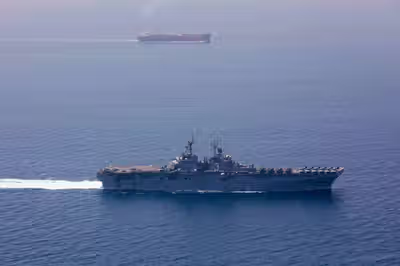
A week of heavy fighting has left parts of Iran’s southern coast looking unmistakably like a war zone. Yet in Tehran, many still struggle to believe the country is at war.

Watching explosions on television and social media from hundreds of kilometers away, many see the confrontation with the United States as another familiar cycle of pressure that may yet give way to negotiations.

Fatemeh Rajabi, the news anchor who first reported the U.S. strikes on ports and military sites in southern Iran on the YouTube program Hasht-e Shab, says many in the capital find it difficult to grasp that a war is unfolding along the northern shores of the Persian Gulf — the region they casually refer to as “down under.”

Reporter Ali Pakzad, who visited the area during the strikes, says missiles hit targets from Abadan near the Iraqi border to Chabahar and Saravan near Pakistan.

He described damaged fishing vessels, battered ports and communities whose livelihoods have been shattered by attacks documented in the program’s footage.

That contrast lies at the heart of an investigative report by journalist Mira Ghorbanifar in Toseh Irani, titled The South in the Fire of War and Ashes of Ceasefire.

Ghorbanifar writes that explosions now puncture the dawn along Iran’s southern coast. Smoke rises from damaged docks, charred dhows lie abandoned, and fish markets once full of noise now speak only of “a war for which no one has yet chosen a definite name.”

While officials speak of “understandings,” “ceasefires” and “crisis management,” she argues, people in Iran’s south are grappling with damaged infrastructure and disrupted shipping, trying to adapt to what increasingly resembles a war of attrition.

She also asks whether the so-called Islamabad Understanding still exists. Is the fighting along Iran’s southern coast part of the same hundred-day conflict, or the start of a new phase of controlled escalation? And can both sides return to negotiations before crossing a point of no return?

The concerns extend well beyond independent journalists.

Government-aligned newspapers have increasingly questioned whether Iran can sustain a prolonged confrontation while struggling to protect civilians and critical infrastructure.

Moderate daily Sharq describes the country’s predicament as “structural and accumulated,” arguing that damaged infrastructure, naval disruption and collapsing logistics have left even minor shocks capable of triggering major crises.

Centrist Etemad warns that public trust has eroded while the state remains unprepared for cascading emergencies.

Economic newspapers have echoed those warnings.

Jahan Sanat argues that Iran’s deterrence is steadily weakening under sustained pressure, while Donya-ye Eghtesad says military decisions are increasingly driven by political necessity rather than strategic advantage, leaving the country more vulnerable in a prolonged conflict.

Washington-based analysts Mohammad Ghaedi and Farzin Nadimi have voiced similar concerns in interviews with Persian-language media abroad.

Ghaedi argues that Iran’s governing system “has repeatedly refused to learn from past mistakes,” pointing to what he sees as a widening disconnect between insulated decision-makers and citizens bearing the costs of conflict.

Nadimi says Iran is confronting the United States at “a moment of maximum structural fragility,” with deterrence eroding and escalation driven more by political necessity than strategic advantage.

“Iran is not in a position to manage a prolonged conflict,” he warns, adding that every new attack “burns away another part of Iran’s deterrent capability.”

Even hardline media have shown hints of concern. Resalat recently urged Iran to “rebuild its defensive capacity” after recent military losses — a rare acknowledgement from a conservative newspaper that the country’s deterrence has been weakened.

For now, the divide remains striking. In Tehran, politicians and commentators continue to debate negotiations, ceasefires and diplomatic understandings.

Along the southern coast, many residents have already stopped asking what to call the conflict. They are simply living through it.

Two Iranians at the World Cup final – and neither represents the Islamic Republic

Jul 15, 2026, 13:27 GMT+1
•
Arash Sohrabi
100%
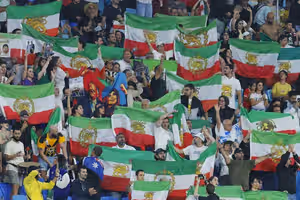
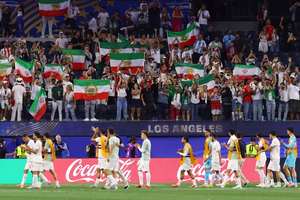
Iranian fans during the Team Melli match against New Zealand at Los Angeles Stadium, Inglewood, California, on June 15, 2026

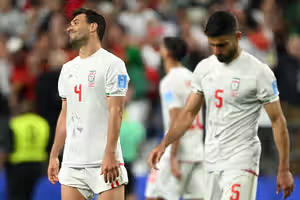
Iran's national team exited the World Cup in the group stage, yet two Iranians may still command Sunday's final: an exiled violinist on the halftime stage and the referee tipped for the whistle. Neither arrives representing the Islamic Republic.

When the whistle blows for halftime at MetLife Stadium on Sunday, July 19, football's first-ever World Cup halftime show will begin – an 11-minute spectacle curated by Coldplay's Chris Martin, headlined by Madonna, Shakira, Justin Bieber, BTS and Burna Boy, with conductor Gustavo Dudamel and the PS22 Chorus.

And if the past week's frenzy in the Persian-speaking world is to be believed, somewhere in that lineup will stand Bijan Mortazavi, the Iranian violin virtuoso, with his famous white violin.

The story first surfaced through Persian-language music outlets, which reported that FIFA had selected Mortazavi for a live performance during the final's interval.

Skepticism followed almost immediately. FIFA's official announcements listed the marquee names but made no mention of the 68-year-old Iranian, and veteran music journalists would only call it the closest rumor to reality.

Then Mortazavi himself all but ended the debate. He posted a photograph alongside Chris Martin and Gustavo Dudamel, describing an "excellent and fruitful" first rehearsal with the New York Philharmonic, an image Coldplay fan accounts quickly carried around the world.

FIFA has yet to publish his name. But artists do not rehearse with the show's musical director and its conductor by accident, and reports say he will perform one of his instrumental works, with a solo passage on the white violin that has been his visual signature for three decades.

The news set Persian social media alight. Posts declaring "It's confirmed" drew hundreds of thousands of views within hours, and the pride quickly turned pointed.

Users contrasted an artist whose albums are still denied release permits inside Iran standing on the world's biggest stage, while the officials who ban his music watch from a country at war and in crisis. Others noted the bitter symmetry: Iran's team went home; Iran's music reached the final.

That symmetry stings because the national team's bond with its own public has frayed. After the side's elimination – three draws in three games – many Iranians described the failure less as a sporting loss than as a verdict on players seen as siding with the government during the nationwide protests, with defender Ramin Rezaeian's name recurring most often.

  • Iran’s lion-and-sun flag at center of FIFA row before 2026 World Cup

    Iran’s lion-and-sun flag at center of FIFA row before 2026 World Cup

  • Iran bows out of World Cup amid flags, Pride and protest

    Iran bows out of World Cup amid flags, Pride and protest

Unlike past tournaments, the matches drew few public gatherings inside Iran, and some openly welcomed the exit. When Shoja Khalilzadeh's late goal against Egypt was ruled offside by five centimeters, users linked it mockingly to his past pledge to dedicate goals to the Supreme Leader.

For millions of Iranians, representation has quietly migrated from the federation's badge to individuals in the diaspora, and Mortazavi embodies that shift.

Born in Sari in 1957, he began violin at three, trained in Tehran under masters including Parviz Yahaghi, and – in a fitting twist – played as a youth goalkeeper, part of Iran's junior national football setup, before music won out.

He left Iran after high school, studied in England, moved to the United States in 1979 and settled in California, where his blend of Persian melody and Western pop made him the best-known Iranian violinist in the world. In 1994 he became the first Iranian artist to headline Los Angeles' Greek Theatre.

  • Can Iranians cheer Team Melli without cheering the state?

    Can Iranians cheer Team Melli without cheering the state?

  • Citizens tell Iran football team it lost the public long ago

    Citizens tell Iran football team it lost the public long ago

He may not be the only Iranian at MetLife on Sunday. Alireza Faghani – born in Kashmar and the first man to referee at four men's World Cups – is widely reported as FIFA's leading candidate to take charge of the final itself.

Faghani left Iran for Australia in 2019, a move linked to his support for the protest movement, and now officiates under the Australian flag. State media in Tehran has attacked him – even censoring footage of him receiving his 2025 Club World Cup final medal – while many Iranians claim him proudly as their own.

No World Cup has ever had a halftime show. Shakira's "Waka Waka" in 2010, Ricky Martin's "La Copa de la Vida" in 1998 and Jung Kook's Qatar 2022 performance all belonged to the ceremonies, never to the final's interval. 

Which means that if Mortazavi walks out on Sunday, he will not just be the first Iranian on a World Cup final stage. He will be part of the first such stage ever built.

  • Thumbs up: Iranian football referee's pose alongside Trump stokes ire

    Thumbs up: Iranian football referee's pose alongside Trump stokes ire

If FIFA's final appointments hold, Sunday could end with an Iranian raising a violin at halftime and another raising the whistle for kickoff – two men who left, on the one stage the country's team could not reach.

Millions inside Iran will likely watch them the way they watch most things now: on any screen but state television's.

Iran parliament probes favoritism in $55 million medical-import allocation

Jul 15, 2026, 11:13 GMT+1
100%

Iran’s parliamentary health committee is investigating the allocation of $55 million in subsidized foreign currency to one importer of hip and knee implants, after its chairman said much of the equipment went to private hospitals and a small group of surgeons.

Hossein-Ali Shahriari told the ILNA news agency that the company, which he did not identify, imports implants made by US medical-device manufacturer Zimmer. He said it received about $37 million at the heavily subsidized rate of 42,000 rials to the dollar in the Iranian year ending March 2025, followed by another $18 million at 285,000 rials per dollar in the following year.

  • Drug prices jump up to 400% as shortages strain Iranian pharmacies

    Drug prices jump up to 400% as shortages strain Iranian pharmacies

  • Iran’s legal drug market is being hollowed out as shortages feed illicit channels

    Iran’s legal drug market is being hollowed out as shortages feed illicit channels

  • AI self-diagnosis rises in Iran as healthcare costs drive patients online

    AI self-diagnosis rises in Iran as healthcare costs drive patients online

Both rates were far more favorable than those available on Iran’s open currency market, giving importers access to dollars at a fraction of their market cost. For comparison, the dollar trades at about 1,875,000 rials on Iran’s open market today. Average monthly income in Iran is about $150.

Shahriari said the committee had received complaints from across Iran about shortages of knee and hip implants in public hospitals. It has sought records from the Central Bank and the Food and Drug Administration to determine which companies received subsidized currency and what happened to the imported equipment.

According to figures cited by Shahriari, 73% of the implants distributed in Tehran went to private hospitals. He also reported sharply unequal distribution outside the capital, with some provinces receiving only a fraction of the supply.

Patients in several provinces were required to pay money directly before company representatives would provide an implant, he said.  “Why should people have to pay hundreds of millions, which many of them cannot afford, leaving them either to die or to sell their homes and cars for treatment?” Shahriari said.

  • Inside Iran’s maze of multiple exchange rates

    Inside Iran’s maze of multiple exchange rates

He called on the judiciary, the national inspectorate and intelligence and oversight agencies to examine the company’s previous currency allocations, arguing that the scale of the case suggested a wider network rather than the actions of one person.

Shahriari did not provide evidence establishing criminal wrongdoing, and the importer was not named in the interview. No response from the company or Iran’s Food and Drug Administration was included in the ILNA report.

The allegations point to a recurring problem in Iran’s multiple-exchange-rate system. Preferential dollars were intended to keep medicines and medical equipment affordable, but the gap between subsidized and market rates created lucrative opportunities for intermediaries. President Masoud Pezeshkian acknowledged the problem in January, saying recipients of dollars at the 285,000-rial rate had “pocketed” the benefit rather than passing it to consumers.

The dispute comes during a broader healthcare crisis. People in Iran have sent messages to Iran International about severe medicine shortages, delays in foreign-currency allocations and price increases of up to 400% for some drugs, pushing more patients toward unaffordable or illicit sources.