The latest incident highlighted the central place of the strategic waterway in the de-escalation agreement, with Iran tightening its warnings to shipping while the United States and Perisan Gulf Arab states insisted any lasting arrangement must guarantee freedom of navigation.
The UK Maritime Trade Operations said the vessel was hit on its starboard side at 2:10 p.m. UTC about 7.5 nautical miles southeast of Dahit, Oman, damaging its bridge. The ship's master reported that all crew were safe and there was no environmental damage.
The Wall Street Journal, citing two senior US officials, reported that Iran's Revolutionary Guards attacked the Singapore-flagged cargo ship in the Strait of Hormuz.
The incident was followed by a warning by Iran's Persian Gulf Strait Authority that vessels using routes outside its designated framework would not be covered by safe-passage guarantees, insurance protections or related liability arrangements.
"Any consequences arising from unauthorized routing shall be the sole responsibility of the vessel owner, charterer, and master," the authority said on X.
IRGC-affiliated outlets also reported that three tankers attempting to pass through a US-declared corridor in Omani waters turned back after receiving warnings from the Revolutionary Guards.
The vessels were identified as the UAE-owned Blue Star I, Japan's Azumasan and the Japan-managed Omega Trader.
The attack prompted the International Maritime Organization to temporarily suspend its evacuation operation for ships in the Persian Gulf, saying it needed to reassess safety guarantees before continuing.
IMO Secretary-General Arsenio Dominguez said the pause was intended "to reconfirm that the necessary safety guarantees continue to be in place for the ships on our evacuation list and all those in the region."
The developments came as US Secretary of State Marco Rubio and GCC foreign ministers met in Manama and reaffirmed that reopening the Strait of Hormuz to free and unrestricted navigation was essential to regional and global security.
Rubio and GCC foreign ministers said in a joint statement on Thursday that "lasting regional peace and security requires addressing the full spectrum of Iran’s threats, including its ballistic missiles, drones, and support of proxies in the region."
The ministers said any US-Iran de-escalation agreement must guarantee Persian Gulf security and freedom of navigation through the strait. They also rejected any tolls, fees or attempts to assert control over Hormuz, saying transit passage must remain protected under international law.
The GCC added that any regional understanding must take into account the security interests of Persian Gulf states while safeguarding the region's economic and developmental gains.
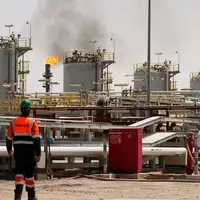
Oil prices rose on Thursday as the latest maritime incident renewed concerns over shipping through one of the world's most important energy corridors.
Brent futures rose just over 2 percent to $75.26 a barrel, according to Reuters, while US West Texas Intermediate rose 2.3 percent to $71.92.