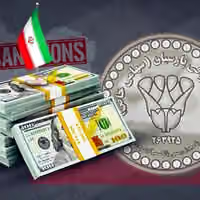
Iranian authorities now face growing public expectations that any diplomatic opening will translate into tangible economic gains. Many hope that sanctions relief or the release of frozen assets will ease financial pressures and improve living standards.
Economists, however, warn that even if restrictions are lifted, the benefits are unlikely to be felt immediately.
The uncertainty has been compounded by the fact that many of the memorandum's economic provisions remain unclear, including the timing and scope of any sanctions relief or asset releases.
According to a recent survey cited by Deputy Interior Minister Mohammad Bathaei during a press conference this week, 60% of respondents said they could no longer tolerate additional economic pressure.
Economist Khalil Janami wrote in Khabar Online that “the real achievement of diplomacy only becomes meaningful when people feel its results in their livelihoods, employment opportunities, and quality of life.”
Economy Minister Ali Madanizadeh also cautioned Thursday that an agreement with Washington would not return Iran's economy to normal conditions overnight.
Discussing government finances, he said Iran had already faced a budget deficit of several hundred trillion tomans before the war and that conditions have since worsened. He said the government also borrowed 100 trillion tomans from the Central Bank after the conflict, with the inflationary consequences likely to become visible in the coming months.
Analysts say Iran's economic challenges—including high inflation, unemployment and years of stagnation—are structural problems that cannot be resolved quickly through a political agreement.
Working people under pressure
Workers have been among the hardest hit by Iran's prolonged economic crisis. In recent years, wage increases have consistently failed to keep pace with inflation, steadily eroding purchasing power.
The Iranian Labour News Agency (ILNA) recently reported that a worker's daily wage after eight hours of work is not enough to buy even 250 grams of red meat. The agency said many workers struggle to cover basic living expenses even when taking on overtime shifts.
Citizen reports received by Iran International indicate that layoffs and delays in wage payments continue in some sectors. Some people approved for unemployment benefits earlier this year say they have yet to receive any payments.
The middle class has also seen its financial position deteriorate. Families that once had the ability to save, buy homes and plan for the future have increasingly been forced to cut both essential and discretionary spending.
Some economists describe the trend as the gradual erosion of the middle class.
Eroding living standards
In May, Iranian families paid nearly 84% more than a year earlier for the same basket of goods and services.
For many households, food prices remain the most immediate concern.
Official figures from the Statistical Center of Iran show that year-on-year inflation for food and beverages reached 130% in the month ending in May. Annual food inflation also climbed to around 83%, up from roughly 75% in April.
Economist Morteza Afghah told Fararu that families are increasingly under pressure as inflation outpaces wage growth.
“Food has not been completely removed from household shopping baskets,” he said, “but nutritious and valuable items are being replaced with low-quality foods that simply fill the stomach.”
He added that lower-income groups, already spending nearly all of their income on essential goods, would face even greater hardship as inflation intensified.
Skepticism and hope online
The prospect of improved relations with Washington has prompted a wave of reactions on social media, where users expressed a mix of optimism and doubt.
Iranian journalist Azadeh Mokhtari wrote on X: “The military war between Iran and the United States has, at least for now, come to an end. But real victory will be felt when the war against inflation begins and ends with its defeat.”
She added: “People feel relieved when the sound of explosions stops, but they become happy when rising prices end. Today is the time to defeat inflation and control prices.”
Another user, Amir, welcomed the memorandum and expressed hope it would lead to a formal agreement, while lamenting the economic damage, job losses and destruction caused by the conflict.
Others remained unconvinced.
One user wrote: “Based on my limited experience, I highly doubt that signing an agreement will have even a small effect on people's lives. Rest assured, this agreement will not fill people's tables either.”