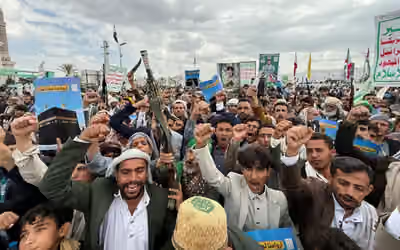
Pro-government "janfada" volunteers' motorcycle parade in Tehran on May 22.
What began as street mourning for Ali Khamenei has become a nightly stage for Iran’s hardliners to attack negotiations with Washington, promote wartime defiance and pressure officials to follow the Supreme Leader’s red lines.
Many of the nightly gatherings – known in Iran’s political and media sphere simply as “the street” – began as collective mourning ceremonies for Supreme Leader Ali Khamenei, who was killed, in squares and streets across Iranian cities before gradually evolving into highly organized political events.
Speakers, most of them from the hardline camp, describe Iran as the victor of the war and oppose negotiations with the United States in many of these events.
The rallies were initially large, but as their rhetoric became more radical attendance gradually declined. Witnesses say most now attract between 100 and 200 people at a time.
Slogans and placards at the anti-negotiation rallies focus on “fully observing the leader’s conditions” and avenging Ali Khamenei and others killed in US and Israeli attacks.
Speakers have branded not only moderates such as former Foreign Minister Mohammad-Javad Zarif but also some conservatives, including Mohammad-Bagher Ghalibaf, head of the negotiating team and an ally of President Masoud Pezeshkian, as “advocates of surrender.”
Social media users say those who favor negotiations and an end to the war do not feel safe attending the rallies or expressing their views there.
The hardline outlet Raja News recently wrote: “The experience of the negotiating team’s mistakes in the Islamabad talks, and the (current) Supreme Leader’s wise decision to halt that flawed process, proved that not ‘unconditional support for negotiators’ but ‘standing firm on the Supreme Leader’s conditions and red lines’ is the people’s primary duty in the arena.”
Amir-Hossein Sabeti, a hardline member of parliament who frequently attends and speaks at the rallies, dismissed negotiations with the United States as futile in a Telegram post on Wednesday.
“The continuation of public gatherings in the streets and demands on officials to preserve the Supreme Leader’s red lines will certainly be influential and will affect officials’ decisions,” he wrote.
He added that lawmakers appear in squares and streets to voice “the people’s demands and the Supreme Leader’s red lines so that no one can easily act against them.”
Journalist Saeed Maleki, reacting to the burning of an effigy of Zarif at one rally in the city of Gorgan earlier this week, described the act as an attempt to break national unity and deepen social divisions.
“How long are we supposed to tolerate this small minority in the streets? If Zarif has committed treason, deal with him. And if he hasn’t, confront this minority before another sedition erupts,” he wrote.
Political analyst Ruhollah Rahimpour told Iran International television that empty streets during a crisis create “a sense of fear and anticipation of disaster.” For that reason, he said, the Islamic Republic attempts to fill public spaces with ceremonies that project a narrative of power.
State media promotion
Television channels run by Iran’s state broadcaster, which is largely controlled by hardliners, have extensively covered the rallies and promoted attendance.
Even so, Mohammad-Hossein Kashkouli, director of Ofogh TV, recently said during a speech at one gathering that the broadcaster was under pressure not to air demonstrators’ slogans and banners.
“Despite the pressure, as long as you remain in the streets, we will stick your placards before their eyes and we will not silence your voices, because the Supreme Leader places hope in your voice,” he said. He added that people would remain in the streets until the Leader himself asked them to leave.
Emphasis on diversity among participants
State and pro-government media have repeatedly emphasized the diversity of participants at the rallies. If a participant appears with looser hijab or an appearance outside the conventional image of government supporters, photos and videos of them are widely circulated.
Images from the gatherings show women and girls without hijab, or wearing forms of hijab that would not normally be accepted in government offices, chanting slogans, waving Islamic Republic flags and even participating in motorcycle parades — despite the government still refusing to issue motorcycle licenses to women.
Many social media users argue that this tolerance reflects not a genuine policy shift but hypocrisy.
Carnival atmosphere
Especially after the ceasefire, many of the gatherings have taken on a carnival-like atmosphere, with families attending alongside children.
Booths and tents set up around streets and squares distribute balloons, ice cream and snacks, reportedly funded voluntarily by participants. Missile mock-ups displayed to attract children are sometimes painted pink. Children’s war-themed drawing activities are also organized.
Since the ceasefire, wedding ceremonies have also become common at the rallies. Clerics perform marriage ceremonies before crowds of spectators. One event in Tehran’s Imam Hossein Square, where 110 couples were married, was broadcast on television.
Weapons training
Recently, some rallies have also included firearms training for participants, including children.
One citizen, in a message sent to Iran International, said: “In Kashan, they’ve set up tents at every intersection and square and are teaching women and children how to shoot and use guns. They are exploiting children who should be kept away from these things.”
The rallies also include registration drives for civilians volunteering to defend the country. Volunteers, both male and female, and of all age groups, are given the title “Janfada,” meaning someone willing to sacrifice their life. State media say there are more than 30 million such volunteers.
Complaints from residents
Many social media users complain about the noise created by participants, who often block streets late into the night with cars and motorcycles while playing religious mourning songs on loudspeakers.
One user on X wrote: “It’s becoming really hard for me to tolerate these flag-waving crowds in the streets. From unnecessary traffic and noise pollution until midnight to the anger caused by discrimination — discrimination in the right to occupy the streets and express opinions, which they enjoy, but not us. For the authorities, we are second-class citizens.”