Iran runs dry as Islamic Republic funds ideology and foreign proxies


Iran’s water crisis is not only about scarcity or drought. It is also about where the Islamic Republic chooses to spend the country’s money, and what it leaves unfunded at home.
Iran’s water crisis is not only about scarcity or drought. It is also about where the Islamic Republic chooses to spend the country’s money, and what it leaves unfunded at home.
In a system where political and ideological objectives consistently outweigh environmental sustainability and public welfare, even severe and widely recognized crises fail to trigger meaningful correction.
In this sense, Iran’s water crisis is not a failure of resources, it is a consequence of deliberate choices. The impact of decades of misguided water engineering and policy decisions is already visible across Iran’s water systems.
Major lakes and wetlands such as Urmia Lake have shrunk. Groundwater has been depleted across more than half of the country’s plains, land subsidence is accelerating, and per capita water availability has fallen to near or below 1,000 cubic meters.
At the same time, access to reliable drinking water has become increasingly uncertain. Water quality is declining because of inadequate wastewater treatment and aging infrastructure, while policy still emphasizes large-scale agricultural self-sufficiency despite mounting environmental constraints.
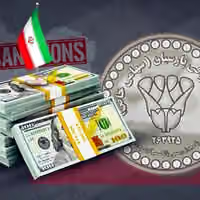
It would be easy to assume that these failures could stem partially from financial limitations. But this is not a story of absolute constraint. Even under sanctions, Iran has continued to generate substantial revenues, particularly from oil exports, over the past decade.
The water crisis is not necessarily due to a lack of resources, but how those resources are allocated. Based on Iran’s FY1404 (2025-2026) public budget, significant funding is still directed toward religious and ideological institutions, amounting to roughly $750 to $860 million annually, depending on exchange rates.
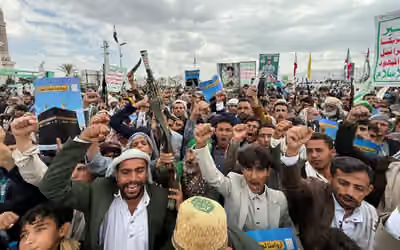
At the same time, Iran’s regional activities, including support for groups such as Hezbollah, Hamas, Palestinian Islamic Jihad, the Houthis, and allied militias, are widely estimated, based on publicly reported figures, to cost an additional $1.1 to $1.5 billion each year.
These estimates reflect direct financial transfers and likely understate total support, which also includes substantial non-cash assistance such as weapons, equipment, and logistical backing.
In total, nearly $1.8 to $2.4 billion per year is allocated to priorities that do little to address Iran’s most urgent domestic challenges. Even redirecting a portion of these resources toward water management and infrastructure could support large-scale, practical solutions. Over a five-year period, such a shift would mobilize roughly $10 billion, enough to move beyond short-term fixes and begin addressing some of the structural drivers of Iran’s water crisis.
Based on order-of-magnitude cost benchmarks for standard water infrastructure projects, a reallocation of roughly $10 billion over five years could finance a coherent national water program. This would include a full-scale effort to reduce water losses in Tehran’s aging distribution network, where non-revenue water (NRW), water lost before it reaches consumers due to leaks, aging infrastructure, and inefficiencies is estimated at roughly 25 to 30 percent.
It could also support the deployment of potable reuse facilities across major urban centers such as Tehran, Mashhad, Isfahan, Shiraz, Yazd, and Ahvaz, helping relieve pressure on overstretched freshwater supplies.
In parallel, a targeted desalination and conveyance package could be implemented for Sistan and Baluchestan province, designed specifically to secure drinking water in a region facing chronic shortages, rather than to support inland agriculture.
Such an investment could also enable the construction of dozens of wastewater treatment plants nationwide, depending on facility size and treatment level, addressing both water quality degradation and reuse potential in regions struggling with untreated discharge.
Beyond urban infrastructure, even limited investments in agriculture could deliver measurable benefits. For example, modernizing irrigation in a single province such as Isfahan, where more efficient systems can reduce water use by roughly 30 to 60 percent, could significantly lower demand in one of Iran’s most water-stressed regions.
Even at the current economic development and growth, over a five-year period, roughly $10 billion directed toward ideological priorities could instead finance a nationwide water recovery program: upgrading Tehran’s water distribution system to reduce losses, building 10 potable reuse facilities for major cities, developing seven coastal desalination plants for southern Iran, and constructing a strategic water transfer system to Zahedan in Sistan and Baluchestan.
It could also fund eight large wastewater treatment plants, dozens of mid-size facilities across the country, and modernize irrigation in Isfahan. Instead, those resources are being directed elsewhere. Now imagine how the country’s water infrastructure can be overhauled if the regime is gone and Iran is back on the path to growth and prosperity, with access to the latest technologies the world has to offer, to tackle this issue.
These figures are illustrative, not precise. They highlight both Iran’s potential capacity to invest in water infrastructure and the scale of resources currently misallocated, without even accounting for additional spending on missile programs, and nuclear development, which further underscores the magnitude of available resources.
Ultimately, the constraint is neither technical nor financial: it is political. As long as the current regime remains in power, resources that could stabilize and modernize Iran’s water systems will continue to be diverted toward non-productive ideological ends.