The hidden target in US war on Iran may be China

Negar Mojtahedi
Iran International

As Washington and Tehran navigate a fragile ceasefire, one of the biggest questions looming over the conflict may not be about Iran at all—but China.
Iran International
As Washington and Tehran navigate a fragile ceasefire, one of the biggest questions looming over the conflict may not be about Iran at all—but China.
Chinese leader Xi Jinping this week publicly called for the Strait of Hormuz to reopen and urged an immediate ceasefire, his clearest intervention yet in the conflict and a sign Beijing is watching events closely.
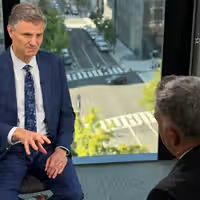
Zineb Zineb Riboua, a research fellow at the Hudson Institute who specializes in Chinese influence in the Middle East and North Africa, told Eye for Iran that the broader significance of Operation Epic Fury—the US campaign against Ira—may lie in weakening China’s strategic position through its deep ties to the Islamic Republic.
“I am in the group of those who think it is about weakening China,” Riboua said. “I don't think the administration says it this way… but I think it's a very important one.”
Beijing forced into the open
For weeks, China had largely avoided direct public comment on the Hormuz crisis despite its dependence on Persian Gulf energy flows.
Riboua said Xi’s sudden remarks reflected Beijing’s anxiety and may also have exposed China’s limited leverage over Tehran.
“For a long time there was this assumption that the United States was in decline,” she said, adding that Xi’s intervention suggests Washington may be “breaking the status quo that benefited China.”
She added that Beijing remains dependent on US positions in the strait and may lack sufficient influence to pressure Tehran directly.
Why Iran matters to China
China remains a major buyer of Iranian crude and has long benefited from Tehran’s isolation.
“China benefited on three fronts,” Riboua said. “The first one is really the oil… It's 90% of Iran’s oil that goes to China and it goes with a discount.”
China is the world’s largest crude importer, bringing in roughly 11 million barrels per day, and is exposed to any disruption in Hormuz, through which about one-fifth of global consumption passes.
Chinese buyers reportedly took more than 80% of Iran’s exported crude in 2025, often at discounts of $8 to $10 below Brent, giving Beijing a valuable cheap supply.
Any prolonged US-Iran standoff or naval blockade in Hormuz could force China to replace cheaper Iranian oil with more expensive alternatives, while higher freight and insurance costs would add further pressure.
Riboua said Iran also serves as a testing ground for sanctions evasion and alternative financial channels.
“What the Islamic Republic was useful for China is really also the sanctions evasion laboratory.”
Chinese-linked networks have used front companies, ship-to-ship transfers, relabeled cargoes and alternative payment channels to keep Iranian oil flowing despite Western restrictions.
‘US trapped in Mideast’
Iran’s efforts to weaponize the Strait of Hormuz may also have hurt one of its own most important partners.
“The Islamic Republic thought that by weaponizing the Strait of Hormuz it could coerce the US president,” Riboua said. “But in the process, they've been hurting China.”
With China heavily reliant on regional energy flows, any prolonged disruption raises the stakes for Beijing.
Riboua argued the wider contest remains centered on Asia.
“You want the Americans to be trapped in the Middle East,” she said. “That’s a perfect scenario when you're thinking about invading Taiwan.”
If Riboua is right, Operation Epic Fury may prove to be more than a campaign to curb Iran. It may mark an early move in a broader contest over China’s reach in the Middle East—and beyond.