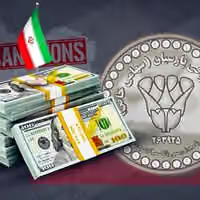
Just before the 12-day war with Israel in June 2025, one dollar traded for around 800,000 rials on Iran’s open market. It now trades at roughly 1,620,000.
The exchange rate has become a blunt signal of economic breakdown, turning the rial into a symbol of dysfunction and accelerating a broader retreat from it as a viable unit for planning daily life.
Policymakers routinely attribute currency surges in Iran to speculation and short-term panic. In reality, the collapse reflects deeper structural imbalances that have pushed the market into a state of chronic disequilibrium.
These pressures fall into two broad categories: chronic domestic problems—persistent budget deficits and a banking system plagued by structural imbalances and quasi-fiscal money creation that drive inflationary pressures—and external shocks, including tightened sanctions, recurring political crises, and the constant threat of war.
Together, these forces transform pessimistic expectations into self-fulfilling inflation.
A failing playbook
Faced with yet another currency crisis, the government has reverted to familiar, largely ineffective tools that may offer brief relief but ultimately deepen instability.
One tactic is “news therapy”—attempts to manage inflationary expectations through signaling and narrative control. Such signals only work when backed by consistent policy, institutional credibility, and public trust.
In Iran, years of broken promises and contradictory actions have eroded that trust, leaving each new round of reassurance less effective than the last.
Officials seek to suppress demand, urging people to “refrain from buying dollars” and insisting that “everything is under control.” But such messages often reinforce pessimism, as an already skeptical public reads them as a warning of further depreciation.
Currency injections—flooding the market to push prices down—have increasingly become a channel for rent distribution and corruption. At best, they buy time at enormous cost. Without addressing root causes, they intensify the recession-inflation cycle and pave the way for sharper future devaluations.
Millions left behind
These currency shocks have devastated daily life for ordinary Iranians, eroding purchasing power and making normal economic planning nearly impossible.
High inflation hits fixed-income households hardest—roughly half of Iran’s workforce—whose wages lag far behind rising prices. Each jump in the dollar translates into lower living standards, pushing millions deeper into economic precarity.
Business owners and large investors, by contrast, are often able to convert assets into more portable stores of value.
Official data point to massive capital flight—around $20 billion in 2024. In the few months prior to the June 2025 war, net outflows reached roughly $9 billion. Given the succession of shocks and Iran’s semi-shutdown state this year, a figure approaching $40 billion for the rest of 2025 appears plausible.
That exodus, in turn, feeds further instability and pushes the dollar higher. In this environment, those lacking the knowledge, access, or means to protect their assets face a growing risk of being left behind.
The specter of dollarization
The rial’s free fall is not merely a temporary crisis; it reflects deep structural failures in Iran’s economy.
Sustainable currency stability would require reforms spanning foreign policy, fiscal discipline, and the restoration of public trust. Instead, Iran’s central bank has shifted away from monetary discipline toward currency-market arbitrage and large-scale gold auctions.
These measures may buy time or temporarily suppress prices, but they contradict basic principles of monetary governance and expose the extent to which the central bank has been reduced to a tool for managing budgetary and political failures.
As trust in the rial as a store of value and unit of account erodes, economic actors will increasingly rely on foreign currencies, further hollowing out the national currency’s role. Without fundamental change, the trajectory points toward dollarization.
For now, the rial’s free fall continues—and Iranian society, especially those least able to adapt, is paying the price of today’s instability and tomorrow’s risk of collapse.