Last week, an international film festival was held in the historic city of Shiraz. To emphasize the festival’s international character, organizers invited one of Turkey’s most acclaimed filmmakers Nuri Bilge Ceylan to head the jury.
The announcement angered hardliners, who framed it as a cultural intrusion. Culture Ministry officials who organized the event did not dare explain the meaning of “international.” Even if they had, few would have listened.
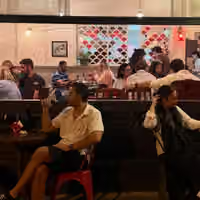
While the festival attempted to celebrate cinematic creativity in a conspicuously muted way—so as not to provide ammunition to political rivals—security forces in Tehran raided a private birthday gathering of Iranian filmmakers and arrested several for drinking.
It was another reminder that even culture, perhaps especially culture, cannot escape the state’s instinctive need to police spontaneity.
On air sagas
That same week, cleric Abdolrahim Soleimani Ardestani sparked outrage during a live debate on a popular YouTube-based platform when he asserted that a Shi'ite Imam was killed by his wife after discovering he had taken a second wife.
Fundamentalists and hardliners swiftly accused him of insulting religious sanctities—an allegation that could carry the death penalty—ultimately forcing him to apologize.
In the same week, a local official in the western province of Kohgiluyeh and Boyer-Ahmad openly questioned President Masoud Pezeshkian’s water policy during a televised event.
Visibly angry, Pezeshkian shouted that the dams in question were not signed off by him. The live broadcast was abruptly cut off when the official produced documents that proved the president wrong.
A mundane administrative event turned combustible in a system where power is perpetually on edge.
Everything—even football
Then came the 2026 World Cup draw in Washington DC, and the saga surrounding entry permits for Iran’s delegation.
Tehran first announced it would boycott the event after the United States issued visas to only four of the nine delegates—a high number, as countries typically send one to four representatives.
After two weeks of heated debate in Tehran, the boycott was abandoned and two delegates were sent to the draw following “consultations with the Foreign Ministry.”
Predictably, no one asked why such consultations had not taken place before the hasty boycott. Nor did anyone question why the federation or government failed to protest the ban on Iranian spectators traveling to the US for the 2026 World Cup.
Sports diplomacy became yet another venue where reflexive posturing overtakes basic competence.
Strange as it may seem, this was simply another ordinary week in Iran—a week where the smallest acts are politicized, the simplest decisions are derailed, and the state’s fear of normalcy turns daily life into a continuous cascade of avoidable crises.