"The JCPOA has not been implemented for seven years, and the European countries halted their obligations after the United States withdrew from the deal," said Kazem Gharibabadi, Iran’s deputy foreign minister for legal and international affairs, in remarks to state news agency IRNA from New York on Tuesday.
"Did they themselves fulfill their commitments under the JCPOA that they now expect the Islamic Republic of Iran to do so?"
Gharibabadi's comments come ahead of a scheduled meeting on Friday in Istanbul between Iranian officials and representatives of the European E3—France, Germany, and the United Kingdom—to discuss recent diplomatic tensions and European statements regarding the activation of the so-called “snapback” mechanism.
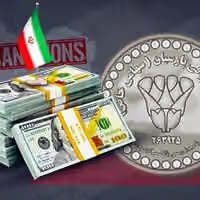
The snapback would restore UN sanctions lifted under the Joint Comprehensive Plan of Action (JCPOA), from which the US unilaterally withdrew in 2018.
'Snapback will complicate nuclear standoff'
Gharibabadi said that reimposing international sanctions on Iran would make the situation over its nuclear program more complex.
“Any move to activate the snapback mechanism and revive terminated Security Council resolutions has no legal basis and will only complicate the situation further,” Gharibabadi said. “The responsibility will lie with the Western parties.”
Speaking about the upcoming Istanbul meeting, Gharibabadi said, “We will discuss diplomatic matters and the snapback mechanism. Of course, we will present our positions. Our goal is to explore what joint solutions we can reach to manage the current situation.”
He described the European effort to reinstate UN sanctions as “an entirely illegal action” with “no legal basis whatsoever.”
According to Gharibabadi, the meeting was arranged following outreach by the foreign ministers of the E3 countries and the High Representative of the European Union for Foreign Affairs Kaja Kalla to Iran’s Foreign Minister Abbas Araghchi.
Iran criticizes UN Security Council
Separately, on Monday in New York, Gharibabadi addressed representatives from UN member states at a closed-door briefing, where he accused the United States and Israel of violating Iran’s sovereignty and threatening global peace.
"Iran has been subjected to aggression by two regimes that possess nuclear weapons. Yet, the United States and its allies have blocked efforts to pass a resolution condemning these acts in the Security Council and the IAEA Board of Governors," Gharibabadi said.
“If the Security Council is unable to fulfill its responsibilities, then which body is accountable for maintaining international peace and security?”
Gharibabadi concluded with a warning about the future of the global non-proliferation regime.
“Does this dangerous silence not send a message to countries like Iran that if you are not a member of the Non-Proliferation Treaty, not only will you not be held accountable, but you may also benefit from immunity and privileges?”
The JCPOA, signed in 2015, offered Iran sanctions relief in exchange for limits on its nuclear program. The US withdrawal under former President Donald Trump in 2018 triggered a gradual unraveling of the deal, with Iran scaling back its commitments and European parties failing to deliver promised economic benefits.