Tanker tracking firms and energy consultants report a steady decline in Iran’s oil exports as top customer China eases buying and a second Trump administration looms.
The exports fell from over 1.8 million barrels per day (mb/d) in September to 1.5 mb/d in October, and further to 1.3 mb/d in November.
It comes amid a gradual shutdown of small independent Chinese refineries, known as "teapots," which are Iran's main oil buyers in China, and have been critical for Iranian oil sales amid US sanctions that target third parties for buying Iranian oil.
China accounts for 95% of Iran's oil exports, but it does not purchase the oil directly. Instead, small independent refineries buy Iranian oil after it is blended with crude from other countries, ensuring it is not labeled as Iranian by Chinese customs, in order to comply with sanctions against Iran.
China has opted to gradually phase out teapot refineries due to their low efficiency and significant environmental impact. They convert a large portion of crude oil into pollutants like fuel oil, which contributes heavily to air pollution.
In September, a Chinese court declared two refineries, Zhenghe and Huaxing, bankrupt. Reuters also reported in early November that teapots are now operating at half capacity.
For years, these refineries relied on 15-30% discounts from Iran, Russia and Venezuela to stay afloat. However, Iran reduced these discounts to $5-7 per barrel in October and $3-5 per barrel last month, according to industry sources who spoke with Iran International.
Ship-to-ship oil transfer aimed at blending crude and hiding the source of the oil.
These refineries typically delay payments for Iranian oil by at least three months, raising concerns about their ability to settle debts amid looming bankruptcies. Meanwhile, Russia has also scaled back discounts to Chinese buyers as it secures a stable customer base, possibly prompting Iran to reevaluate its competitive pricing strategy.
Shrinking market opportunities in China
Homayoun Falakshahi, a senior analyst at Kpler, told Iran International that China’s oil market is saturated, and demand is unlikely to grow further. He emphasized that even if the teapots avoid bankruptcy, China will gradually phase them out due to their environmental impact.
He said Iran has delivered only 1.33 mb/d of crude oil to China in November, 500,000 b/d less than the September level.
China, as the world’s largest emitter of greenhouse gases, is simultaneously one of the most vulnerable countries to climate change. It faces severe air pollution in major cities and is heavily investing in renewable energy. According to the International Energy Agency, China is expected to account for 60% of global renewable energy capacity additions by 2030.
Moreover, half of the cars sold in China in October were electric. State-run PetroChina predicts that China’s diesel demand peaked in 2023 and will decline by 5% annually in 2024 as LNG-fueled trucks replace diesel trucks. Gasoline demand is also declining.
The impact of Trump’s return
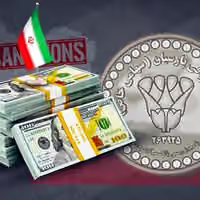
Before the Trump administration imposed sanctions in 2018, Iran exported 2.5 million barrels per day (mb/d) of oil. However, this figure plummeted to 350,000 barrels per day by the end of Trump's term in 2020. Under Joe Biden's more relaxed enforcement of sanctions, exports steadily increased year-over-year, reaching 1.6 mb/d by 2024.
The prospect of Trump reinstating his “maximum pressure” sanctions presents significant challenges for both Iran and China. New orders placed by Chinese refineries will take time to reach their ports, with less than two months remaining before Trump assumes office.
Circumventing sanctions—such as rebranding Iranian oil as Iraqi, Omani, or Malaysian—requires over a month of complex logistical operations. Additionally, Iran allows Chinese refineries up to three months to settle payments in yuan or through barter trade, further complicating deals going forward.
Although an immediate drop to 2020 export levels is unlikely, the $750 billion trade relationship between China and the US make further declines in exports highly probable during Trump’s presidency.
According to Vortexa tanker tracking data, about 60% of very large crude carriers involved in smuggling Iranian oil to China remain unsanctioned. Imposing US sanctions on these vessels could significantly increase the cost and complexity of bypassing restrictions.