The Statistical Center of Iran, a government agency, has reported a growing income gap between social classes in urban areas. According to the data, cited by Etemad newspaper, income inequality has been rising since the beginning of the current Iranian year, which started in late March.
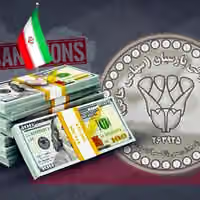
Iran has been struggling with a deep economic crisis since 2018 when the United States withdrew from the JCPOA nuclear deal and imposed sanctions. Monthly incomes for ordinary workers, teachers and nurses has fallen to $200 per month.
According to the report, the income gap between the rich and poor has been widening since 2022. Jomhuri Eslami, a critic of the government's policies, remarked, "The government certainly did not promise to increase the disparity between the rich and poor." The conservative newspaper added that this growing inequality is the result of the cumulative actions of various Iranian governments over time.
In another development, reformist commentator and former pollster Abbas Abdi wrote on Etemad Online that public support for Iran's foreign policy has significantly declined. According to him, while surveys in previous decades showed up to 60% support for the country’s foreign policy, this figure has dropped to as low as 35% in the current decade.
President Masoud Pezeshkian's new government has pledged to improve Iran's global relations and seek an understanding with the West. Despite low voter turnout, hopes for reform and a more pragmatic foreign policy helped him defeat hardliner Saeed Jalili in the July election. Abbas Abdi stressed that rhetoric from officials and diplomats won’t change foreign policy, arguing that national interests should guide it. He emphasized, "There are no permanent friends or foes—only permanent national interests."
The commentator further criticized Iran's official policy for failing to effectively convey its values and stances, calling this a major shortcoming. He explained that the decline in public support for foreign policy is due to the lack of visible impact on people's daily lives and livelihoods, despite periodic statements in support of dialogue and peace. Additionally, he noted that the rise of radical opinions advocating unconditional compromise with the West stems from the perceived ineffectiveness of foreign policy over the past decade.
The decline in support for the official foreign policy is a combination of the government's inefficiency and people's distrust in the official’s political behavior that has led to sanctions and resolutions against Tehran.
Iranian economist Kamal Athari, in an interview with Shargh newspaper’s economic editor Maryam Shokrani, criticized the government for straying from the Constitution's definition of governance. He emphasized that officials are meant to serve as representatives of the people, avoiding despotism and the monopolization of power and resources. The government should focus on providing welfare, education, housing, and healthcare while promoting individual growth. However, Athari argued that the current government has deviated from these principles and abandoned rational governance in practice.
He added that Iran's seventh development plan is designed to serve only one political faction and give it power, wealth and ownership of resources. He added: "With such an approach, development becomes meaningless."