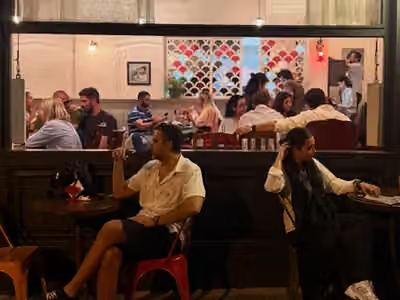
A model of a ballot box is being placed on an avenue in downtown Tehran, Iran, on June 15, 2024, amidst the early presidential election campaigns.
Experiencing tightly controlled and unfree elections for five decades, most voters in Iran have realized since 2020 that they do not have a meaningful role in electing their president or members of parliament.
The most significant reasons for the declining trust include the mass disqualification of candidates by the unelected 12-member Guardian Council, the use of tens of thousands of mobile ballot boxes (up to one-third), voting in military barracks, and the involvement of dirty and non-transparent money.
Although many were aware of the undemocratic nature of elections long before, participation rates in some periods reached more than two-thirds of eligible voters, such as in 1997 and 2013. One of the main reasons for this high participation was the government’s propaganda machine, which effectively "heated up the election."
There are three main methods. The first is dedicating significant airtime on state TV and radio stations, which have dozens of networks, to election-related content to encourage participation. This includes debates between candidates, interviews with them, and election roundtables, all orchestrated by government outlets. For the 2024 elections, the candidates and their consultants have dozens of introductory interviews, and panel discussion programs, other than five collective debates.
A billboard with a picture of the late President Ebrahim Raisi and the presidential candidates is displayed on a street in Tehran, Iran, June 17, 2024.
The second method involves billboards and banners funded by public resources, displayed throughout cities and along roads across the country. These advertisements use quotes from Shia saints, leaders of the Islamic Republic, and celebrities who cooperate with the government to encourage voter participation. These ads are displayed alongside the individual advertisements of the candidates.
However, the most effective method of attracting silent majority voters is to amplify the voices of university professors (especially those residing in Western countries), non-conformist celebrities, and figures occasionally critical of regime policies. This approach helps bring a segment of the undecided population to the polls. Typically, the opinions and positions of these figures, which are not necessarily independent, are not featured by government-controlled outlets during ordinary times.
However, the effectiveness of these methods has waned since the February 2020 parliamentary elections, followed by the presidential vote in 2021 and the second parliamentary election in March 2024. Turnout in these elections was significantly below 50%, according to official figures, which many believe are inflated to portray a more favorable picture.
“A new wave of hope”
During electoral campaigns, supporters of the Islamic Republic have employed three tactics both inside and outside the country to encourage voter turnout.
The first tactic involves instilling misleading hopes in a society desperate for change. "With the announcement of the names of the approved candidates, a new wave of hope has flowed through Iranian society. If political groups use it correctly and follow the right principles, we will have one of the most refreshing choices in the history of Iran since Mr. Khatami," said Saeed Leilaz, a high-ranking member of a 'reformist' party within the Reform Front, supporting the 'moderate' candidate Masoud Pezeshkian.
President Mohammad Khatami (1997-2005) aimed to reform some notorious characteristics and undemocratic practices of the Islamic regime but was stopped by conservatives supported by Supreme Leader Ali Khamenei and the Revolutionary Guard. The same scenario repeated itself during the eight years of relatively moderate Hassan Rouhani (2013-2021), who was constantly pummeled by hardliners.
Leilaz believes 40 million people may participate in this election. Of course, according to the IRNA news agency, based on the content analysis of people's posts on Instagram pages of "about 31 million active users" the electorate has not become mobilized for the election.
Abbas Abdi, one of the leftist figures of the Khomeini era and a leading figure among the students who took the American Embassy staff hostage for 444 days, also repeated the above hope: "The elections of June 28, 2024, can create a social wave with over 60% participation," Abdi predicts, though he does not specify which poll supports this claim. He emphasizes Pezeshkian’s personality rather than his executive performance or experience, which is not particularly notable: "The most important and outstanding feature of him... is that he is an honest person who does not lie, and this is a rare quality among Iranian officials, and people are very hungry for that."
Abdi and Leilaz spent time in prison just for expressing their views in the past, which has made their voices to be heard outside the ruling elite.
“Surprising decision of the Guardian Council”
The second tactic used to stir up election enthusiasm is to portray the Guardian Council's decision to approve Pezeshkian as a surprising move, framing him as a reformist candidate to attract those who still believe in reforms within the regime.
Pezeshkian, who is known more as a ‘reformist’ than a conservative is the only non-hardliner candidate approved by the Guardian Council. All sorts of regime supporters, including some individuals in the United States, portray his candidacy as a good omen showing the Islamic Republic’s goodwill. However, in the past eight days after his candidacy was approved, Pezeshkian has come across more as a conservative loyal to Ali Khamenei than a reformist.
“Not voting is not a political act”
The third tactic is to frame non-participation not as a protest, but as an apolitical act. "I don't consider not voting to be a political act," an American-Iranian supporter of the Tehran government said on social media. This viewpoint fails to distinguish between democratic and totalitarian regimes. In totalitarian regimes, not voting can lead to the loss of certain rights, such as employment in government affairs. Therefore, abstaining from voting is a costly political act. In fact, the decline in election turnout in the past four years has shaken and weakened Islamic Republics claims of legitimacy.
The opinions expressed by the author are not necessarily the views of Iran International.