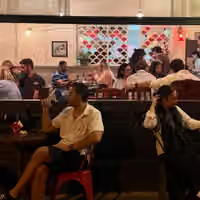
The press present at Iran's Interior Ministry building where presidential elections candidates registered their bid
The state-run Islamic Republic of Iran Broadcasting (IRIB) has warned presidential candidates against tarnishing the country's image in their campaign broadcasts, threatening to block their airing.
The Guardian Council's approved presidential candidates, to be announced next week, will each have an allocated time to air their promotional campaigns on state TV starting June 12 until June 26.
The presidential debates will also be broadcast live.
The IRIB’s election headquarters’ warning, issued alongside guidelines for candidate ads on Thursday, prohibited content that could “sow doubt,” “undermine the Islamic Republic's achievements,” or “erode public trust in the electoral process.”
The US and EU sanctioned IRIB in 2013, and 2022 for being a "critical tool of the Iranian government's mass suppression and censorship campaign against its people.”
An opinion survey by the Netherlands-based Gamaan Institute last year collected information from 38,445 people inside Iran about their views on media, revealing that only about 21 percent of the respondents followed the developments about Iran from IRIB.
Criticism of the current administration, particularly under Ebrahim Raisi, whose death last month triggered the snap election, will be closely scrutinized, with any perceived negative portrayal risking exclusion from national media coverage.
The directive came amid broader restrictions on media content ahead of elections, warning the candidates to refrain from defamation and actions detrimental to national unity and participation.
Iran's Press Supervisory Board also warned that violators would be punished with 74 lashes if found guilty.
According to instructions published on Wednesday, disseminating material that promotes "the boycott of elections and lower participation" and "organizing unauthorized protests, strikes, or sit-ins" constitutes a crime.
Iran's Minister of Intelligence also stated that his agency is closely monitoring the behavior of presidential candidates and their supporters, warning that those promoting "subversive" narratives will be prosecuted.
The warnings follow the Supreme Leader's address on Monday, in which he urged competitors to avoid slander and refrain from smearing each other.
Ghalibaf seen with Supreme Leader Khamenei in this undated photo
These cautions are issued amid a backdrop where several candidates, among them Mohammad Bagher Ghalibaf and Mostafa Pour Mohammadi, are linked to cases of corruption and human rights violations, where the electoral debates may provide an opportunity for candidates to expose each other.
Ghalibaf, the conservative parliament speaker and former mayor of Tehran, was embroiled in multiple financial scandals involving his immediate aides. Several of his associates, who were also former IRGC officers, were tried and convicted in cases involving approximately $5 billion.
The Iranian politician Pour Mohammadi, who served as interior minister and justice minister in two different administrations, was on the "Death Commission" responsible for the execution of thousands of Iranian political prisoners during the 1980s.
Despite many warnings, the usual protocol—where candidates launch their campaigns and engage in verbal sparring after receiving approval from the Guardian Council, a 12-member non-elected oversight body—has been disrupted, with confrontations starting prematurely this time.
A high-profile clash erupted between Ghalibaf and Vahid Haghanian, a prominent figure in the Office of the Supreme Leader of Iran and a presidential candidate, drawing significant attention. Media affiliated with the IRGC criticized Haghanian and supported Ghalibaf.