Iranian businessman Babak Zanjani during a court session
Babak Zanjani, an Iranian oil sales middleman sentenced to death for embezzling the proceeds, may be released, as the judiciary has confirmed that his overseas assets were transferred to the country to settle his debts.
Zanjani, a regime insider once hailed as Iran's wealthiest man, was tasked with exporting oil circumventing international sanctions in the early 2010s when Mahmoud Ahmadinejad was president. He failed to pay back about $3 billion. Zanjani was arrested and convicted in 2013 after Hassan Rouhani was elected president. His accomplices in the government were never identified. It would not have been possible for him to embezzle such a large amount of money without insider support.
Earlier in the week, his lawyer, Rasoul Kouhpayehzadeh, pleaded for his release in light of recent disclosures by the Judiciary, which stated that Zanjani’s assets abroad have been located and transferred to Tehran to offset his debts and liabilities.
Chief Justice Gholam-Hossein Mohseni-Ejei claimed that, according to preliminary assessments, the collected assets are worth more than what he owes. Zanjani's assets in Iran had been confiscated by court order after his arrest but they were reportedly only a fraction of the assets abroad that he initially refused to repatriate. Iranian authorities have not released any details or figures about his assets.
Iran's Chief Justice Gholam-Hossein Mohseni-Ejei
However, Khabar Online website, which is close to moderate conservatives, reported Tuesday that the total value of Babak Zanjani's assets abroad is estimated to be around $4 to $5 billion. According to the report, approximately $2 billion has been deposited into the central bank's account following the sale of his foreign assets. Zanjani's total debt was about $2.8 billion. A portion of this amount, approximately $1.3 billion, was repaid after the seizure of Zanjani's assets within the country, which included Sorinet Holding Company and Qeshm Airlines. The remaining $1.5 billion was updated to $2 billion, taking into account the accumulated interest over several years.
Zanjani sold Iranian oil on behalf of the National Iranian Oil Company (NIOC) during Ahmadinejad's second term (2009-13) through an elaborate network of black-market dealers and money-launderers − particularly in the UAE, Turkey and Malaysia. According to his statements, he had managed to transfer $17 billion of the proceeds from oil sales to the country by 2013.
The shifting political landscape in Iran transformed Zanjani, once synonymous with immense wealth and influence, into a figure facing legal scrutiny and international sanctions, thrusting him into a high-profile legal battle with widespread ramifications. His name is linked to varioushigh-profileeconomic scandals and legal investigations.
In addition to failing to repatriate oil sales proceeds, he is also accused of securing foreign currency from Iran’s Central Bank for imports, selling it in the black market. In another case he was accused of misappropriating funds from Iran's Social Security Organization in collaboration with Saeed Mortazavi, the former head of the organization who was also Iran’s former deputy prosecutor general.
At the time of his arrest and trial, Iranian media highlighted his ties to the Revolutionary Guards (IRGC), while some outlets portrayed him as a scapegoat. Subsequently, he was sanctioned by the Council of the European Union in December 2012 and by the United States Treasury in April 2013.
Zanjani, now over 50 years old, built a business empire in a short time, claiming his net worth was $13.5 billion. Zanjani had reportedly stashed billions of dollars from oil sales in foreign bank accounts or invested the money abroad in a range of enterprises including hospitality, commercial aviation, infrastructure, and real estate. He once said in an interview that he owned 64 companies.
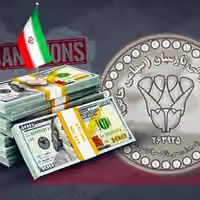
The Islamic Republic has numerous mechanisms in place through a wide range of entities and organizations to sell its oil via third parties to evade sanctions. The country has also started giving oil to state organizations, including the IRGC, to boost their budgets without allocating any money to them. Such operations are usually carried out by a network of state bodies and businesspeople with close ties to the regime, who usually gain huge profits in the process. However, with every new administration in office, former assets become a liability and bear the brunt of the political games of the regime.
Documents leaked by a cyberattack on the Iranian parliament’s media arm last week revealed the parliament's coordination with designated Iranian entities and individuals to facilitate their trade activities and conceal their identities and connections from international regulatory bodies as the ever evolving web of sanctions evasions continues.