Iran's Nuclear Enrichment Advances As It Stonewalls UN Watchdog

Iran has enough uranium enriched to up to 60% for three atom bombs and is still stonewalling the agency on key issues, confidential IAEA reports showed on Wednesday.
Iran has enough uranium enriched to up to 60% for three atom bombs and is still stonewalling the agency on key issues, confidential IAEA reports showed on Wednesday.
Iran's stock of uranium enriched to up to 60% grew by 6.7 kg (14.8 pounds) to 128.3 kg (282.9 pounds) since the last report on September 4, one of the two reports to member states seen by Reuters said. That is more than three times the roughly 42 kg (92.6 pounds) that by the IAEA's definition is theoretically enough, if enriched further, for a nuclear bomb. Weapons-grade is around 90% purity.
In the second report issued on Tuesday, the agency said there still had been no progress on two pressing issues in Iran: getting more monitoring equipment re-installed after it was removed at Tehran's behest last year and getting answers on the origin of uranium particles found at two undeclared sites.
It is the second time in a row that the IAEA's quarterly reports have said there was no progress on either issue.
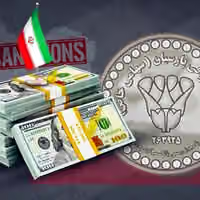
Negotiation since April 2021 to revive the Obama-era JCPOA nuclear deal have failed to make progress, and Iran continues to expand its nuclear program. The previous US administration withdrew from the agreement in 2018 and imposed harsh economic sanctions. Iran retaliated by starting to violate the JCPOA limits and substantially increased both the quantity and the quality of its uranium enrichment. It also reduced monitoring by the International Atomic Energy Agency.
Iran did not agree to a compromise plan proposed by the European Union in 2022 to revive the agreement, despite the Biden administration’s stated goal of finding a diplomatic solution.
There also had been no progress in getting Iran to reverse its so-called "de-designation" in September of some IAEA inspectors assigned to the country.
The move effectively barred some inspectors, who diplomats said were from France and Germany and the IAEA said were among its most experienced experts, from working in Iran.
Tehran's move, which the IAEA called "disproportionate and unprecedented", was in response to a call on Iran by the United States, France, Britain and Germany at the IAEA's 35-nation Board of Governors to give credible explanations on the uranium particles and let the IAEA install more surveillance cameras. In fact, the Western powers did not pursue any censure of Iran as expected, and simply issued a rebuke.
"This measure, while formally permitted... was exercised by Iran in a manner that directly and seriously affects the Agency's ability to conduct effectively its verification activities in Iran, in particular at the enrichment facilities," the second IAEA report said.
"The (IAEA) Director General (Rafael Grossi) continues to strongly condemn Iran's sudden withdrawal of the designations of several experienced Agency inspectors," it added.
Washington has informally relaxed sanctions on Iran’s oil exports and allowed blocked funds in Iraq and South Korea to be released, but Tehran has shown no willingness to resolve the nuclear issue.
US officials and experts believe that having stockpiled enriched uranium, Iran can build a bomb in a matter of months. It can be considered as a nuclear threshold state.
With reporting by Reuters