Iran’s Tilt To Moscow Casts Shadow Over Vienna Talks

With Vienna nuclear talks at a crucial stage, Iran’s relations with Russia are both central to the talks and a pillar of Tehran’s likely strategy should talks fail.
With Vienna nuclear talks at a crucial stage, Iran’s relations with Russia are both central to the talks and a pillar of Tehran’s likely strategy should talks fail.
In a tweet Monday, Mikhail Ulyanov, Russia’s lead negotiator in Vienna, highlighted Russian support for Iran’s “absolutely right” demand for guarantees that the United States would not again leave the 2015 nuclear deal, the JCPOA (Joint Comprehensive Plan of Action).
US and European officials have told reporters that they have examined ideas to give Iran extra confidence − including letters of assurance from the US Treasury − over a revived JCPOA but have insisted that no US administration can bind its successors.
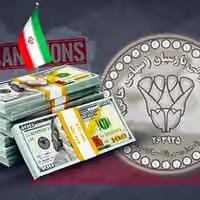
Iran’s Supreme Leader Ali Khamenei and President Ebrahim Raisi (Raeesi), who took office in August, are wary of being exposed politically at home should the US again leave the JCPOA, as it did under former president Donald Trump, a move that sent the Iranian economy into recession with ‘maximum pressure’ sanctions and undermined Iranian President Hassan Rouhani.
The conservative website Farhikhtegan Tuesday cited “informed sources” suggesting Rouhani’s negotiators, led by deputy foreign minister Abbas Araghchi, had made undue concessions in earlier rounds of the Vienna talks between April and June. Farhikhtegan suggested these included agreeing to limit uranium enrichment to 3.65 percent − which is clearly required under the JCPOA − and to remove more advanced centrifuges, over which there may be limited ambiguity.
While Raisi said during June’s presidential election campaign that he would support reviving the JCPOA if it were in “the people’s interests,” many of his supporters have opposed the agreement, and it would be important politically for Raisi to secure, or appear to secure, more favorable terms that Rouhani would have done.
Conservative media in Tehran and many parliament members have been lauding Russia, both in terms of its role in Vienna and as a trading partner. The English-language Tehran Times Tuesday described Russia as “a country that has always supported Iran in the face of brutal and unilateral sanctions on Iran” and which had “great potential to be Iran’s close ally in economic field.”
Turning point
The Tehran Times lauded Raisi’s visit to Moscow, which begins Wednesday, as “undoubtedly a turning point in relations between the two countries, as Russia and Iran are actively trying to expand economic relations.”
Similar sentiments came in an extensive interview published Monday by the official news agency IRNA with Mahmoud-Reza Sajjadi in which the former ambassador described closer banking cooperation between Tehran and Moscow as a suitable way to sidestep the threat of US sanctions that target any third party dealing with Iran’s financial sector.
While Iran has joined the Shanghai Cooperation Organization, which encourages non-dollar trade among its nine members including Russia and China, Iran-Russia bilateral trade, while increasing, is yet to return to a 2010-11 high of $3.5 billion.
Critics of the Raisi administration argue that in current circumstances, any disproportionate tilt towards Russia, in politics or economics, would disadvantage Iran. Such critics point to the recent reported deal over the Chalous gasfield in the Caspian Sea and suggest that a proposed 20-year strategic agreement with Russia should not be agreed when Tehran is vulnerable due to US ‘maximum pressure.’
As Iran’s nuclear program continues beyond JCPOA limits, which it began breaching in 2019, many analysts suggest the Vienna talks are at a stage where political decisions cannot be avoided. European officials have told journalists that mid-February may be an effective cut-off, while both Iran and Russia have dismissed ‘artificial deadlines.’