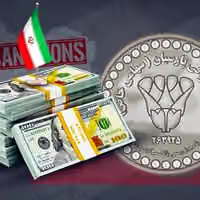
President Ebrahim Raisi in an interview on Monday insisted the government could phase out cheap dollars for selected imports without "a shock to the market."
An exchange rate of 42,000 rials to the dollar is applied to imports of ‘essential’ commodities while the dollar trades in the open market at over 270,000 rials. The hugely discounted dollar for importers of essential goods was meant to keep down the cost of the commodities facing consumers.
The government's foreign exchange subsidy not only failed to prevent the further fall of the rial or stabilize the market but also it soon became a new problem as allegations of corruption in the distribution of the cheaper dollar began to haunt the government in a matter of months. Much of the valuable was being spent on importing luxury items, from cars to household appliances while subsidized food, medicine, and animal feed was being smuggled out of the country.
Inflation protest near Tehran Bazar in June 2018.
According to the Tasnim news agency, Economy Minister Ehsan Khandouzi this week said the government's economic team was considering allocating the resources currently channeled into supporting essential imports into direct payments to citizens.
Such a move could bolster the ability of recipients to pay higher prices, but economists have argued in recent days that price inflation will accelerate if cheap dollars stop, and the cash handouts would never make up the difference.
That would carry a serious risk of political unrest for the government, as events in November 2019 showed. A sudden hike in gasoline prices led to spontaneous widespread protests. Security forces used military weapons to fire on unarmed protesters, killing hundreds in three days.
The government of President Ebrahim Raisi faces a budget deficit of around $12 billion. A recent report from the Planning and Budget Organizationput Iran’s debt at 30 percent of GDP: this compares to 40 percent in Turkey, 67 percent in Egypt, 117 percent in the US, and 171 percent in Lebanon, but is onerous where denominated in dollars.
Due to demand on foreign exchange − and with the rial at a market rate of 140,000 against the dollar − a meeting of the president with the heads of parliament and judiciary in April 2019 fixed the subsidized rate at 42,000 and limited its allocation to imports such as food and medicine.
The Central Bank, accordingly, constrained the allocation. By July 2021, reports emerged that 1.3 million metric tons of ‘essential’ goods in Iranian ports could not be unloaded because importers lacked dollars to pay foreign vendors.
Sugar was dropped from the list of eligible items in November 2020, while cooking oil remained. Since late March the government has allocated at least $6.9 billion for importing ‘essential’ goods at the set rate, including $1.5 billion for cooking oil.
Nonetheless the price of cooking oil has almost doubled in a year, given rising inflation put at close to 50 percent annually by the Statistical Center of Iran. The IMF projects consumer price inflation of 39 percent in 2021, and 28 percent in 2022.